
Many people in Canada who are thinking about a hair transplant look at clinics in India as well as at home. Some have family in India, some want to combine the procedure with a visit, and some are comparing the overall cost. Whatever the reason, the decision deserves the same care wherever the surgery takes place.
This guide from Eugenix Hair Sciences sets out what a Canadian patient should check before choosing a clinic in India: the doctor and who does what, the technique, the cost and how it is worked out, how long to stay, and how aftercare continues once you are back in Canada. It does not rank one country above the other. Good and poor care can be found anywhere, and the checks below apply to any clinic.
Can Canadian patients have a hair transplant in India?
Yes. A hair transplant in India for Canadian patients follows the same steps and treatment plan as for any patient, and most international patients plan a stay of about 7 to 10 days. The steps are: photographs and a medical history for a first assessment, a consultation, blood tests and medical clearance, the procedure under local anaesthesia, the first head wash on Day 7, and follow-up by video and photographs once you are home.
How hair transplant surgery works
A hair transplant moves hair follicles from the donor area at the back and sides of the scalp, where hair is usually less affected by pattern hair loss, to the thinning or bald area. The transplanted hair is your own natural hair. No synthetic hair or implants are used.
The procedure is performed under local anaesthesia and is completed in a single day.
Direct Hair Transplant (DHT)
Eugenix performs Direct Hair Transplant (DHT) only. Direct Hair Transplant (DHT) is a modified FUE technique described by Eugenix Hair Sciences’ Co-Founders in their 2013 research paper, “Direct hair transplantation: a modified follicular unit extraction technique”, published in the Journal of Cutaneous and Aesthetic Surgery (https://pmc.ncbi.nlm.nih.gov/articles/PMC3764754/).
In DHT, the lead surgeon carries out Planning & Designing and makes all the slits first. Extraction follows, and implantation into the slits already made happens at the same time. Grafts stay outside the body for under 30 minutes with Direct Hair Transplant, compared to 3 to 6 hours with conventional FUE. DHT is different from DHI: in DHT the slits are made first and grafts are placed into them, rather than an implanter pen making the opening and placing the graft in one step.
Who does what on the day
The lead surgeon performs the extraction and sets every technical parameter. The Eugenix medical team assists and carries out implantation under the lead surgeon’s parameters and supervision, using the SAVA Implanter, a no-root-touch instrument. The lead surgeon supervises your procedure throughout, taking rounds between active steps and remaining available at all times during your surgery.
Why timing and planning matter
Pattern hair loss is progressive. It usually progresses in the 20s and 30s, and slows down from the mid-40s towards the 50s. A good plan accounts for where your hair loss is heading, not only for where it is today. That means hairline design that suits your age, careful donor management to protect your donor area against future hair loss and, for many men, medical management alongside surgery.
Finasteride slows the progression of male pattern hair loss. It is not a cure and is taken under medical supervision. This is discussed at consultation, before any date is fixed.
How to check the doctor and the clinic
The most important decision is the doctor and the team, not the country. These checks work for any clinic, in India or in Canada.
Registration and qualifications
In India, every doctor must be registered with a State Medical Council or the National Medical Commission. Ask for the doctor’s full name, qualifications and registration number, and check that they are published. Fellowship of the International Society of Hair Restoration Surgery (ISHRS) is one sign of a doctor’s commitment to this field.
Who performs each step
Ask who plans your hairline and donor area, who makes the slits, who performs the extraction, who places the grafts and who supervises on the day. A clear answer to each question tells you how the clinic works.
The written plan
Ask for your plan in writing: the areas to be treated, the graft number, the technique and the cost. No clinic should promise a result in advance. Our aim is a natural-looking result. Results vary from person to person.
Accreditation
Ask whether the clinic is accredited and by whom. At Eugenix, the Gurugram centre is NABH-accredited (Certificate No. DE-2026-0004).
What does a hair transplant in India cost for a Canadian patient?
The cost depends on the number of grafts planned for your case, which is decided after your scalp and donor area are assessed. Our team explains the costs in full at consultation.
When you compare the hair transplant cost in each place, look at the total cost of the plan rather than a single number: the procedure cost, blood tests, flights, your stay, any follow-up and post-operative care. In Canada, a hair transplant is usually treated as a cosmetic procedure and paid for privately; check with your provincial plan or private insurer what, if anything, they cover.
No Cost EMI is available only to patients living in India, so it does not apply to patients travelling from Canada.
Planning your trip from Canada
How long to stay
Most international patients plan to stay for about 7 to 10 days. This allows for the pre-procedure checks, the procedure itself, the first few days of healing and the first head wash on Day 7 before travelling home. Your team will advise on your own dates once your plan is made.
Visa
Canadian passport holders should check the current visa rules, including the e-Medical visa category, on the Government of India’s official visa website before travelling. For patients who need a medical visa, Eugenix can issue a medical invitation letter.
Getting to the clinic
Our Gurugram (Gurgaon) centre is close to Delhi’s international airport. Eugenix also has centres in Mumbai, Hyderabad, Bhubaneswar and Bengaluru, and the centre is chosen with you at the planning stage.
Before you travel
Blood tests are done within 15 days before the procedure. The standard panel is a haemogram, PT INR, aPTT, RBS, HbA1c, HIV 1 and 2 antibody test (Anti-HIV), HBsAg and Anti HCV. Patients aged 40 and above also need an ECG reported by a physician or cardiologist, and a blood pressure check is done for everyone. Medicine department clearance is mandatory for every patient. Female patients need additional hormonal tests.
Do not trim or shave your scalp hair for at least 30 days before the procedure, and avoid alcohol and smoking for at least 1 week before surgery. If you take Aspirin after heart surgery, tell the team early: written clearance from your cardiologist is needed before any change.
Aftercare and follow-up once you are back in Canada
The first 7 days
After surgery, the recipient area is sprayed every 30 minutes to 1 hour during the day for 7 days, but not at night. Gentle walking can start the next day. A short course of medicines is given after surgery, such as an antibiotic, a pain reliever, a probiotic, a stomach protector and an ointment for the donor area, explained in person by the Eugenix team. Avoid direct sun on the transplanted area for 1 week, and avoid alcohol and smoking for 1 week. Gym, yoga and contact sports wait until after 7 days.
Follow-up from home
Follow-up does not stop when you fly home. The Eugenix E-Care team calls daily for the first 7 days, and you send photographs at 2, 3 and 4 weeks and then every month. Video consultations with the operating doctor are held on Day 8 and at Month 1, so your early recovery is followed even after you leave. Questions in between go to the E-Care team.
The results timeline
Between Day 30 and Day 90, much of the transplanted hair sheds; only the hair shaft falls and the root stays in place. New growth begins from Month 4, growth becomes visible from Months 6 to 8, and full results take 10 to 12 months, with the crown taking 12 to 15 months. Most of this happens after you are home, so the photo check-ins matter.
Frequently asked questions
Is it safe for a Canadian patient to have a hair transplant in India?
A hair transplant is surgery, and safety depends on the doctor, the team and the clinic, not on the country. Check that the doctor’s name, qualifications and medical council registration number are published, ask who performs each step, and ask for a written plan. Blood tests, a blood pressure check and medicine department clearance before surgery are part of a careful process at Eugenix.
How long do I need to stay in India for a hair transplant?
Most international patients plan about 7 to 10 days. That covers the checks before surgery, the procedure, the first few days of healing and the first head wash on Day 7. The procedure is completed in a single day. Your exact dates are planned with you once your graft number and procedure date are fixed.
Will I get follow-up support after I return to Canada?
Yes. The Eugenix E-Care team calls you daily for the first 7 days, and you send photographs at 2, 3 and 4 weeks and then every month. Video consultations with the operating doctor are held on Day 8 and at Month 1. Because most of the growth happens after you are home, these check-ins let the team follow your progress through to full results.
How do I check an Indian doctor’s qualifications?
Every doctor in India must be registered with a State Medical Council or the National Medical Commission. Ask for the doctor’s full name, qualifications and registration number, and check that they are clearly published. Ask about professional fellowships such as ISHRS, and ask who will perform each step of your procedure. A careful clinic answers these questions openly and in writing.
Does provincial health insurance cover a hair transplant?
In Canada, a hair transplant for pattern hair loss is usually treated as a cosmetic procedure and paid for privately. Coverage rules can differ by province and by private plan, so check with your provincial plan or your insurer before you decide. Whatever you choose, compare the full cost of each option, including travel, your stay and follow-up, rather than the procedure fee alone.
How much does a hair transplant in India cost for patients from Canada?
The cost depends on the number of grafts planned for your case, which is decided after your scalp and donor area are assessed. Our team explains the costs in full at consultation. When comparing, include blood tests, flights, your stay and follow-up as well as the procedure. No Cost EMI is available only to patients living in India.
Key takeaways
- Choose the doctor and the team first; check names, qualifications and registration numbers.
- Ask who performs each step and ask for a written plan.
- The cost depends on the number of grafts planned after your scalp and donor area are assessed.
- Most international patients plan about 7 to 10 days in India.
- Follow-up continues from home, with daily calls in the first week, photo check-ins and video consultations.
Eugenix Hair Sciences has worked only in hair restoration since 2009, with centres in Gurugram, Mumbai, Hyderabad, Bhubaneswar and Bengaluru. It was founded by Dermatologists, alumni of AIIMS, New Delhi, and Fellows of ISHRS.
Read more.
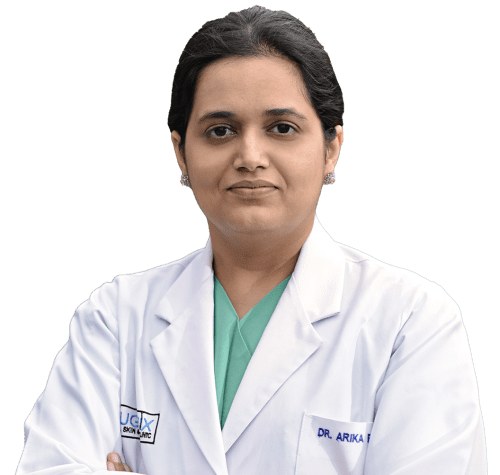
Medically reviewed by Dr. Arika Bansal, Co-Founder, Eugenix Hair Sciences; MBBS, MD Dermatology, Fellow of ISHRS; Reg. No. HN-34095 (Haryana Medical Council).
Dr. Arika Bansal
Dr. Arika Bansal, Co-Founder, Eugenix Hair Sciences. MBBS (Gold Medallist, Lady Hardinge Medical College), MD Dermatology, alumni of AIIMS, New Delhi. Fellow of ISHRS. Reg. No. HN-34095 (Haryana Medical Council).
