
Turkey and India are both places where many people travel for a hair transplant. If you are weighing a hair transplant in Turkey or India, the country is only the starting point. Within each country there is a wide range of clinics, doctors and ways of working, and the result depends far more on who plans and performs your procedure than on where it happens.
This guide from Eugenix Hair Sciences does not rank one country above the other. It sets out the questions to ask any clinic, in Turkey, India or anywhere else. Whether you are looking at a hair transplant in India or abroad, the aim is an informed decision based on facts you can check.
Hair transplant Turkey or India: which is better?
Neither country is better in itself. Each has clinics of every kind. What decides your experience is the doctor and the team: their registration and qualifications, who performs each step, how your plan protects your donor area, and the aftercare you receive once you are home. Compare clinics on these facts, and compare the full cost, including travel, your stay and follow-up.
What to check first: the doctor
Registration and qualifications
Ask for the full name, qualifications and medical registration number of the doctor who will lead your procedure, and check that they are clearly published. In India, every doctor must be registered with a State Medical Council or the National Medical Commission. Fellowship of the International Society of Hair Restoration Surgery (ISHRS) is one sign of a doctor’s commitment to this field.
Who performs each step
A hair transplant has several steps: planning the hairline and donor area, making the slits, extracting the grafts, placing them, and supervising throughout. Ask who does each one. A clinic should be able to answer clearly and in writing.
At Eugenix, the lead surgeon carries out Planning & Designing, including marking the complete recipient and donor area, and makes all the slits. The lead surgeon performs the extraction and sets every technical parameter. The Eugenix medical team assists and carries out implantation under the lead surgeon’s parameters and supervision, using the SAVA Implanter, a no-root-touch instrument. The lead surgeon supervises your procedure throughout, taking rounds between active steps and remaining available at all times during your surgery.
What to check next: the hair transplant procedure
Technique names vary from clinic to clinic, and the same name can mean different things across many clinics. A hair transplant is a medical procedure, so ask the clinic to explain, step by step, what happens to each graft and the level of surgeon involvement at each stage.
FUE, DHI and DHT
FUE (follicular unit extraction) is the conventional technique: grafts are taken one by one from the donor area and placed in the recipient area. DHI uses an implanter pen that makes the opening and places the graft in one step.
Eugenix performs Direct Hair Transplant (DHT) only. Direct Hair Transplant (DHT) is a modified FUE technique described by Eugenix Hair Sciences’ Co-Founders in their 2013 research paper, “Direct hair transplantation: a modified follicular unit extraction technique”, published in the Journal of Cutaneous and Aesthetic Surgery (https://pmc.ncbi.nlm.nih.gov/articles/PMC3764754/).
In DHT, the lead surgeon makes all the slits first; extraction follows, and implantation into the slits already made happens at the same time. Grafts stay outside the body for under 30 minutes with Direct Hair Transplant, compared to 3 to 6 hours with conventional FUE. DHT is different from DHI: in DHT the slits are made first and grafts are placed into them, rather than an implanter pen making the opening and placing the graft in one step.
Graft numbers and your donor area
Your donor area at the back and sides of the scalp is limited. For Indian and Asian patients, about 3,000 to 4,500 grafts can usually be taken in one sitting and about 5,000 to 8,000 over a lifetime. Ask how your graft number was worked out, and how the plan leaves enough donor hair for the future. A graft number should come from an examination of your scalp, not from a package size.
What to check about your plan
A plan for how your hair loss may progress
Pattern hair loss is progressive. It usually progresses in the 20s and 30s, and slows down from the mid-40s towards the 50s. A good plan accounts for where your hair loss is heading. Your hairline is planned to suit your face and age, and keeping in mind how your hair loss may progress. Single-hair grafts are placed at the front of the hairline, as in a natural hairline.
For many men, medical management is part of the plan. Finasteride slows the progression of male pattern hair loss. It is not a cure and is taken under medical supervision.
Realistic results
Transplanted hair density is about 50% of natural density. New growth begins from Month 4, growth becomes visible from Months 6 to 8, and full results take 10 to 12 months, with the crown taking 12 to 15 months. No clinic should promise a result in advance. Our aim is a natural-looking result. Results vary from person to person.
Checks before surgery
A careful clinic checks that you are fit for surgery. At Eugenix, the standard blood panel is a haemogram, PT INR, aPTT, RBS, HbA1c, HIV 1 and 2 antibody test (Anti-HIV), HBsAg and Anti HCV, with an ECG reported by a physician or cardiologist for patients aged 40 and above and a blood pressure check for everyone. Medicine department clearance is mandatory for every patient. Ask any clinic what it checks before your surgery date is fixed.
What to check about hair transplant cost
Compare the full cost, not only the procedure fee: blood tests, flights, your stay, any follow-up visits and post-operative care. In any India vs Turkey comparison, the total for the whole journey is the number that matters. Ask for the cost in writing before you travel, with the graft number it is based on.
At Eugenix, the cost depends on the number of grafts planned for your case, which is decided after your scalp and donor area are assessed. Our team explains the costs in full at consultation.
What to check about travel and your stay
How long to stay
Most international patients plan to stay for about 7 to 10 days. This allows for the checks before surgery, the procedure, the first days of healing and the first head wash on Day 7 before travelling home.
The first 7 days
After surgery, the recipient area is sprayed every 30 minutes to 1 hour during the day for 7 days, but not at night. A short course of medicines is given, such as an antibiotic, a pain reliever, a probiotic, a stomach protector and an ointment for the donor area, explained in person by the Eugenix team. Avoid direct sun on the transplanted area for 1 week, and avoid alcohol and smoking for 1 week. Gym, yoga and contact sports wait until after 7 days.
What to check about follow-up once you are home
Most of the growth of the transplanted hair happens months after you have flown home, so ask about long-term follow-up and how the clinic will track your progress. At Eugenix, the E-Care team calls daily for the first 7 days, you send photographs at 2, 3 and 4 weeks and then every month, and video consultations with the operating doctor are held on Day 8 and at Month 1.
Between Day 30 and Day 90, much of the transplanted hair sheds. Only the hair shaft falls; the root stays in place. Knowing this in advance, and having someone to ask, matters when you are far from the clinic.
Frequently asked questions
Is Turkey or India better for a hair transplant?
Neither country is better in itself; both have clinics of every kind. Your experience depends on the doctor and the team: their published registration and qualifications, who performs each step, how your graft number and donor area are planned, and the aftercare once you are home. Compare clinics on these facts, and compare the full cost, including travel, your stay and follow-up.
What should I ask a hair transplant clinic abroad?
Ask for the lead doctor’s full name, qualifications and medical registration number. Ask who plans your hairline, who makes the slits, who extracts the grafts, who places them and who supervises. Ask how your graft number was worked out, what blood tests are done before surgery, what the full cost includes, and how follow-up works after you fly home.
What is the difference between DHT and DHI?
DHT is different from DHI: in DHT the slits are made first and grafts are placed into them, rather than an implanter pen making the opening and placing the graft in one step. Direct Hair Transplant (DHT) is a modified FUE technique described by Eugenix Hair Sciences’ Co-Founders in their 2013 research paper. Eugenix performs DHT only.
How long should I stay in India for a hair transplant?
Most international patients plan about 7 to 10 days. That covers the checks before surgery, the procedure, the first few days of healing and the first head wash on Day 7. After you fly home, follow-up continues with daily calls in the first week, photographs at set times and video consultations with the operating doctor on Day 8 and at Month 1.
How many grafts can be done in one session?
It depends on your donor area. For Indian and Asian patients, about 3,000 to 4,500 grafts can usually be taken in one sitting and about 5,000 to 8,000 over a lifetime. Your own number is decided after your scalp and donor area are examined. Ask any clinic how it worked out your number and how much donor hair it leaves for the future.
Can results be promised in advance?
No clinic should promise a result in advance. Results depend on your donor area, your hair characteristics, how your hair loss progresses and your aftercare. Transplanted density is about 50% of natural density, new growth begins from Month 4, and full results take 10 to 12 months, with the crown taking 12 to 15 months. Results vary from person to person.
Key takeaways
- Compare clinics, not countries: the doctor and the team decide your experience.
- Check the lead doctor’s name, qualifications and registration number, and ask who performs each step.
- Ask how your graft number was planned and how your donor area is protected.
- Compare the full cost, including travel, your stay and follow-up.
- Ask how aftercare continues once you are home.
Eugenix Hair Sciences has worked only in hair restoration since 2009, with centres in Gurugram, Mumbai, Hyderabad, Bhubaneswar and Bengaluru. It was founded by Dermatologists, alumni of AIIMS, New Delhi, and Fellows of ISHRS.
Read more.
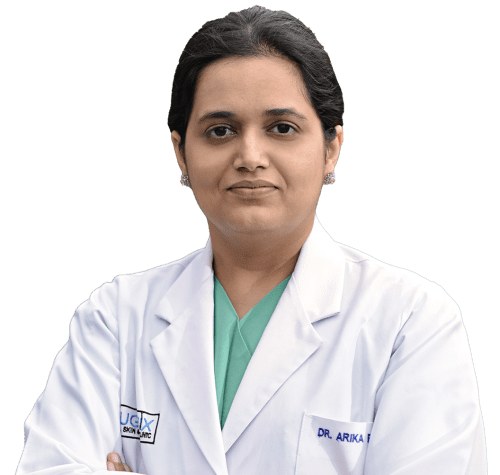
Medically reviewed by Dr. Arika Bansal, Co-Founder, Eugenix Hair Sciences; MBBS, MD Dermatology, Fellow of ISHRS; Reg. No. HN-34095 (Haryana Medical Council).
Dr. Arika Bansal
Dr. Arika Bansal, Co-Founder, Eugenix Hair Sciences. MBBS (Gold Medallist, Lady Hardinge Medical College), MD Dermatology, alumni of AIIMS, New Delhi. Fellow of ISHRS. Reg. No. HN-34095 (Haryana Medical Council).