

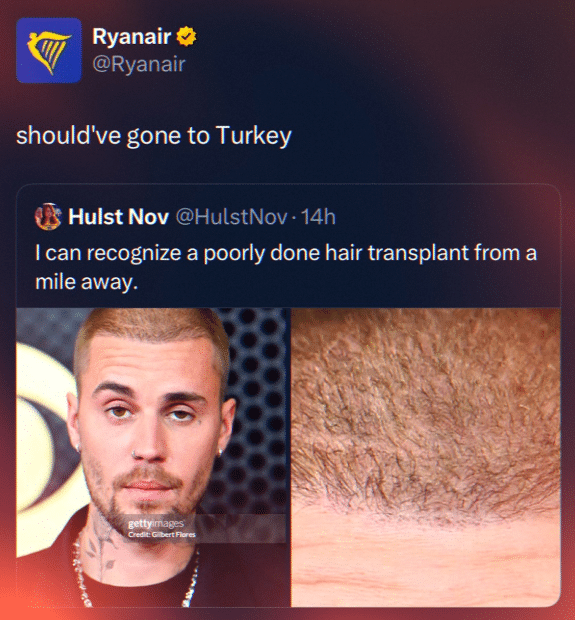
Somewhere between a paparazzi long lens and a Ryanair social media intern having the time of their life, Justin Bieber became the unwilling face of yet another global conversation about hair. Screenshots were zoomed. Circles were drawn. Opinions were formed by people who cannot keep a houseplant alive, let alone understand follicular science.
The punchline, of course, was Turkey. Turkey has become shorthand now. Not a country, not a culture, but a concept. “Went to Turkey” is internet code for cheap, rushed, and we’ll see how it looks in six months. It’s funny. It’s memeable. It’s also painfully lazy.
From inside the Eugenix writing room, the reaction wasn’t outrage or offence. It was more… fatigue. Because the joke isn’t wrong. It’s just incomplete.
Justin didn’t make a mistake by wanting to fix his hair. Hair loss humbles everyone eventually. Pop stars, billionaires, yoga gurus, men who swear they “don’t care” right up until they do. The mistake, if there was one, was believing that hair restoration is a destination-based decision rather than a doctor-based one.
And that’s where India quietly walks into the conversation, adjusts its glasses, and clears its throat.
Here’s the thing people don’t like admitting: hair transplants are boring when done properly. There are no dramatic reveals. No instant gratification. No viral “Day 10” glow-ups that look suspiciously dense and slightly tragic by Year 3.
Good hair restoration is slow. Thoughtful. Slightly annoying. Full of conversations that begin with, “No, let’s not do that.”
India became good at this not because it tried to be trendy, but because it had to deal with complexity early. Advanced baldness. Limited donor areas. Repair work from procedures done elsewhere. Patients who didn’t want spectacle, just dignity.
At Eugenix Hair Sciences, hair isn’t treated like inventory. It’s treated like a finite resource. You don’t spend it all at once. You invest it.
What will this patient look like in five years?
What happens when the crown goes?
What do we preserve now so we don’t regret it later?
These are deeply unsexy questions. They also happen to be the ones that matter. Celebrities are the worst candidates for hair transplants. Not medically. Psychologically.
They live under lights that could interrogate a crime scene. They age publicly. Their mistakes don’t fade quietly; they get archived in 4K.
A celebrity transplant does not need density. It needs invisibility. The real win is not “Wow, look at his hair.” It’s “Did he do something? He looks… rested.”
That’s not achieved with aggressive hairlines or teenage fantasies. It’s achieved with restraint, asymmetry, and the courage to leave well enough alone.
Which brings us, inevitably, to the woman everyone at Eugenix quietly refers to as the final boss of hairline design.
Every serious field has its artisans. The ones whose work you don’t notice because noticing it would defeat the point. In Indian hair restoration, that name is Dr. Arika Bansal. Dr. Bansal doesn’t “design” hairlines the way Instagram would like you to believe. There are no dramatic sketches meant for reels. No sharp edges. No influencer peaks engineered for likes. Her hairlines look… inevitable.
They sit where they’re supposed to. They retreat slightly where they should. They carry tiny irregularities that make the brain relax and say, “Yes, this belongs here.”
Within Eugenix, she’s known for something that terrifies impatient patients and impresses everyone else: she says no. Often. Calmly. With reasons.
No to density that will age badly.
No to hairlines that borrow confidence from your twenties.
No to trends that won’t survive your forties.
In an industry obsessed with numbers, she obsesses over taste. And taste, inconveniently, cannot be automated.
Robots can harvest. AI can assist. But judgment? Judgment is still human. India didn’t become good at hair restoration by marketing itself as fun. It became good because its medical culture is deeply allergic to shortcuts. That’s why we have the best doctors in the world. Look it up.
Surgeons here are trained to deal with complexity daily. Reconstruction. Trauma. Scar tissue. Hair transplants aren’t their party trick. They’re a discipline layered onto an already rigorous surgical foundation.
Add to that India’s early adoption of beard-to-scalp integration for advanced baldness, and you get something most “hair tourism” destinations still struggle with: solutions for difficult cases that don’t steal from the future.
The internet moves on quickly. Today it’s Justin Bieber’s hair. Tomorrow it’s someone else’s jawline, eyebrows, or suspiciously aggressive beard.
What doesn’t move quickly is regret.
Bad transplants don’t announce themselves immediately. They wait. They sit quietly. Then one day, under unforgiving light, they introduce themselves with a vengeance.
Good hair restoration, on the other hand, disappears into your life. It grows old with you. It doesn’t demand applause. This was never really about Justin Bieber. He’ll be fine. He always is.
It’s about the larger myth that hair restoration is a quick fix, a destination hack, a memeable detour. It isn’t. It’s a medical decision that lives on your face. India doesn’t sell miracles. It sells adulthood.
And if there’s one thing worth flying across the world for, it’s not cheap hair or loud promises. It’s the quiet confidence of someone who looks at you and says, “Let’s do this properly.”
No jokes required.
Dr. Arika Bansal
One of only a few female surgeons specializing in hair transplant surgery in India, Dr. Arika Bansal has been voted one of the best doctors in the world. She maintains an active fellowship in the ISHRS and regularly submits research papers to medical journals. 15+ years down the line, 20,000+ surgeries are accomplished under Dr. Bansal’s supervision. She specializes in female hair transplant, density improvement, corrective hair transplantation and hairline design.