

Yes, in many people a hair transplant can make a big forehead look smaller. It does this by placing your own hair below your current hairline, so the hairline sits lower and the bare skin of the forehead is reduced. The forehead itself does not change; what changes is where your hair starts. How low the new hairline can go depends on your face, your age, how your hair loss may progress and how much donor hair you have.
This guide from Eugenix Hair Sciences explains when a big forehead is due to hair loss and when it is natural, how a new hairline is planned, what limits it, and how a hair transplant differs from forehead reduction surgery.
Is it a big forehead or a receding hairline?
A forehead can look big for two different reasons. Some people are born with a naturally high hairline, and it has looked the same since their teens. Others have a hairline that has moved back because of male pattern baldness, often first at the temples, forming an “M” shape. In women, a big forehead is often due to a naturally high hairline.
The cause matters, because it changes the plan. If the hairline is moving back, the doctor also has to think about future hair loss behind the new hairline. Our guide to hair transplant for a receding hairline explains the pattern in more detail.
How does a hair transplant lower the hairline?
In a hair transplant for a big forehead, hair is taken from the back and sides of your scalp, where it is usually less affected by pattern hair loss, and placed along a new, lower hairline. The transplanted hair is your own natural hair. It grows naturally from your own roots, and can be washed, cut and styled like the rest of your hair.
With Direct Hair Transplant (DHT), a modified FUE technique described by Eugenix Hair Sciences’ Co-Founders in their 2013 research paper, the slits are made first and grafts are then placed into them. The lead surgeon carries out Planning & Designing, including marking the new hairline, makes all the slits and sets every technical parameter. The Eugenix medical team carries out implantation under the lead surgeon’s parameters and supervision, using the SAVA Implanter, a no-root-touch instrument. The procedure is performed under local anaesthesia.
How is a new hairline designed?
Hairline design starts with your face. Your hairline is planned to suit your face and age, and keeping in mind how your hair loss may progress. Single-hair grafts are placed at the front of the hairline, as in a natural hairline, and grafts are placed in natural groups of 1 to 4 hairs, the way hair grows. Each graft is placed at the angle and direction in which your own hair grows. Read more on our hairline reconstruction page.
How low can the new hairline go?
This is the most important question, and the answer is different for each person. A hairline that is too low may look out of place as you get older, and it uses more donor hair. Three things usually decide the height:
- Your face: the hairline is drawn to suit the shape of your face and your facial proportions.
- Your age and hair loss: in younger men, the doctor allows for hair loss that may still come behind the new hairline.
- Your donor hair: donor hair over a lifetime is limited, so grafts used to lower the hairline are not available for other areas later.
The doctor marks a proposed hairline at consultation, so you can see it and discuss it before anything is decided.
How many grafts are needed for a big forehead?
The number of grafts depends on how far the hairline is lowered, how wide the area is, and the density planned. The hairline zone is usually planned at about 35 to 45 grafts per square centimetre. A small lowering at the temples needs far fewer grafts than lowering the whole front. For a sense of scale, read whether 1,500 grafts are enough for a hairline. The cost depends on the number of grafts planned for your case, which is decided after your scalp and donor area are assessed. Our team explains the costs in full at consultation.
Hair transplant or forehead reduction surgery?
Forehead reduction surgery, also called hairline lowering surgery, is a different operation. It removes a strip of forehead skin and moves the whole existing hairline forward, which leaves a scar along the hairline. A hair transplant does not remove skin; it adds your own hair below the current hairline, one graft at a time.
Which approach suits a person depends on the cause of the big forehead, whether hair loss is still progressing, and the scalp itself. Discuss the options and their potential risks with your doctor.
What to expect after the procedure
Recovery usually takes about 7 days, and most people resume their normal activities after that. The first head wash is on Day 7, as advised by our team, and following the post-operative care instructions given to you supports healing. Between 30 and 90 days, the transplanted hairs shed, which happens in every patient. New hair usually starts to grow from Month 4, and full results take 10 to 12 months.
Eugenix Hair Sciences has worked only in hair restoration since 2009, with centres in Gurugram, Mumbai, Hyderabad, Bhubaneswar and Bengaluru. Our aim is a natural-looking result. Results vary from person to person, and no clinic should promise a result in advance.
Key points
- A hair transplant can make a big forehead look smaller by lowering the hairline.
- It can be used for a naturally high hairline and for a hairline that has receded.
- The new hairline is planned for your face, your age and future hair loss.
- Donor hair is limited, so the hairline is not placed lower than your plan allows.
Know more about lowering your hairline by speaking to our team.
Frequently asked questions
Can a hair transplant reduce a big forehead?
A hair transplant cannot change the size of the forehead itself, but it can make it look smaller by lowering the hairline. Your own hair from the back and sides of the scalp is placed below the current hairline. How low it can go depends on your face, age, future hair loss and donor hair, and the doctor marks a proposed hairline at consultation.
Can I get a hair transplant for a naturally high hairline?
Yes, a hair transplant may be used to lower a naturally high hairline, not only one that has receded. The doctor first checks whether the hairline is natural or moving back because of hair loss, as this changes the plan. The hairline is then designed to suit your face and age, and the number of grafts depends on how far it is lowered.
How many grafts do I need to lower my hairline?
It depends on how far the hairline is lowered, how wide the area is and the density planned. The hairline zone is usually planned at about 35 to 45 grafts per square centimetre. A small change at the temples needs fewer grafts than lowering the whole front. The exact number is decided after your scalp and donor area are assessed at consultation.
Should I choose a hair transplant or forehead reduction surgery for a big forehead?
They are different operations. Forehead reduction surgery removes a strip of forehead skin and moves the whole hairline forward, leaving a scar along it. A hair transplant adds your own hair below the current hairline, one graft at a time. Which suits you depends on the cause of the big forehead, whether hair loss is still progressing and your scalp. Discuss both with your doctor.
Will a lowered hairline look natural?
The transplanted hair is your own natural hair, and it grows from your own roots. Single-hair grafts are placed at the front of the hairline, and each graft follows the angle and direction of your own hair. Your hairline is planned to suit your face and age. Our aim is a natural-looking result, and results vary from person to person.
Can women have a hair transplant for a big forehead?
Yes. In women, a big forehead is often due to a naturally high hairline rather than pattern hair loss, and a hair transplant can lower it. Women need a separate assessment of the cause of any hair loss, and some additional blood tests are needed before surgery. The hairline is designed to suit the face, and the doctor explains the plan at consultation.
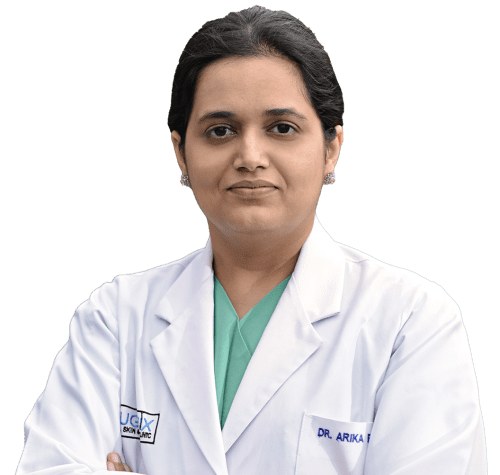
Medically reviewed by Dr. Arika Bansal, Co-Founder, Eugenix Hair Sciences; MBBS, MD Dermatology, Fellow of ISHRS; Reg. No. HN-34095 (Haryana Medical Council).
Dr. Arika Bansal
Dr. Arika Bansal, Co-Founder, Eugenix Hair Sciences. MBBS (Gold Medallist, Lady Hardinge Medical College), MD Dermatology, alumni of AIIMS, New Delhi. Fellow of ISHRS. Reg. No. HN-34095 (Haryana Medical Council).
