

Usually, no. Transplanted scalp hair grows with the texture of the area it was taken from, because the hair follicles keep their own characteristics after they are moved. Hair is taken from the back and sides of your scalp, so once it has fully grown, the transplanted hair usually looks and feels like your own hair from those areas. What can look different for a while is the new hair growth in the first months, which often starts thin and soft and matures over time.
This guide from Eugenix Hair Sciences explains why texture can seem to change after a hair transplant, when it settles, how beard and body hair behave when they are moved, and how to care for transplanted hair as it grows.
Why does transplanted hair keep its texture?
Each of your individual hair follicles carries its own instructions for how thick, how curly and what colour its hair will be. During a hair transplant, follicles are moved from the donor area to the area of thinning hair or baldness, and they usually keep the behaviour of the area they came from. This is also why hair from the back and sides, where hair is usually less affected by pattern hair loss, usually keeps growing in its new place.
The transplanted hair is your own natural hair. It grows naturally from your own roots, and can be washed, cut and styled like the rest of your hair. In most people, hair from the back and sides of the scalp is close to the hair that once grew on top, so the transplanted hair blends with it once it has grown.
Why does new hair look different in the first months?
The early months are when most people notice a change in texture. The timeline after a hair transplant usually runs like this:
- Day 30 to Day 90: the shedding phase. Most transplanted hairs shed, while the roots stay in place.
- From Month 4: new hair growth starts. These early hairs are usually soft, thin and lighter in colour than they will become.
- Months 5 to 6: more follicles start growing, hair density builds and the early hairs thicken.
- Months 10 to 12: full results for the front and mid-scalp, when the new hair has matured in thickness and texture. The crown usually takes 12 to 15 months.
Some people also notice that the early hairs look a little wavier, drier or more uneven than the rest of their hair. In most cases this is part of the same maturing process and settles as the hair grows longer and thicker. If anything about the new hair worries you, share photos with the Eugenix team at your follow-up reviews. For the month-by-month detail, read our hair transplant growth chart.
Can a hair transplant make straight hair curly?
Not usually. Scalp hair moved from the back and sides keeps its own pattern, so straight hair usually grows back straight and wavy hair grows back wavy once it has matured. A lasting change in curl usually has another cause, such as hair moved from the beard or body, or the normal changes in hair that come with age.
Hair type also shapes how a hair transplant is planned. Indian and other Asian hair is usually straight to gently wavy and thick, Caucasian hair ranges from straight to wavy, and Afro hair is tightly coiled, with a curl that continues under the skin. The doctor assesses your hair diameter, curl pattern and donor area before planning. Read more in Asian hair vs Caucasian hair and on our Afro hair transplant page.
Beard and body hair: why their texture stays different
When scalp donor hair is limited, beard hair can be used as a filler. Beard hair is wiry, curly and thicker in calibre than scalp hair, and it keeps these characteristics on the scalp. For this reason, at Eugenix beard grafts are always mixed with scalp grafts, are used from about 2 cm behind the hairline for density, and are not placed in the hairline zone, the temple points or the crown whorl. Hair grown from beard grafts may need a little grooming with gel or wax to blend with scalp hair.
Chest hair has a very different texture from scalp hair and can look unnatural on the scalp. Arm, leg, armpit and pubic hair are not routinely used as donor hair. To read more, see can body hair be used for a hair transplant?
Beard and eyebrow transplants
The same rule works the other way. Scalp hair moved to the beard is straighter, thinner and finer than beard hair and grows faster, so it does not blend well with a coarse natural beard. Transplanted eyebrow hair is usually thicker than natural eyebrow hair, and it keeps growing in length like scalp hair, so it needs to be trimmed every week.
Can transplanted hair texture change over the years?
Once matured, transplanted hair usually keeps its texture for many years. Two normal changes can still happen. Hair can turn grey with age, along with the rest of your hair. In some men, especially those not on medical treatment, the transplanted hair can also become finer over the years. Finasteride slows the progression of male pattern hair loss. It is not a cure, and it is taken under medical supervision. Your doctor decides whether it suits you.
How to care for transplanted hair as it grows
- Your first head wash is on Day 7. After that, wash with a mild shampoo as advised by the team.
- Hair products: mousse after 7 days; hair gel, serum and colour after 30 days.
- Avoid regular hair dryer use on the transplanted hair, because hot air damages the outer layer of the hair. If you need one, use a low heat or cold air setting, held at a distance.
- Use conditioner once the transplanted hair has grown some length, applied along the hair, not at the roots.
Eugenix Hair Sciences has worked only in hair restoration since 2009, with centres in Gurugram, Mumbai, Hyderabad, Bhubaneswar and Bengaluru. It was founded by Dermatologists, alumni of AIIMS, New Delhi, and Fellows of ISHRS. No clinic should promise a result in advance, and results vary from person to person.
Key points
- Transplanted scalp hair usually keeps the texture of the donor area.
- Early hairs from Month 4 are often thin, soft and lighter, and mature by 10 to 12 months.
- Beard and body hair keep their own texture, so they are used only as a filler, in set areas.
- Transplanted hair can turn grey with age, like the rest of your hair.
Know more about how your hair type shapes your plan by speaking to our team.
Frequently asked questions
Does a hair transplant change hair texture?
Usually not. Transplanted scalp hair grows with the texture of the area it was taken from, because the follicles keep their own characteristics after they are moved. The new hair often starts thin, soft and lighter in colour from Month 4, and it matures in thickness and texture by about 10 to 12 months. Beard and body hair keep their own texture when moved to the scalp.
Why is my new hair thin or wavy after a hair transplant?
The early hairs that grow from Month 4 are usually soft, thin and lighter in colour than they will become, and some people notice that they look a little wavier or drier. In most cases this settles as the hair matures over Months 5 to 12. If anything about the new hair worries you, share photos with the Eugenix team at your follow-up reviews.
Can a hair transplant make straight hair curly?
Not usually. Scalp hair moved from the back and sides keeps its own pattern, so straight hair usually grows back straight once it has matured. A lasting change in curl is more likely to come from beard or body hair used as a filler, which stays wiry and curly, or from the normal changes in hair that come with age. Your doctor can check any change you notice.
Does beard hair look different when transplanted to the scalp?
Yes. Beard hair is wiry, curly and thicker than scalp hair, and it keeps these characteristics on the scalp. That is why beard grafts are always mixed with scalp grafts, used from about 2 cm behind the hairline for density, and kept out of the hairline zone, the temple points and the crown whorl. Some grooming with gel or wax helps it blend.
Can curly or Afro hair be transplanted?
Yes. Curly and Afro hair can be transplanted, and the transplanted hair keeps its curl. Afro hair is tightly coiled and the curl continues under the skin, so the follicle follows a curved path, which makes extraction more complex and needs careful technique. The doctor assesses your hair diameter, curl pattern and donor area at consultation before any plan is made.
How should I care for transplanted hair as it grows?
Your first head wash is on Day 7, and after that you wash with a mild shampoo as advised. Mousse can be used after 7 days, and hair gel, serum and colour after 30 days. Avoid regular hair dryer use on the transplanted hair, or use a low heat or cold setting from a distance. Use conditioner along the hair once it has grown some length.
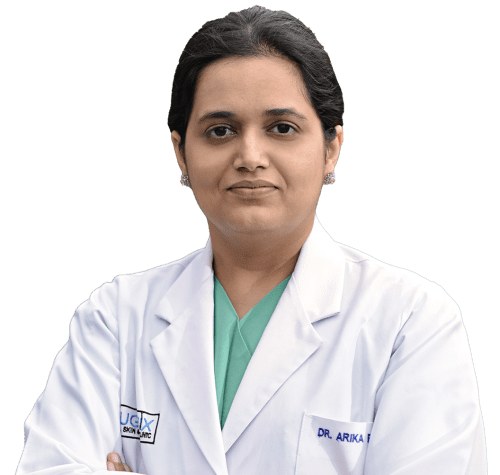
Medically reviewed by Dr. Arika Bansal, Co-Founder, Eugenix Hair Sciences; MBBS, MD Dermatology, Fellow of ISHRS; Reg. No. HN-34095 (Haryana Medical Council).
Dr. Arika Bansal
Dr. Arika Bansal, Co-Founder, Eugenix Hair Sciences. MBBS (Gold Medallist, Lady Hardinge Medical College), MD Dermatology, alumni of AIIMS, New Delhi. Fellow of ISHRS. Reg. No. HN-34095 (Haryana Medical Council).
