Across the Gulf and the wider Middle East, demand for hair transplant surgery has grown significantly over the past decade. Hair transplant clinics have opened in major cities, awareness has increased, and the stigma around hair restoration has diminished. Yet a consistent pattern has emerged: patients who research carefully and compare their options frequently conclude that the most compelling combination of surgical expertise, value, and experience is not available locally. It is in India.
This article examines the hair transplant in Middle East vs India question in full, and explains why that conclusion keeps drawing international patients from across the region to make the journey.
Why Middle Eastern Patients Are Choosing India for Hair Restoration
Hair loss in the Middle East follows the same global patterns. Male pattern baldness and excessive hair loss affect a significant proportion of men across the region, and the desire for a permanent, natural-looking solution is no different here than it is anywhere else in the world. What is different is the medical ecosystem in which patients are trying to find that solution.
The Middle East has invested heavily in its healthcare infrastructure. World-class hospitals exist across the Gulf, and cosmetic surgery and aesthetic procedures are widely available. However, hair transplant surgery is a niche and highly specialised field. For many international patients considering this procedure, the choice of where to undergo hair transplantation is among the most consequential decisions they will make.
The Gap Between Demand and Specialist Availability
The number of hair transplant surgeons with deep, exclusive, long-term experience in hair restoration is smaller than the general cosmetic surgery market suggests. For a patient who wants a hair transplant procedure performed by someone who has completed thousands of cases, who has published research in the field, and who has spent their career doing nothing else, the options within the Middle East narrow considerably.
India offers something the Middle East currently cannot: a critical mass of skilled surgeons and hair transplant clinics that have trained at elite medical institutions, refined their protocols over 15 to 18 years of exclusive practice, and built dedicated infrastructure around a single discipline. For hair transplant in India, this depth of specialisation is the foundation of everything else.
Hair Transplant in India: What the Numbers Tell You
India’s hair transplant industry has grown into one of the most advanced in the world. Top Indian hair transplant clinics perform thousands of hair transplant procedures annually, generating the clinical volume that drives precision, consistency, and best outcomes. Many international patients who choose India report that the case volume at India’s best hair transplant clinics exceeds what they encountered in their home markets by a significant margin. When it comes to hair restoration, volume and experience are directly correlated.
The Expat Doctor Reality: What It Tells You About Where the Expertise Actually Lives
One of the less-discussed aspects of the Middle East’s medical landscape is its heavy reliance on internationally trained and expatriate doctors. Across the Gulf, a significant proportion of practising physicians, including those in cosmetic surgery and hair transplant surgery, received their medical training and built their early careers outside the region, with a large number having trained in India.
India’s Medical Education and Its Global Reach
India’s medical education system requires approximately ten years of training to qualify as an MD in Dermatology, producing world-class dermatologists and hair transplant surgeons. Premier institutions such as AIIMS and PGI are internationally recognised for producing doctors of the highest calibre. Many Indian surgeons hold international certifications and go on to practice across the globe. Indian doctors are a presence in the hair transplant industry across the Gulf, Europe, North America, and beyond.
Why This Matters for Your Treatment Plan
The point for a patient seeking the best possible result is straightforward. If many of the hair transplant surgeons treating Middle Eastern patients were trained in India, the question is whether it makes sense to access that expertise in India directly, at its source and at a significantly lower cost, rather than through an intermediary market at a high cost. For a medical procedure as precise and permanent as a hair transplant, accessing the expertise where it is deepest is always the stronger choice.
Cultural Familiarity and Shared Understanding
One of the underappreciated advantages of choosing India for a hair transplant is the cultural familiarity that exists between Indian medical teams and Middle Eastern patients.
The Indian community is one of the largest expatriate populations in the Middle East. Millions of Indians live and work across the Gulf, and decades of interaction have created genuine cultural fluency on both sides. Indian doctors understand the communication styles, expectations, and sensitivities of Middle Eastern patients in ways that may not always exist with European or American surgical teams. Most patients from the region who have undergone hair transplant surgery in India describe the experience as immediately comfortable, with a level of warmth and communication clarity that they did not expect.
Hair Type Expertise and Personalised Care
Hair characteristics differ significantly by ethnicity, and Indian surgeons have extensive experience treating hair types common across the Arab and broader Middle Eastern population. Dense, dark hair with specific curl patterns requires a considered approach to donor area extraction, graft preparation, and implantation. Reputable clinics in India have built this expertise over thousands of cases, with personalised care and tailored treatment plans that reflect each patient’s individual hair loss pattern, hair density, and long-term restoration goals.
Proper diagnosis before any hair transplant procedure is essential. India’s best hair transplant clinics prioritise a thorough initial assessment, reviewing the extent of hair loss, donor area capacity, hair follicles available for extraction, and the patient’s long-term hair loss trajectory before recommending a treatment plan. This approach to personalised care is a mark of reputable clinics the world over, and India’s top clinics consistently deliver it.
What Indian Hair Transplant Clinics Offer That the Middle East Currently Cannot Match
The case for India goes beyond cost, though the cost advantage is real and significant. The deeper argument is about specialisation, advanced technologies, and the clinical depth that comes from performing exclusively one discipline at scale.
Cutting-Edge Technology and Instrumentation
Indian clinics invest in cutting-edge technology that is not always widely available in the Middle East. High-magnification loupes imported from Germany, surgical extraction punches from the United States, and proprietary implantation systems developed specifically for minimising graft trauma are standard at the best Indian hair transplant clinics. This instrumentation reflects a commitment to patient safety, natural-looking results, and natural results that stand up over time.
Hair transplantation at India’s leading clinics uses advanced techniques that are governed by the same advanced technologies found at the world’s top hair restoration centres. Modern hair transplant techniques at these clinics reduce the time hair follicles spend outside the body, support higher graft survival, and deliver natural looking results that most patients from other countries find difficult to access locally at an affordable price.
Case Volume and Clinical Depth
Top clinics in India perform thousands of hair transplant procedures annually. This is not simply a commercial metric. It is a clinical one. Hair transplant surgery is a skill refined through repetition. A hair transplant surgeon who has performed thousands of procedures has encountered and resolved clinical scenarios that a surgeon with a limited case history has not. This depth cannot be manufactured. It accumulates over years of exclusive focus on hair restoration.
Performed Exclusively: The Advantage of Specialisation
Hair transplant surgery in India is not a service offered alongside skin treatments and general dermatology at most of the leading centres. At the best hair transplant clinics in India, it is the only thing the team does, every day, over many years. This means that every qualified doctor, every senior surgical assistant, every piece of equipment, and every protocol in the building exists for one purpose: delivering the best possible hair transplant outcome. Most clinics that offer hair transplants as one service among many simply cannot match this standard.
Hair Transplant Cost: India Compared to the Middle East
The hair transplant cost differential between India and the Middle East is one of the most commonly cited reasons that many international patients choose India.
Hair transplant costs in the Gulf region are driven by high overhead costs, premium real estate, staff salaries, and the general cost of delivering private medical care in one of the world’s highest-cost regions.
Understanding What Drives the Cost Difference
In India, the same procedure performed to the same standard by a qualified doctor with equivalent credentials costs significantly lower. The lower cost is not a function of lower quality. It reflects lower staff salaries, affordable operating infrastructure, and a medical economy built to serve both domestic and international patients at a reasonable price. This is the structural reason why so many international patients from western countries and the Gulf choose India for hair transplant surgery.
The same procedure that might require a very high cost investment in the Middle East is available in India at an affordable price, with the total expenditure including flights, accommodation, airport transfers, and airport pickup often remaining considerably lower than the cost of the procedure alone in the region. Patients genuinely save money by making the trip, and they do so without compromising on the clinical standard of their hair transplant procedure.
Best Value Without Compromise
India offers something rare: best value without a trade-off on quality. The affordable hair transplants available at India’s top clinics are not a low-cost version of the real thing. They are the real thing, performed by experienced hair transplant surgeons with international credentials, in clinics equipped with cutting-edge technology, at a low cost that reflects India’s medical economy rather than any reduction in standard.
For patients who have reviewed the hair transplant cost landscape and are looking for the best destination that offers genuine quality alongside an affordable price, India compared to the Middle East presents a clear and well-evidenced answer.
Travel Accessibility: The Geography Works in Your Favour
For Middle Eastern patients, travel to India is among the most accessible international medical journeys possible. Direct flights from Dubai, Abu Dhabi, Riyadh, Doha, Kuwait City, and Muscat to Delhi or Mumbai are frequent, competitively priced, and typically between 3 and 5 hours in duration. India compared to other countries that offer comparable hair transplant quality, such as the UK or the USA, is far closer and easier to reach.
Planning Your Hair Restoration Journey
Most patients planning a hair restoration journey from the Middle East to India find that the logistics are more straightforward than anticipated. India’s major metropolitan hubs, Delhi and Mumbai, are well connected to the Gulf and offer a wide range of accommodation options. Premium hotels near the leading clinics provide comfortable environments for the recovery period. Most patients plan a visit of 5 to 7 days, which comfortably covers a pre-procedure assessment, the hair transplant procedure itself, an initial recovery period, and a final review before departure.
Airport Transfers and Arrival Support
India’s best hair transplant clinics have coordinated hundreds of patient journeys from the Middle East and have dedicated international patient teams who manage every aspect of the visit. Airport pickup and airport transfers, accommodation arrangements, pre-procedure documentation, and post-operative follow-up are all handled as part of a coordinated patient journey. For many international patients, this level of support is what converts the idea of travelling for a hair transplant into a confident decision.
Privacy, Discretion, and the Full Experience
Privacy is a consideration that many Middle Eastern patients raise early in the conversation, and it is worth addressing directly.
The decision to seek hair transplant surgery remains a personal matter, and the preference for discretion is entirely understandable. Travelling to India for a hair transplant provides a level of privacy that treatment in a home market cannot. The hair transplant procedure is conducted in a different country, among a clinical team with no connection to the patient’s local community or professional network. Recovery takes place away from home. Most patients are well through the initial healing period by the time they return.
India’s leading hair transplant clinics are accustomed to treating VIP patients and individuals who require complete confidentiality. Safety measures around patient privacy are built into how these clinics operate. Beyond the procedure itself, Delhi and Mumbai offer genuine luxury: five-star properties, dedicated concierge services, and the option to experience India’s culture and hospitality as part of the overall trip. Many Middle Eastern patients describe their hair restoration journey to India as a positive experience rather than merely a medical obligation.
Why Middle Eastern Patients Choose Eugenix Hair Sciences
Eugenix Hair Sciences has a well-established track record with patients from across the Middle East. With over 22,000 hair transplant procedures completed over 15 years, and a patient base drawn from over 90 countries, the clinic has the depth of international experience that patients travelling from the Gulf deserve.
Founded by Dr. Pradeep Sethi and Dr. Arika Bansal, both MBBS and MD alumni of AIIMS New Delhi and both Fellows of ISHRS, Eugenix operates as one of India’s best hair transplant clinics, working performed exclusively in the field of hair restoration for its entire 15+ years history.
NABH Accreditation and International Recognition
Eugenix’s Gurgaon clinic holds NABH accreditation, Certificate No. DE-2026-0004, valid through March 2030, under the Allopathic Clinics Dermatology Clinics Programme (2nd Edition). NABH is recognised by international bodies as ISQua accredited, making this a quality benchmark that carries weight beyond India’s borders. For Middle Eastern patients evaluating patient safety standards at Indian clinics, NABH accreditation is a meaningful and verifiable signal of clinical credibility.
Eugenix’s founding surgeons have published research in peer-reviewed international journals indexed in PubMed, one of the world’s most respected medical databases. The 2013 paper established the DHT technique as a significant advance in hair transplant surgery. A separate 2019 publication validated the combined approach of pre-made sites and no-root-touch implantation that Eugenix practises today.
The DHT Technique and What It Means for Your Result
The Direct Hair Transplantation (DHT) technique practised at Eugenix is one of India’s most significant contributions to the global hair transplant industry. DHT reduces the time hair follicles spend outside the body, from 3 to 4 hours under conventional methods to under 30 minutes. This directly supports graft survival and is a key reason why Eugenix’s results are consistent and natural-looking.
DHT at Eugenix is governed by the ADDD principle: Angle, Depth, Density, and Direction or Design. Every slit in every hair transplant procedure is planned and executed according to this framework, ensuring that each graft grows in the direction and at the hair density intended. The result is a natural-looking outcome that integrates seamlessly with the patient’s existing hair, regardless of hair type or grade of hair loss.
Eugenix also specialises in a full range of hair restoration solutions beyond scalp hair transplants, including beard transplants, eyebrow transplants, corrective hair transplant surgery for patients who have had poor results elsewhere, and advanced body hair transplantation for patients with extensive baldness and limited scalp donor area.
Follow-Ups and Long-Term Care
Eugenix’s commitment to international patients does not end when the hair transplant procedure is complete. The clinic’s E-Care team provides structured follow ups over a five-year post-procedure period, with virtual consultations at 1 week, 1 month, 3 months, 6 months, and 12 months, continuing on a long-term basis thereafter. Follow up care is managed remotely for international patients, meaning that Middle Eastern patients returning home after their procedure remain fully supported throughout their hair restoration journey.
For many international patients, this level of follow up care is what distinguishes the best hair transplant clinics from the rest. Most clinics that handle international patients offer limited post-procedure contact. Eugenix’s E-Care model is built around long-term accountability, not a single transactional procedure.
Frequently Asked Questions
Is travelling to India from the Middle East practical for a hair transplant?
Yes. Direct flights from the major Gulf cities to Delhi or Mumbai are between 3 and 5 hours, frequent, and cost-effective. Most patients plan a trip of 5 to 7 days, which comfortably accommodates a pre-procedure assessment, the procedure, initial recovery, and a final review. Follow up care for the hair transplant continues remotely with the clinic’s team after departure.
How does hair transplant quality in India compare to the Middle East?
India’s leading hair transplant clinics have a longer track record, higher case volume, and a more exclusive focus on hair restoration than most facilities available in the Middle East. The depth of surgical expertise and protocol refinement at India’s top hair transplant clinics is difficult to match in a market where hair transplant surgery remains one service among many.
When will I see results after the procedure?
Hair transplant results develop over time. A shedding phase between 30 and 90 days post-procedure is normal and expected. Initial regrowth typically begins around months 3 to 4. Visible improvement is generally seen from months 6 to 8, with full results achieved at 10 to 12 months. The crown area may take up to 15 months. At 14 to 15 months, some patients experience a temporary hair density reduction of around 20% as the hair returns to its natural cycle, a process known as anagen desynchronization. This is completely normal and does not represent permanent hair loss.
Will my privacy be protected?
Yes. At reputable clinics like Eugenix, patient confidentiality is managed with the same rigour as the clinical care itself. Travelling to India also provides a natural layer of geographic privacy. Recovery takes place away from home, and the post-procedure period is well underway before the patient returns to their home country.
How do I begin the process as a Middle Eastern patient?
The first step is a virtual consultation with the clinic’s medical team. Eugenix offers free video consultations for international patients, with no obligation to book.
This allows the medical team to review your hair loss history, assess your donor area, and provide an honest, personalised treatment plan before you make any travel decisions.
For a growing number of Middle Eastern patients, the comparison between hair transplant in Middle East vs India ends in the same place. The deepest expertise, the most refined protocols, and the most complete patient experience are available in India, at an affordable price that makes the decision straightforward. The journey is shorter than most people expect. The results are longer-lasting than most people hope.
Book a virtual consultation today to take the first step in your hair restoration journey.
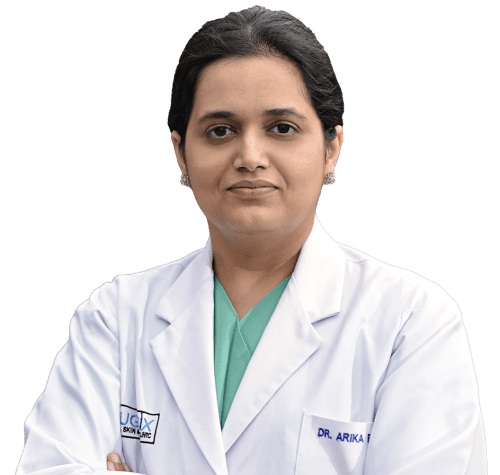
Dr. Arika Bansal
One of only a few female surgeons specializing in hair transplant surgery in India, Dr. Arika Bansal has been voted one of the best doctors in the world. She maintains an active fellowship in the ISHRS and regularly submits research papers to medical journals. 15+ years down the line, 22,000+ surgeries are accomplished under Dr. Bansal’s supervision. She specializes in female hair transplant, density improvement, corrective hair transplantation and hairline design.