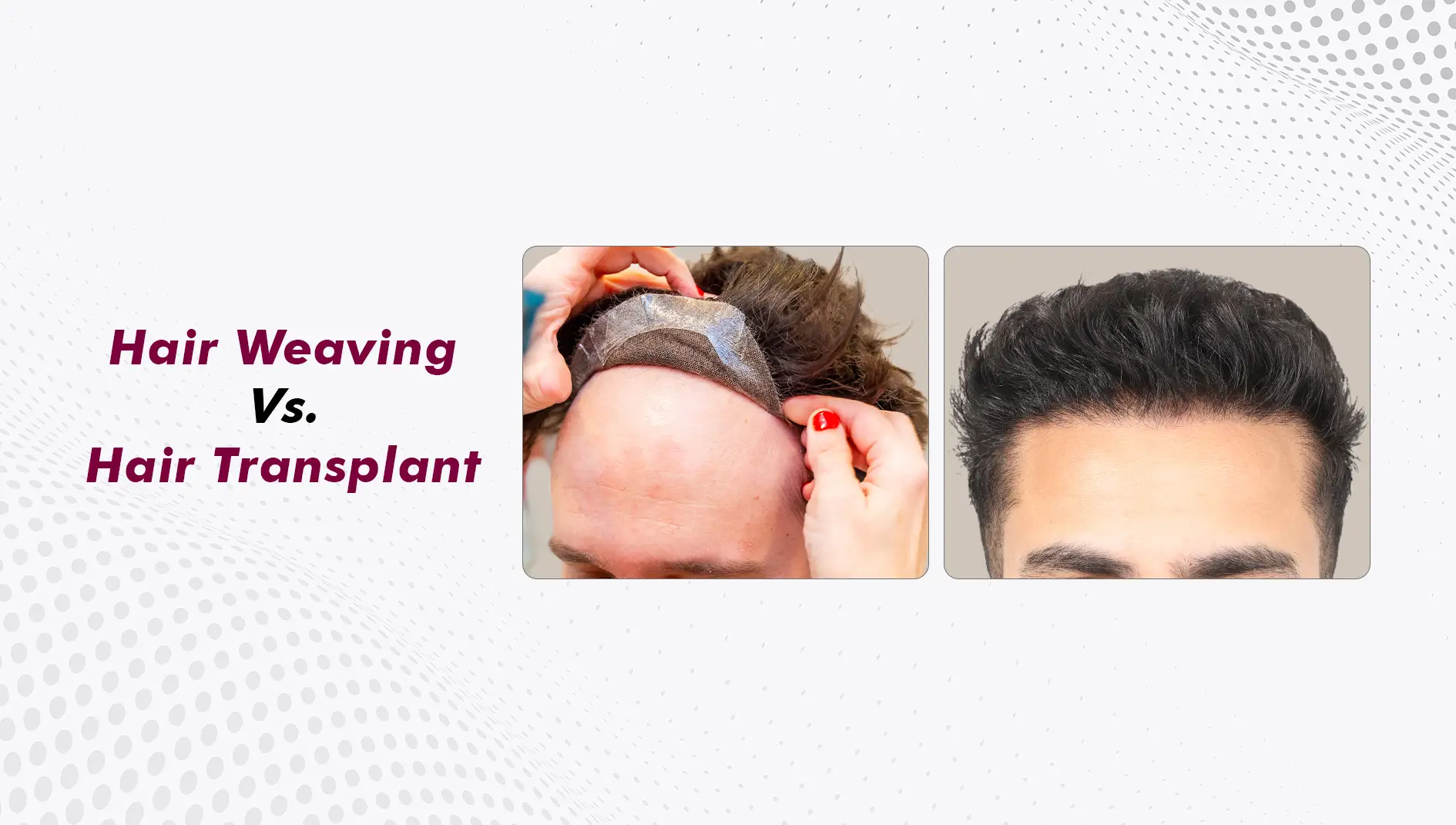

If you have started researching solutions for hair loss, you have probably compared hair weaving cost with hair transplant cost and wondered which one makes financial sense. It is a natural starting point. Non-surgical options promise instant coverage, and the initial quote often looks far smaller than the investment a hair transplant requires.
But the sticker price rarely tells the full story. Hair weaving, hair patches, and replacement systems are recurring commitments, while a hair transplant is a one-time medical procedure that restores your own growing hair. The right way to compare them is not by the first bill but by what each option asks of you over five, ten, or twenty years in money, in maintenance, and in the health of your natural hair.
This guide gives you a fair, honest comparison of hair weaving, hair patches, replacement systems, and hair transplant surgery. By the end, you will understand what drives the cost of hair weaving, what determines hair transplant cost, where non-surgical options genuinely make sense, and why so many people eventually move from temporary coverage to a permanent solution.
What Is Hair Weaving?
Hair weaving is a non-surgical method in which natural or synthetic hair is woven, braided, or bonded into your existing hair to add length, volume, or coverage over thinning areas. Because it anchors to your own hair, you need a reasonable amount of existing natural hair for the weave to hold.
Common Hair Weaving Techniques
– Bonding: the added hair is glued to your existing hair or scalp. This is typically the fastest and most affordable method, but temporary bonding often lasts only a few weeks and may cause hair damage.
– Sew-in weave: your natural hair is braided into a base, and hair extension wefts are sewn onto those braids. Sew-in weaves last longer than bonding but place more tension on your hair.
– Net weaving: a net is fixed over the thinning area, and hair is woven onto the net, often used when the bald patch is larger.
– Micro-link and tape-in: the added hair is attached strand by strand or in tapes, avoiding glue and heat, with its own maintenance cycle.
What Drives the Cost of Hair Weaving?
Several factors determine what you will pay for hair weaving:
– Quality of hair used: human hair costs significantly more than synthetic fiber because it lasts longer and looks more natural.
– Length and thickness of the extensions: longer, denser hair drives the price up.
– Extent of coverage: a larger bald patch requires more hair and more work than a small crown patch.
– Technique: bonding, sew-in, net weave, and micro-link each carry different pricing.
– Stylist expertise and location: skilled practitioners in major cities charge more, and prices vary widely by geography.
The Maintenance Cycle Nobody Mentions
Here is the part most first-time buyers miss: hair weaving is never a one-time expense. As your natural hair grows, the weave loosens and must be tightened or redone every few weeks. Regular maintenance includes tightening, reattachment, and special shampoos, and the woven hair itself wears out and needs periodic replacement. Over the years, these multiple sessions add up to a total cost that can quietly overtake the cost of a permanent solution.
Hair Patches and Replacement Systems
A hair patch, sometimes called a hair system or toupee, is a prosthetic unit of natural or synthetic hair attached to the scalp using adhesives, tapes, or clips. A full replacement system extends the same idea to larger areas of advanced baldness.
Modern systems can look convincing when new and professionally fitted, but they come with ongoing realities:
– Regular servicing: the unit must be removed, cleaned, and reattached at set intervals, usually at a salon.
– Periodic replacement: even high-quality units degrade with sun, sweat, chemical treatments, and washing and typically need full replacement several times over a few years.
– Daily restrictions: swimming, heavy workouts, and certain hairstyles need planning around the attachment.
– Scalp health: adhesives and prolonged coverage can irritate some scalps, and the skin underneath still needs care.
Like weaving, the true treatment cost of a patch is the recurring one. The purchase price is only the entry fee. Servicing, adhesives, and replacements continue for as long as you wear it, which for most users means indefinitely.
Hair Transplant Surgery: Your Own Hair, Growing Permanently
A hair transplant takes a fundamentally different approach. Instead of covering hair loss, a hair transplant procedure reverses its visible effect by relocating your own healthy hair follicles from the donor area, typically the back and sides of the scalp, to the areas of loss. These hair follicles are genetically resistant to the hormone dihydrotestosterone, the primary driver of androgenetic alopecia, also called androgenic alopecia, so they continue producing hair growth in their new location for life.
How a Hair Transplant Procedure Works
Hair transplant surgery is a surgical procedure performed under local anesthesia, so you are awake and comfortable throughout. Individual hair grafts are extracted from the donor area and implanted into the thinning zones, where they establish a new blood supply and begin their natural growth cycle. It is a medical procedure, which is why the choice of hair transplant clinic and hair transplant surgeons matters far more than chasing the lowest quote.
FUE, FUT, and DHT: Understanding Hair Transplant Techniques
You will encounter three names while researching hair transplantation:
– Follicular unit transplantation (FUT): the older strip harvesting method, in which a strip of scalp is removed and dissected into hair grafts. It leaves a linear scar at the back of the head. Eugenix does not perform FUT; it is relevant today mainly as historical context.
– Follicular unit extraction (FUE): the technique that replaced strip harvesting. Follicular unit extraction removes grafts individually, avoiding the linear scar. In traditional FUE, however, grafts stay outside the body for 3 to 4 hours before implantation.
– DHT (Direct Hair Transplant): the flagship Eugenix hair transplant technique, a modified FUE approach pioneered by Eugenix’s co-founders, Dr. Pradeep Sethi and Dr. Arika Bansal, and published in a peer-reviewed PubMed-indexed paper in 2013. The defining refinement is simultaneous extraction and implantation, which keeps hair grafts outside the body for under 30 minutes. Shorter out-of-body time protects graft health, which directly supports graft survival and consistent results.
What Results Can You Realistically Expect?
– Transplanted hair sheds initially between 30 and 90 days after the procedure, which is a normal part of the process.
– New hair growth begins around month 4.
– Results become visible between Months 6 and 8.
– Full results appear at 10 to 12 months, with the crown taking 12 to 15 months.
– The result is your own natural hair: you wash it, cut it, and style it exactly as before.
Honesty matters here. Hair transplantation restores approximately 50% of your natural original density, which is the clinical benchmark for natural looking hair, not a return to your teenage hairline in every case. Outcomes depend on your donor area, hair characteristics, and hair loss stage, which is why planning by qualified surgeons makes all the difference.
What Determines Hair Transplant Cost?
The cost of a hair transplant in India varies widely, and any clinic quoting a fixed hair transplant price before examining your scalp should give you pause. A reliable cost estimate is only possible after a proper scalp analysis. These are the factors that shape the final cost:
Number of Grafts and Your Norwood Stage
Graft count is the single biggest driver of hair transplant cost. Your Norwood stage determines the number of grafts required: early hairline recession needs far fewer grafts than advanced baldness, where a larger bald patch requires a higher graft count. Since many clinics quote a per-graft cost, the FUE cost for a Norwood 2 patient and a Norwood 6 patient can differ several times over, even at the same clinic.
Technique and Surgeon Expertise
The hair transplant technique used, and who performs it, both shape the estimated cost. Surgeon expertise, the experience of the surgical team, and the involvement of specialists, whether dermatologists or plastic surgeons, all factor into hair transplant price. Corrective procedures, where a previous transplant or long-term weave damage must be repaired, are typically more complex and priced accordingly.
Clinic Standards and City
Hair transplant cost varies across major cities: Delhi hair transplant cost differs from other metros, and premium clinics with world-class infrastructure, accredited operating standards, and comprehensive support after surgery price differently from budget setups. For international patients, hair transplant in India remains attractive precisely because world-class clinical standards are available here, but the deciding factor should be the clinic’s standards and results, not geography alone.
The practical takeaway: treat any average hair transplant cost you read online as background only. Detailed pricing for your case comes from an initial consultation and scalp analysis, where your treatment plan and graft count are actually determined.
Recurring vs One-Time: The Real Comparison
Because figures vary by provider, city, and case, the structure of the spending is what you should compare:
– Hairdressing: lower entry cost, but tightening every few weeks, periodic hair replacement, and salon dependency for as long as you use it. The total cost never stops growing because the solution never becomes yours.
– Hair patch or replacement system: moderate entry cost, plus servicing, adhesive supplies, and full unit replacement multiple times over the years. The spending continues for life.
– Hair transplant surgery: a higher one-time investment, followed by essentially normal hair care and routine follow-up visits. Prescribed medication such as finasteride may be recommended to protect your existing non-transplanted hair, always under medical supervision, but the transplanted result itself requires no servicing or replacement.
Run that structure over a decade and the comparison often inverts. The option with the lowest hair cost in Month 1 frequently becomes the most expensive by Year 5, while delivering a result that was never permanent.
The Hidden Cost: What Weaving Can Do to Your Natural Hair
There is one more cost that never appears on a bill. Hair weaving anchors added hair to your existing hair, and that anchoring creates constant tension on your hair follicles. Prolonged tension from tight weaves, braids, and extensions is a recognised cause of traction alopecia, a form of hair loss driven purely by physical pulling.
In its early stages, traction alopecia is reversible if the tension is removed. But advanced cases can cause permanent follicle damage, which means a solution chosen to hide hair loss can end up accelerating it. Anyone using weaves long term should watch for thinning along the areas of highest tension and take it seriously.
Hair patches carry a related practical point: a hair transplant clinic needs your scalp in its natural state to plan a procedure. At Eugenix, hair transplant patients are asked to stop wearing any toupee, wig, or patch for at least 30 days before their procedure. So if you use a patch today and are considering hair restoration later, that transition is entirely possible and is planned for routinely.
What About Non-Surgical Medical Treatments?
Camouflage is not the only non-surgical route. Medical hair restoration treatments such as platelet rich plasma therapy work on your own follicles rather than covering them. Platelet rich plasma is prepared from your own blood and delivered to the scalp over multiple sessions to support hair health, particularly in early thinning. It is not a permanent fix on its own, and results are temporary without maintenance, but for the right candidate it can form part of a broader treatment plan alongside prescribed medication or a hair transplant treatment.
Which Option Is Right for You?
A fair comparison acknowledges that every option has a legitimate use case.
Hair weaving or a hair system may suit you if you need an immediate cosmetic change, if your hair loss is medically unsuitable for a transplant, or if you are not ready for a surgical procedure and want coverage in the meantime. Some patterns, such as unstable hair loss affecting the donor area, can make transplantation inadvisable, and certain cases of female pattern hair loss also need careful medical evaluation before surgery is considered. In such situations, a well-made system is a reasonable choice.
A hair transplant is the stronger option if you have stable male pattern baldness or early hairline recession with a healthy donor area, and you want a permanent solution that needs no ongoing maintenance and no anxiety about wind, water, or close inspection. It is the only option here that gives you back your own growing hair.
The honest answer for most people with established pattern hair loss and a good donor area is that hair restoration surgery delivers more value over time, both financially and personally. The only way to know which category you fall into is a proper clinical evaluation of your scalp, donor density, and progression.
Why Patients Choose Eugenix for the Permanent Route
Moving from temporary coverage to permanent hair restoration is a significant medical decision, and the team behind it matters more than any price list. If you are searching for the best hair transplant clinic for your case, judge clinics on technique, transparency, and track record.
Eugenix Hair Sciences has performed over 20,000 procedures across more than 15 years of exclusive focus on hair restoration, serving Indian and international patients alike. The Co-Founders, Dr. Arika Bansal and Dr. Pradeep Sethi, are alumni of AIIMS, New Delhi, Fellows of ISHRS, and the authors of the 2013 PubMed-indexed paper that introduced the DHT technique to the global hair restoration community. Eugenix deliberately chose not to patent DHT so that surgeons worldwide could adopt it for better patient outcomes.
Consultations are conducted by a panel of experienced hair transplant surgeons, each personally handpicked and trained by the Co-Founders, with the Co-Founders themselves available by appointment. Eugenix operates centres in Gurgaon, Mumbai, Hyderabad, and Bhubaneswar, and the Gurgaon centre is NABH accredited, a nationally recognised benchmark for quality and patient safety. At Eugenix, major complications are exceptionally rare, supported by over 20,000 procedures performed across more than 15 years of clinical practice.
Frequently Asked Questions
Is hair weaving permanent?
No. Hair weaving is a temporary cosmetic solution. The added hair does not grow, the attachment loosens as your own hair grows out, and the weave must be maintained every few weeks and replaced periodically. Only a hair transplant produces permanent, growing hair.
How long does hair weaving last?
It depends on the technique. Temporary bonding methods often last only a few weeks, while sew-in weaves blend natural hair and extensions for a longer-lasting application. Even the most durable methods need regular tightening and, eventually, full replacement. No weaving method lasts permanently.
Is hair weaving good or bad?
It is situational. As a short-term cosmetic fix, or for people who are not candidates for surgery, weaving serves a genuine purpose. Its downsides are the endless maintenance cycle, the recurring spend, and the tension it places on your natural hair, which can cause traction alopecia over time. As a long-term strategy for pattern hair loss, it compares poorly with a permanent solution.
What is the cost of 4000 hair grafts?
There is no honest universal answer, because most clinics price per graft and rates differ by clinic, technique, and city. A 4,000-graft case sits at the larger end of hair transplant surgery, so the graft count itself is the main cost driver, alongside surgeon expertise and clinic standards. For a genuine cost estimate, you need a scalp analysis confirming that 4,000 grafts is actually the right number of grafts for your pattern and donor capacity, followed by a personalised quote.
Can I get a hair transplant if I currently wear a patch or use weaving?
Yes, in most cases. Suitability depends on your donor area and the stability of your hair loss, not on your current cosmetic solution. If you proceed at Eugenix, you will be asked to stop wearing any patch, wig, or toupee for at least 30 days before the hair transplant procedure so the team can assess your scalp in its natural state.
The Bottom Line
Comparing the cost of hair weaving with hair transplant cost is really a comparison between renting and owning. Weaving, patches, and replacement systems rent you an appearance, with payments and maintenance that continue for as long as you use them. A hair transplant is a one-time investment in your own permanent, growing hair.
If you are weighing these options, start with clarity about your own case. Book a free consultation and photo evaluation with a Eugenix Hair Science Advisor to understand your hair loss stage, your donor capacity, and whether permanent hair restoration is right for you. There is no obligation, only an honest assessment, so you can make this decision with complete information.
Dr. Arika Bansal
One of only a few female surgeons specializing in hair transplant surgery in India, Dr. Arika Bansal has been voted one of the best doctors in the world. She maintains an active fellowship in the ISHRS and regularly submits research papers to medical journals. 15+ years down the line, 22,000+ surgeries are accomplished under Dr. Bansal’s supervision. She specializes in female hair transplant, density improvement, corrective hair transplantation and hairline design.