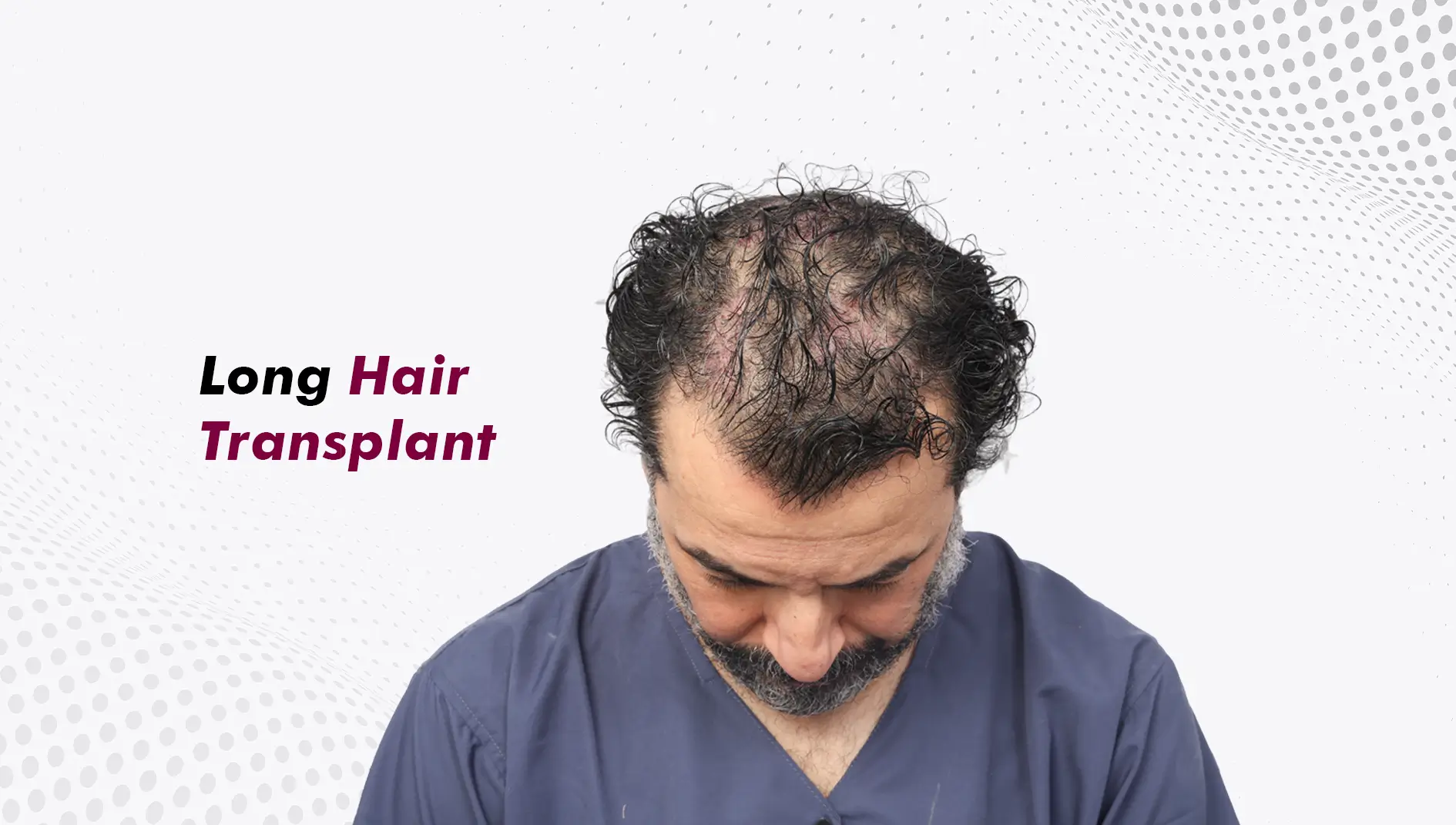
If you wear your hair long, the thought of clippers can be the hardest part of deciding on hair restoration. This is why many patients search for a long hair transplant: a procedure that restores thinning areas while the hair on top stays at its current length.
The reassuring answer is that, for the right candidate, you can keep your length on top. The hair at the back is still trimmed in a small, hidden section, and a little preparation makes a real difference.
Our guide on who suits a hair transplant without shaving head covers candidacy in depth. This article covers the practical side: preparing your hair, the procedure day, and recovery and styling afterwards.
What Does “Unshaven” Mean in Hair Transplantation?
In everyday language, “unshaven” or “unshaved” simply means “not shaved.” In hair transplantation, an unshaven hair transplant is one in which the existing hair in the recipient area is left at its current length and the new grafts are placed between your existing hairs. You may also see it called a no-shave hair transplant, a non-shaven hair transplant, or a long hair FUE.
“Long hair transplant” is the term many patients use for the same idea. Keeping your length changes how the procedure looks during surgery and in the weeks that follow. It does not change how your transplanted hair grows, how long results take, or the density you can expect.
Your Length Stays on Top, the Donor Area Is Trimmed Discreetly
The recipient area stays unshaven, keeping your long hair intact. The donor area at the back and sides of the scalp is still trimmed because the surgical team needs a clear view of each follicular unit to extract donor hair safely. This trimming is done as a concealed window or pattern, with longer hair above falling over it. So a hair transplant with no trimming at all in the donor or recipient areas is not possible.
Is It Better to Shave or Stay Unshaven?
Neither is better for everyone in hair restoration. A shaved, regular transplant gives the team full visibility and allows larger sessions drawing on more donor hair, so it suits patients who need extensive coverage. An unshaven hair transplant trades a graft ceiling of approximately **1,500 to 2,000 grafts** per session for discretion. The right choice depends on your hair loss pattern, donor density, and goals, and it is made at consultation, planning for future hair loss as well as current loss.
Who Is Suitable for an Unshaven Procedure
Suitability is highest when the area to be restored is modest, such as an early receding hairline, thinning temples, or localized thinning. It appeals to business leaders, public-facing professionals, and anyone who values discretion, and it is the preferred approach for most women at Eugenix, since female hair loss usually calls for density within existing hair. It is not suited to extensive baldness, where a standard procedure delivers better coverage.
Preparing Your Hair Before the Procedure
A few weeks of preparation is what makes the donor area invisible and the recovery easy to carry through daily life.
Stop Trimming at Least 30 Days Before
Eugenix preoperative guidance asks patients not to trim or shave scalp hair for **at least 30 days** before the procedure.
Grow the back to at least 5 to 7 cm.
For the trimmed donor section to stay hidden, the surrounding hair at the back of the head, particularly at the occiput, should be at least **5 to 7 cm** long. If you currently keep the back and sides short, your surgeon may advise waiting until they grow out before booking your date.
Complete Your Medical Workup
Medicine department clearance is mandatory for every patient, healthy or not, alongside a standard blood panel. For female patients, an additional hormonal blood panel is also mandatory: pre-menopausal women complete nine additional tests on Day 3 to Day 5 of the menstrual cycle, and post-menopausal women complete five. Our guide on how to prepare for hair transplant surgery walks through the full month before your procedure.
How Long Hair Changes the Procedure Day
Every slit has to be made, and every graft placed, between hair shafts that must be left undisturbed. This means a longer day, which is why unshaven procedures are planned and priced differently.
Planning & Designing Around the Hair You Already Have
Your procedure begins with planning & designing by the lead surgeon, including marking of the complete recipient and donor area. This planning also accounts for how your existing hair falls and how it will conceal the treated zone. In the hairline, only single-hair grafts are used in the first 4 to 6 rows, which gives a soft, natural edge.
The lead surgeon sets all technical parameters for recipient site creation, including slit size, angle, depth, direction, and density. Matching the angle and direction of your existing hair, while accounting for hair characteristics such as caliber and curl, is what allows new hair to blend with longer hair.
Working Between Existing Hair Shafts
At Eugenix, unshaven procedures are performed using our flagship DHT (Direct Hair Transplant) technique, a modified FUE. Unlike traditional FUE, where grafts can spend 3 to 6 hours outside the body, DHT keeps each graft outside the body for under 30 minutes because extraction and implantation happen simultaneously.
The lead surgeon creates every recipient slit hands-on and performs the extraction, with senior surgical assistants assisting. Senior surgical assistants then implant each graft using the SAVA Implanter (no-root-touch): the graft is visible throughout and inserted smoothly into the pre-made slit without a plunger-based blind push. This careful graft handling is especially valuable when placing grafts between longer hairs. The lead surgeon supervises your procedure throughout, taking rounds between active steps and remaining available at all times during your surgery.
Postoperative Care With Long Hair
Most postoperative care is identical to a standard procedure. What changes is that your hair now serves as camouflage and needs gentle handling.
Saline Spray Through Your Hair
For the first 7 days, you spray saline on the transplanted area every 30 minutes to 1 hour during the day. With longer hair, the spray needs to reach the scalp rather than sit on the lengths, and your team will show you how to do this without disturbing the grafts.
Your first head wash is on day 7
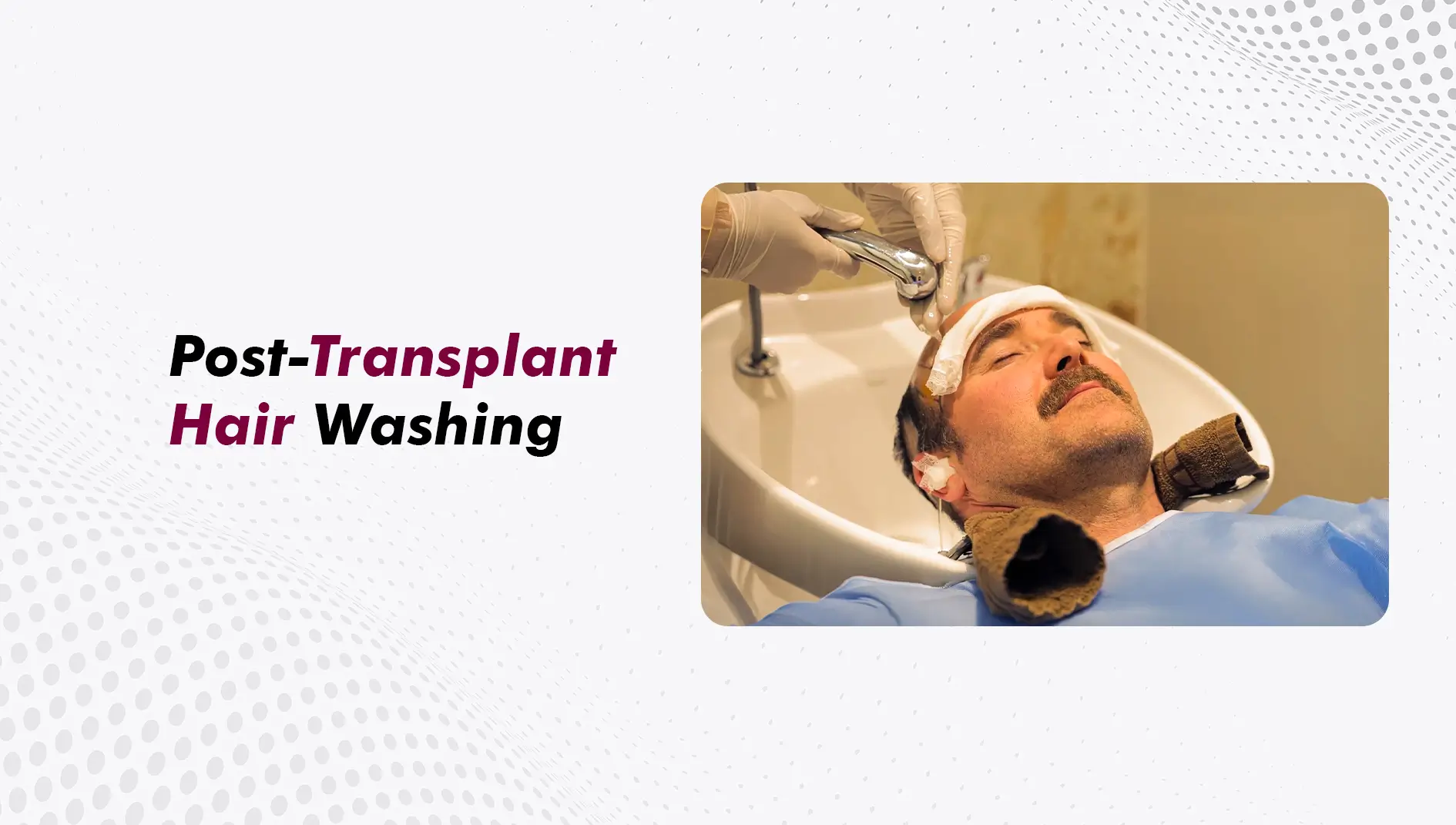
Your first head wash takes place on Day 7 only. Longer hair takes a little more care to rinse and dry gently around the recipient area, and our guide to washing your hair after a hair transplant explains the technique for the first 30 days.
Daily Life and Return to Work
– The next day: gentle walking, office work, and household tasks can resume. No bed rest is required.
– Medication: a 7-day course is prescribed, and SignoFlam is the painkiller prescribed by the Eugenix team for any discomfort.
– Sun: avoid direct sun on the transplanted area for 1 week, then minimize prolonged exposure.
– Alcohol and smoking: avoid both for at least 1 week
– Exercise: yoga, gym, and other intense physical activities are cleared after 7 days.
– Work: most patients return after 7 days, or take 5 to 7 days off in public or client-facing roles
This is where keeping your length pays off most: existing hair over the recipient area makes visible signs of early healing far less noticeable, allowing patients to keep their existing hairstyle through recovery.
Cutting, Colouring, and Styling After Your Procedure
These are the Eugenix timelines for returning to your usual routine:
– Hair fibers: can be used after 10 to 15 days if you want extra cover
– Haircut: after 15 days
– Hair color and gel: after 30 days
The Shedding Phase and Long Hair
Between 30 and 90 days after your procedure, most transplanted hair sheds. This is completely normal: the hair shaft falls while the root stays in place to grow a new hair. For patients with long hair, the shedding phase is usually easy to carry because the surrounding length continues to cover the area.
Shedding is not the same as shock loss. Shock loss affects some of your existing hairs around the treated area rather than the grafts, and your surgeon will explain your individual risk. Intraoperative PRP (Platelet Rich Plasma), derived from your own blood, helps minimize the risk of shock loss and may be recommended depending on your case.
New Hair Growth and Final Results
Regrowth begins around Month 4, with visible results from Month 6 to 8 and final results at 10 to 12 months, or 12 to 15 months for the crown. Because new hair growth starts short, it grows in underneath your existing length and blends progressively.
Your result depends on your donor density, hair characteristics, and hair loss progression, none of which keep your length changing.
The Honest Trade-Offs of Keeping Your Length
Discretion comes with conditions worth weighing before you decide:
– A graft ceiling of approximately 1,500 to 2,000 grafts per unshaven session
– A longer procedure day, because working between hair shafts takes more time and expertise
– Additional cost, as a surcharge applies on the base package price, confirmed at consultation
– Donor trimming still happens, concealed rather than avoided
– Some preparation, since you need to stop trimming and grow the back out beforehand
Why Eugenix for Long Hair Transplant Surgery
Working through existing hair makes technique and expertise essential. Eugenix performs DHT, a modified FUE technique developed by Co-Founders Dr. Pradeep Sethi and Dr. Arika Bansal and described in their 2013 PubMed-indexed paper, “Direct hair transplantation: a modified follicular unit extraction technique”. Both Co-Founders are alumni of AIIMS, New Delhi and Fellows of ISHRS.
Procedures are carried out by a panel of experienced surgeons, personally handpicked and trained by Dr. Arika Bansal and Dr. Pradeep Sethi, whose training and oversight shape every Eugenix procedure. Consultations with the Co-Founders themselves are available by appointment. Our Gurgaon clinic is **NABH accredited**, and at Eugenix, major complications are exceptionally rare, supported by over 22,000 procedures performed across more than 15 years of clinical practice.
You can read more on our unshaven hair transplant service page, or explore hair transplant in Mumbai and hair transplant in Hyderabad.
Frequently Asked Questions
Can a hair transplant be done on long hair?
Yes, for suitable candidates. The hair in the recipient area stays at its current length and grafts are placed between existing hairs. The donor hair at the back is still trimmed in a concealed section, and your doctor confirms suitability at consultation.
Will people be able to tell I have had a procedure?
Early recovery is far less noticeable, since your existing hair falls over the treated area and the longer hair at the back covers the donor section. How discreet it looks depends on your hair length, density and the size of the area treated, and you can usually keep your existing hairstyle.
Conclusion
You do not always have to choose between restoring your hair and keeping the length you love. For patients with modest areas to restore, a long hair transplant keeps the hair on top untouched, hides the donor area under longer hair, and follows the same healing and growth timeline as any other procedure, in return for honest planning.
The best first step is an honest assessment of your hair loss pattern, donor area and goals. Book a free photo evaluation with a Eugenix Hair Science Advisor (https://eugenixhairsciences.com/book-an-appointment/), and we will help you understand whether keeping your length is the right route for you, and approach your hair restoration with confidence.
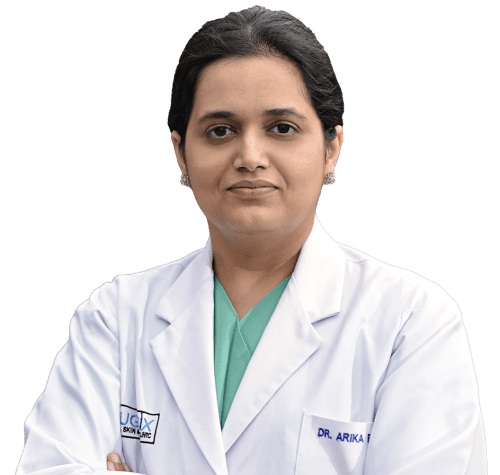
Dr. Arika Bansal
One of only a few female surgeons specializing in hair transplant surgery in India, Dr. Arika Bansal has been voted one of the best doctors in the world. She maintains an active fellowship in the ISHRS and regularly submits research papers to medical journals. 15+ years down the line, 22,000+ surgeries are accomplished under Dr. Bansal’s supervision. She specializes in female hair transplant, density improvement, corrective hair transplantation and hairline design.