

A new hairline is planned by the doctor before the hair transplant begins, by studying your face, your age, how your hair loss may progress and how much donor hair you have. The hairline is then drawn on your forehead, discussed with you and adjusted before any graft is placed. It is planned as a soft zone, not a sharp line, with single hairs at the front and slightly irregular edges, the way hair grows.
This guide from Eugenix Hair Sciences explains each step of hairline planning, and why the plan looks ahead to the years after surgery.
Who does the hairline design?
At Eugenix, Planning & Designing is done by the lead surgeon. It includes marking the complete recipient area, with the new hairline, and the donor area at the back and sides of the scalp. The lead surgeon also makes all the slits and sets every technical parameter, including the angle, depth, density and direction of each graft. The Eugenix medical team carries out implantation under the lead surgeon’s parameters and supervision, using the SAVA Implanter, a no-root-touch instrument.
A proposed hairline is usually marked at consultation too, so you can see it in the mirror and discuss it before anything is decided. For an overview of the procedure, see our hairline reconstruction page.
Step 1: Where should the hairline sit?
The first decision is the height of the hairline, measured from the centre of the forehead. Three guides are used together:
- Your face: in a balanced face, the forehead, the middle of the face and the lower face are roughly three equal sections, often called the rule of thirds. The hairline is drawn to suit your face shape and facial structure.
- The forehead muscle: the hairline is placed above the part of the forehead that moves when you frown or raise your eyebrows. A hairline placed lower than this looks unnaturally low.
- The shape of the scalp: the front of the hairline usually sits where the forehead curves from vertical to horizontal.
In men, the centre of the hairline usually sits about 7 to 10 cm above the point between the eyebrows. The exact height depends on your grade of hair loss, your donor hair and the shape of your head.
Step 2: Choosing the shape
Hairlines come in different shapes, and the shape changes how many grafts are needed:
- Triangular or V-shaped: a more conservative shape that uses fewer grafts at the front.
- Oval: a moderate shape.
- Rounded or U-shaped: a fuller, lower shape that uses more grafts and is risky for young patients.
- Square or M-shaped: suited to some face shapes or natural patterns.
The corners where the front of the hairline meets the sides are planned with care. At Eugenix, this angle is kept sharp, not flared, and it usually lines up with the outer edge of the eyebrow. A flared corner, spread too wide, does not look like a natural hairline.
Step 3: Planning the hairline as a zone
A natural hairline is not a single straight line. The front hairline, or anterior hairline, is a zone about 1.5 to 2 cm deep, and it is planned in layers:
- The front of the zone: only single-hair grafts, placed across the first 4 to 6 rows, lightest at the very front. Single-hair grafts are placed at the front of the hairline, as in a natural hairline.
- The transition zone behind it: a mix of single and double grafts, with density building up gradually.
- The main area behind: grafts are placed in natural groups of 1 to 4 hairs, the way hair grows.
Each graft is placed at the angle and direction in which your own hair grows. At the hairline, grafts lie at a low angle to the skin. The hairline zone is usually planned at about 35 to 45 grafts per square centimetre, depending on hair thickness and the skin.
Step 4: Building in natural irregularity
A hairline drawn with a ruler looks artificial. So the plan deliberately avoids a perfectly straight or perfectly even line:
- Micro-irregularities, like tiny waves along the edge, are planned on purpose.
- The left and right sides are kept slightly different, because a mirror-image hairline does not look natural.
- Single hairs are placed casually at the edge rather than in a neat row.
A hairline that is too straight, too low, too round or too symmetrical looks unnatural, so the plan is checked against each of these.
Step 5: Deciding about the temples
The temple points, the small points of hair at the sides of the forehead, are planned separately. Very fine single hairs are used, usually taken from just above or behind the ears, because these hairs are naturally finer. They are placed almost flat to the skin, and the density is kept low on purpose.
Temple restoration is not right for everyone. In young patients whose hair loss is progressing quickly, it is usually avoided, because new thinning can appear behind the transplanted temples.
Why age and future hair loss shape the plan
Pattern hair loss usually progresses in the 20s and 30s, and slows down from the mid-40s towards the 50s. Your hairline is planned keeping in mind how your hair loss may progress, not only how your hair looks today.
If a low hairline is placed and the hair behind it thins later, a strip of hair is left at the front, which looks out of place, and correcting it uses many grafts. This is why a more conservative hairline, set a little higher, is often advised for younger patients. Our guide to hair transplant for a receding hairline explains this further.
Why donor hair limits the plan
Donor hair is limited over a lifetime. For Indian hair, one sitting usually moves 3,000 to 4,500 grafts, and the scalp donor area can usually provide 5,000 to 8,000 grafts over a lifetime. Every graft used to bring the hairline lower or fuller is not available for the top or crown later, so hairline design and donor supply are planned together. In advanced hair loss, Grade 6 and 7, a higher, V-shaped hairline is usually planned so that the available grafts can cover more of the scalp. To see how numbers work for the front, read whether 1,500 grafts are enough for a hairline.
How hairline planning differs for women
A woman’s natural hairline is usually rounder, without the receding corners seen in men, and often has a small central peak, sometimes a widow’s peak. It also has many fine baby hairs, so the plan is adapted. Some women want a hairline lowered because the forehead is naturally high, which is explained in our guide to a hair transplant for a big forehead. An extra sitting may be needed later to refine a woman’s hairline.
Direct Hair Transplant (DHT) is a modified FUE technique described by Eugenix Hair Sciences’ Co-Founders in their 2013 research paper. Grafts stay outside the body for under 30 minutes with Direct Hair Transplant, compared to 3 to 6 hours with conventional FUE. Eugenix Hair Sciences has worked only in hair restoration since 2009, with centres in Gurugram, Mumbai, Hyderabad, Bhubaneswar and Bengaluru. Results vary from person to person.
Know more about planning your hairline by speaking to our team.
Frequently asked questions
How is a hairline designed for a hair transplant?
The lead surgeon studies your face, age, hair loss and donor hair, then draws the hairline on your forehead and discusses it with you. The height is set above the forehead muscle and to suit your facial proportions. The front of the hairline uses single-hair grafts, with small irregularities planned on purpose, and each graft follows the angle and direction of your own hair.
Can I choose how low my new hairline will be?
Your wishes are discussed and matter, but the final height is a medical decision. A hairline placed too low can look out of place as hair behind it thins with age, and it uses more donor hair. The doctor marks a proposed hairline at consultation, explains the reasons for its position, and adjusts it with you within what is safe for your face, age and donor area.
Why is a hairline not drawn as a straight line?
A natural hairline is a soft zone about 1.5 to 2 cm deep, not a sharp line. It has tiny irregularities, and the left and right sides are slightly different. A perfectly straight or symmetrical hairline looks artificial. So the plan places single hairs casually at the front, builds density gradually behind them, and avoids flared corners at the sides.
Are the temples always included in a hairline transplant?
No. Temple restoration is decided case by case. Very fine single hairs from above or behind the ears are used, placed almost flat and at a low density. In young patients whose hair loss is progressing quickly, temple restoration is usually avoided, because new thinning can appear behind the transplanted temples. The doctor explains whether the temples suit your plan at consultation.
Does age change how my hairline is planned?
Yes. Pattern hair loss usually progresses in the 20s and 30s, and slows down from the mid-40s towards the 50s. For younger patients, the doctor allows for hair loss that may still come, and often advises a more conservative hairline, set a little higher. This keeps donor hair for the future and avoids a hairline that looks out of place later.
How many grafts does a new hairline need?
It depends on how far the hairline has receded, its height and shape, and the density planned. The hairline zone is usually planned at about 35 to 45 grafts per square centimetre. A V-shaped hairline uses fewer grafts than a rounded one. The exact number, and the cost, are decided after your scalp and donor area are assessed at consultation.
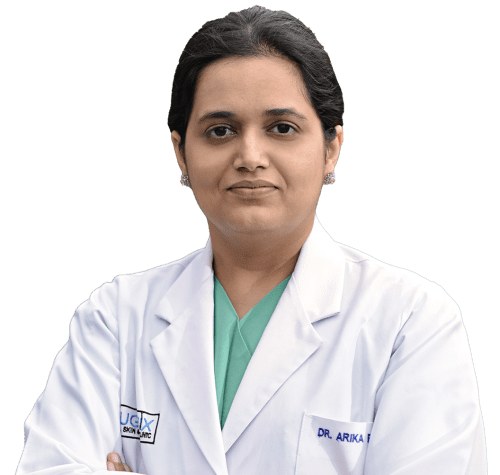
Medically reviewed by Dr. Arika Bansal, Co-Founder, Eugenix Hair Sciences; MBBS, MD Dermatology, Fellow of ISHRS; Reg. No. HN-34095 (Haryana Medical Council).
Dr. Arika Bansal
Dr. Arika Bansal, Co-Founder, Eugenix Hair Sciences. MBBS (Gold Medallist, Lady Hardinge Medical College), MD Dermatology, alumni of AIIMS, New Delhi. Fellow of ISHRS. Reg. No. HN-34095 (Haryana Medical Council).
