

Before a hair transplant, ask who will perform each step of your procedure, the name, qualification and registration number of the doctor who leads it, and what your written plan includes: the areas, the number of grafts, the hairline and how much donor hair is kept for later. Then ask about the tests before surgery, the costs, and the aftercare and follow-up you will receive.
Choose a clinic on facts you can check: the doctor’s name, qualification and registration number, who performs each step, and the written plan. The questions below, from Eugenix Hair Sciences, help you collect those facts at your consultation.
Who will perform each step of my procedure?
A hair transplant has several steps, and it is fair to ask who does each one. In Direct Hair Transplant (DHT), the steps are:
- Planning & Designing: marking the hairline and the full recipient and donor areas
- making the slits where the grafts will be placed
- extracting the grafts from the donor area
- implanting the grafts into the slits already made
At Eugenix, the lead surgeon carries out Planning & Designing and makes all the slits. The lead surgeon performs the extraction and sets every technical parameter. The Eugenix medical team assists and carries out implantation under the lead surgeon’s parameters and supervision, using the SAVA Implanter, a no-root-touch instrument. The lead surgeon supervises your procedure throughout, taking rounds between active steps and remaining available at all times during your surgery.
What is the doctor’s name, qualification and registration number?
Under Indian law, a doctor must be enrolled in a State Register or the National Register to practise medicine. Ask for the name of the doctor who will lead your procedure, the doctor’s qualification and the registration number with the council that issued it. You can then check these details yourself on the Indian Medical Register on the National Medical Commission’s website.
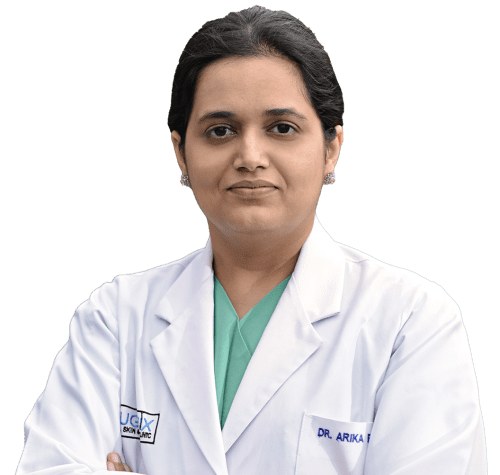
As an example, a registration line looks like this: Dr. Arika Bansal, MBBS, MD Dermatology, Fellow of ISHRS. Reg. No. HN-34095 (Haryana Medical Council). You can read about our doctors on Our Founders.
Am I a suitable candidate right now?
Ask whether a hair transplant suits you at this point, or whether medicines should come first. Pattern hair loss usually progresses in the 20s and 30s, and slows down from the mid-40s towards the 50s, so the doctor considers your age, how fast your hair loss is changing and the strength of your donor area. A good answer explains the reasons, not only a yes or no.
How many grafts are planned, and how much donor hair is kept for later?
Your donor area, the back and sides of your scalp, is usually less affected by pattern hair loss, but it is limited. As a guide for Indian hair, one sitting usually moves 3,000 to 4,500 grafts, and the lifetime total is about 5,000 to 8,000 grafts. Ask how many grafts are planned now, which areas they will cover, and how much donor hair is kept in case you need a second session later.
Where will my hairline sit, and why?
Ask to see your planned hairline marked before surgery. Your hairline is planned to suit your face and age, and it is planned keeping in mind how your hair loss may progress. Single-hair grafts are placed at the front of the hairline, as in a natural hairline, and grafts are placed in natural groups of 1 to 4 hairs, the way hair grows.
Which technique will be used?
Ask the name of the technique and what it involves. Eugenix performs Direct Hair Transplant (DHT), a modified FUE technique described by our Co-Founders in their 2013 research paper, which is available on PubMed Central. Grafts stay outside the body for under 30 minutes with Direct Hair Transplant, compared to 3 to 6 hours with conventional FUE. DHT is different from DHI: in DHT the slits are made first and grafts are placed into them, rather than an implanter pen making the opening and placing the graft in one step.
What tests do I need before surgery?
Ask for the list of tests and the reason for each. The standard tests are haemogram, PT INR, aPTT, RBS, HbA1c, HIV 1 and 2 antibody test (Anti-HIV), HBsAg and Anti HCV. Patients aged 40 and above also need an ECG reported by a physician or cardiologist, a blood pressure check is done for everyone, and clearance from the medicine department is required for all patients. Women need additional hormonal tests. If you take blood thinners or have had heart surgery, ask what your doctor needs to review before any change.
What does the cost include?
Ask what the quoted cost covers. The cost depends on the number of grafts planned for your case, which is decided after your scalp and donor area are assessed. Our team explains the costs in full at consultation. No Cost EMI for up to 12 months. A processing fee applies, charged by the finance provider. See hair transplant cost for more detail.
What aftercare and follow-up will I receive?
Ask what happens after you leave the clinic and who you can call. At Eugenix, your aftercare instructions are explained in person, and a short course of medicines is given, explained by the Eugenix team. Your first head wash is on Day 7, and the operating doctor holds a short video call with you on Day 8 and again at Month 1. You share photos on Day 13, Day 21 and Day 30, and then every month, and each set is reviewed. Our guide to hair transplant recovery explains the first weeks.
What results are realistic, and when?
Ask the doctor to explain the timeline. Shedding of the transplanted hairs happens in every patient in the first weeks. Transplanted hair usually starts to grow from Month 4, and full results take 10 to 12 months. No clinic should promise a result in advance, because results vary from person to person. A clear answer covers the timeline, the density you can expect in your case and whether more sessions may be needed.
A short checklist to take with you
- Who leads my procedure, and who performs each step?
- What are the doctor’s name, qualification and registration number?
- Is a transplant right for me now, or should medicines come first?
- How many grafts are planned, and how much donor hair is kept for later?
- Where will my hairline sit?
- Which tests do I need?
- What does the cost include?
- What aftercare and follow-up will I receive, and who do I contact?
Frequently Asked Questions
Is it fine to ask the doctor for their registration number?
Yes. Under Indian law, a doctor must be enrolled in a State Register or the National Register to practise medicine, and the registration number is a normal detail to ask for. Note the doctor’s name, qualification, registration number and the council that issued it. You can then check these details on the Indian Medical Register on the National Medical Commission’s website.
Should I get my hair transplant plan in writing?
Yes, it helps. A written plan lets you check the areas to be treated, the estimated number of grafts, where the hairline will sit and which tests you need. It also gives you something to compare against if you have questions later. Ask the team to explain anything in the plan you do not understand before you decide.
What should I ask about the donor area?
Ask how dense your donor area is, how many grafts can be taken safely now, and how much is kept for the future. The donor area is limited: for Indian hair, the lifetime total is about 5,000 to 8,000 grafts. Knowing this helps you understand whether a second session could be possible later if your hair loss progresses.
Can a clinic promise my result in advance?
No clinic should promise a result in advance, because results vary from person to person. What the doctor can explain is the plan, the timeline and what is realistic for your case. Transplanted hair usually starts to grow from Month 4, and full results take 10 to 12 months, with shedding of the transplanted hairs in the first weeks.
What should I ask about aftercare and follow-up?
Ask what you need to do in the first 7 days, when your first head wash is, which medicines you will take and who you can call with a concern. At Eugenix, the operating doctor holds a short video call on Day 8 and at Month 1, and you share photos on Day 13, Day 21 and Day 30, and then every month.
Should I ask about medicines alongside a hair transplant?
Yes. A transplant moves hair to thinning areas, but pattern hair loss can continue in the hair you still have. Ask whether a medicine is advised for you and why. Finasteride slows the progression of male pattern hair loss. It is not a cure, and it is taken under medical supervision, so the doctor explains whether it suits you.
Know more.
Medically reviewed by Dr. Arika Bansal, Co-Founder, Eugenix Hair Sciences; MBBS, MD Dermatology, Fellow of ISHRS; Reg. No. HN-34095 (Haryana Medical Council).
Dr. Arika Bansal
Dr. Arika Bansal, Co-Founder, Eugenix Hair Sciences. MBBS (Gold Medallist, Lady Hardinge Medical College), MD Dermatology, alumni of AIIMS, New Delhi. Fellow of ISHRS. Reg. No. HN-34095 (Haryana Medical Council).
