

At a hair transplant consultation, a doctor examines your scalp and donor area, finds the pattern and grade of your hair loss, and tells you whether a hair transplant suits you at this point. If it does, you receive a plan: the areas to be covered, an estimate of the grafts needed, the tests before surgery and the costs. Medicines are discussed too, and you can ask every question you have.
The consultation can take place in person at a hair transplant clinic or by video call. Eugenix Hair Sciences has worked only in hair restoration since 2009, with centres in Gurugram, Mumbai, Hyderabad, Bhubaneswar and Bengaluru. This guide explains each step, so you know what to expect and what to bring.
What happens before the consultation?
Before you speak with the doctor, a Hair Advisor (also called a Counsellor) usually asks for clear photos of your hair and some details about your health. The photos let the doctor see the pattern of your hair loss in advance. Good photos are:
- taken from the front, the top, both sides and the back (the donor area)
- well lit, with the hair dry and no cap
- recent, so they show your hair as it is today
Poor quality photos make it hard to judge the donor area and the degree of baldness, so the team may ask you to take them again. You will also be asked about your medical conditions, the medicines you take and any earlier hair treatment.
Can I have the consultation by video?
Yes. A face-to-face consultation takes place at one of our centres. A video consultation suits patients who live far from a centre or want to understand their options before they travel. In a video consultation the doctor works from your photos and what can be seen on camera, and the same questions about your health and hair loss are covered.
What does the doctor check during the consultation?
Your hair loss history
The doctor asks when your hair loss started, how quickly it has changed, whether you have a family history of hair loss, and what you have already tried. Pattern hair loss usually progresses in the 20s and 30s, and slows down from the mid-40s towards the 50s, so your age and the speed of change matter when the plan is made.
Your scalp
The doctor looks at where the hair is thinning, how much existing hair and hair density remain in the area, and whether there is any scalp condition that needs to be treated first.
Your donor area
The donor area is the back and sides of your scalp, which is usually less affected by pattern hair loss. The doctor checks the density of your donor hair, because it decides how many grafts can be moved safely now and how many should be kept for the future. As a guide for Indian hair, one sitting usually moves 3,000 to 4,500 grafts, and the lifetime total is about 5,000 to 8,000 grafts.
Your general health
You will be asked about bleeding or clotting problems, high blood pressure, diabetes, heart conditions, drug allergies, past heart surgery, blood thinners and supplements such as vitamin E. These details decide which tests you need and whether any medicine has to be reviewed before surgery.
How is my hair loss grade decided?
Hair loss in men, often called male pattern baldness, is graded on the Norwood scale, from a receding hairline in the early grades to a larger bald area in the higher grades. Hair loss in women is graded on the Ludwig scale. The doctor also divides the bald area into zones: the front, the mid-scalp and the crown. Your grade and these zones show how many grafts each area needs, and which areas come first when donor hair is limited.
Will the doctor tell me if I need a hair transplant?
Yes. The consultation can end in more than one way, and each is a medical decision:
- A hair transplant is suitable, and the doctor explains your plan.
- The donor area is limited, so medicines may be suggested first.
- The thinning is spread across the scalp, so medicines may be advised before any surgery is considered.
- A scalp condition is found, and it is treated first.
- A transplant is not needed now, and medicines to slow the hair loss may be advised.
Finasteride slows the progression of male pattern hair loss. It is not a cure, and it is taken under medical supervision. The doctor explains whether any medicine suits you and why.
What is in the hair transplant plan?
If a hair transplant suits you, the doctor explains the plan in clear terms:
- the areas to be treated, and which come first
- the estimated number of grafts, and how much donor hair is kept for later
- where your hairline will sit: your hairline is planned to suit your face and age, keeping in mind how your hair loss may progress
- the technique: Eugenix performs Direct Hair Transplant (DHT), a modified FUE technique described by our Co-Founders in their 2013 research paper
- the tests needed before surgery
The standard tests before hair transplant surgery are haemogram, PT INR, aPTT, RBS, HbA1c, HIV 1 and 2 antibody test (Anti-HIV), HBsAg and Anti HCV. Patients aged 40 and above also need an ECG reported by a physician or cardiologist, and a blood pressure check is done for everyone. Clearance from the medicine department is required for all patients, and women need additional hormonal tests.
The doctor also explains what to expect afterwards. The procedure is performed under local anaesthesia, recovery usually takes about 7 days, transplanted hair usually starts to grow from Month 4, and full results take 10 to 12 months. To see how the graft estimate is worked out, read how grafts are calculated for a hair transplant. The 2013 DHT paper is available on PubMed Central.
How are costs explained at the consultation?
The cost depends on the number of grafts planned for your case, which is decided after your scalp and donor area are assessed. Our team explains the costs in full at consultation. No Cost EMI for up to 12 months. A processing fee applies, charged by the finance provider. For more detail, see our page on hair transplant cost.
What questions should I ask at the consultation?
Write your questions down before you start. Useful ones include:
- Who leads my procedure, and what are the doctor’s name, qualification and registration number?
- How many grafts are planned now, and how much donor hair is kept for the future?
- Where will my hairline sit, and why?
- Which medicines do you suggest alongside, and for how long?
- Which tests do I need, and where can I have them done?
- What does aftercare involve, and who do I contact after surgery?
To understand the role of the doctor at each step, read about our doctor-led hair transplant.
What should I bring to the consultation?
Bring photos of your hair from earlier years if you have them, a list of your current medicines, any recent blood reports, and details of earlier hair treatments or procedures. If you have a medical condition, bring the latest notes from your doctor.
What happens after the consultation?
Take your time. No decision is expected on the day. Your Hair Advisor remains your point of contact and can answer follow-up questions. If you decide to go ahead, the team helps you with the tests and the procedure date, and your aftercare is explained in person before the procedure.
Frequently Asked Questions
Can I have a hair transplant consultation by video?
Yes. A video consultation suits patients who live far from a centre or want to understand their options before they travel. You share clear photos of the front, top, sides and back of your scalp first, and the doctor works from these photos and what can be seen on camera. Your health history, hair loss grade and possible plan are discussed in the same way as in person.
What photos should I send before the consultation?
Send clear, well-lit photos from the front, the top, both sides and the back of your head, with your hair dry and no cap. The back view shows your donor area, which matters for planning. If you have older photos from before your hair loss started, share those too. Poor quality photos may need to be taken again before the doctor can assess them.
Will I know how many grafts I need after the consultation?
You will receive an estimate. It depends on your hair loss grade, the areas to be covered and the density of your donor area. As a guide for Indian hair, one sitting usually moves 3,000 to 4,500 grafts, and Grade 6 and 7 hair loss usually needs 7,000 to 9,000 grafts, often over more than one session.
Are hair transplant costs explained at the consultation?
Yes. The cost depends on the number of grafts planned for your case, which is decided after your scalp and donor area are assessed. Our team explains the costs in full at consultation, including what is covered. No Cost EMI for up to 12 months. A processing fee applies, charged by the finance provider.
What if the doctor says I do not need a hair transplant yet?
That can happen. If your donor area is limited, your thinning is spread across the scalp, a scalp condition needs treatment first, or a transplant is not needed now, the doctor may suggest medicines to slow your hair loss and a review later. The decision is based on your assessment and your health, not on a target number of grafts.
Do I have to decide on the day of the consultation?
No. You can take time to think about the plan, the tests and the costs. Your Hair Advisor remains your point of contact and can answer any follow-up questions. If you decide to go ahead later, the team helps you with the tests before surgery and with fixing a procedure date that suits you.
Know more.
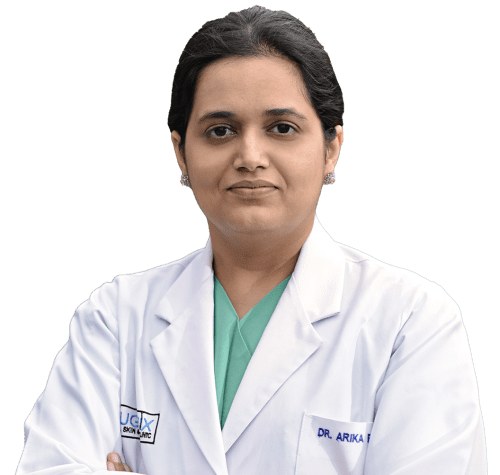
Medically reviewed by Dr. Arika Bansal, Co-Founder, Eugenix Hair Sciences; MBBS, MD Dermatology, Fellow of ISHRS; Reg. No. HN-34095 (Haryana Medical Council).
Dr. Arika Bansal
Dr. Arika Bansal, Co-Founder, Eugenix Hair Sciences. MBBS (Gold Medallist, Lady Hardinge Medical College), MD Dermatology, alumni of AIIMS, New Delhi. Fellow of ISHRS. Reg. No. HN-34095 (Haryana Medical Council).
