
Most patients planning a hair transplant focus almost entirely on the front of the scalp. What receives far less attention is the back of the head, specifically the hair transplant donor area from which all grafts are taken. Understanding how this area heals, what donor area scars look like across different techniques, and how to care for it properly is essential before committing to hair restoration surgery.
This article covers donor area healing in detail: a day-by-day guide, a comparison of scarring across hair transplant methods, care instructions, long-term appearance, and answers to the most common questions patients ask after their procedure.
What Is the Hair Transplant Donor Area?
The Permanent Zone
The hair transplant donor area refers to the back and sides of the scalp, typically spanning from the temples to the lower occipital region. Hair follicles in this zone are genetically resistant to dihydrotestosterone (DHT), the hormone responsible for genetic hair loss. Because these hair follicles are not programmed to miniaturise, donor hair extracted from this permanent zone retains its resistance even after being moved to balding areas. This is why hair restoration surgery using follicles from the safe donor area delivers long-lasting, natural-looking results.
The quality, density, and size of the hair transplant donor area directly determine the available graft supply and the longevity of transplant results. A high-quality donor area with good hair density enables skilled surgeons to achieve denser packing, resulting in a more natural appearance after the hair transplant procedure.
How Many Grafts Can the Donor Area Provide?
On average, a healthy scalp donor area can yield between 5,000-8,000 hair grafts in Asians/Indians and between 6,000-9,000 hair grafts in Caucasians in lifetime period for transplantation, depending on individual characteristics including scalp laxity, hair calibre, and donor density. An experienced surgeon assesses the donor site thoroughly during Contact Us to determine how many grafts are available and how to distribute the extraction to avoid visible thinning.
Overharvesting is a significant risk in hair transplantation. If too many follicles are removed from the donor area, the result can be an unnatural-looking donor site that depletes healthy hair follicles available for future procedures. Skilled surgeons at a reputable hair transplant clinic always prioritise sustainable extraction over aggressive yield.
Donor Area Healing: A Week-by-Week Guide
Days 1 to 7
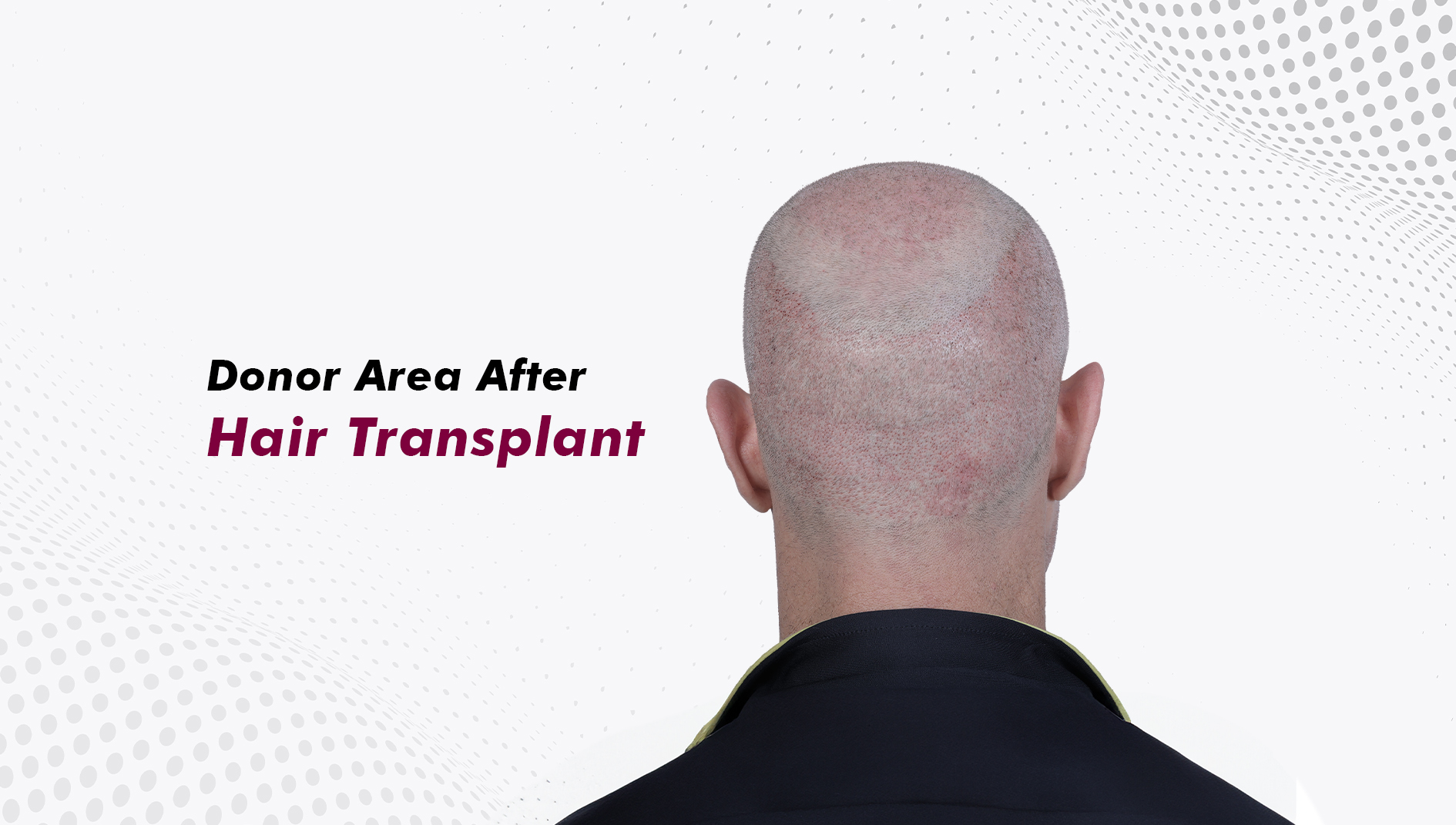
Donor area healing after a hair transplant begins immediately following the procedure. Within 24 to 48 hours, tiny red dots appear at extraction points where individual hair follicles were removed. Micro-wounds begin to scab over during this period, which is a normal part of the healing process.
Day 1 involves some yellowish or pinkish serum oozing from the donor site, which is completely normal. Cleaning begins on day one with Betadine solution applied to the donor area, followed by Mupirocin ointment to prevent infection. The donor site is left open with no bandage required.
By Day 5, the donor area is nearly fully healed for most patients. The extraction points have closed and the skin has largely recovered. The first week ends with the Day 7 head wash, which uses a gentle shampoo and a careful technique to loosen any remaining scabs without disturbing the transplanted hair follicles.
Weeks 2 to 8
Proper care during the first two weeks is crucial for minimising irritation and ensuring optimal donor area healing. After a hair transplant using DHT or FUE, the donor area typically looks normal within one month. Residual redness fades over a few months, and surrounding donor hair fills in the extraction points. New hair growth in adjacent areas further supports a natural-looking outcome.
Donor Area Scars: FUT, FUE, and DHT Compared
The hair transplant technique used has a significant difference on what the donor area looks like after the procedure.
Follicular Unit Extraction (FUE) is a minimally invasive hair transplant technique that extracts individual hair follicles using a micro-punch tool. There is no linear scar: each extraction point heals as a tiny white dot. These dot scars are invisible to the naked eye at normal hair lengths, resulting in minimal scarring and faster healing compared to FUT.
Direct Hair Transplant (DHT) is Eugenix’s advanced technique and an evolution of FUE. As an experienced hair transplant surgeon extracts individual hair follicles, they are implanted simultaneously rather than stored outside the body. This reduces out-of-body time to under 30 minutes, compared to 3 to 6 hours in standard FUE, approaching 100% graft survival. The donor area scars are identical to FUE: tiny dot scars with no visible scarring at normal hair lengths. For patients concerned about donor area scarring, both FUE and DHT minimise scarring to the smallest clinically possible footprint.
Distributing extractions evenly across the hair transplant donor area through advanced techniques prevents visible thinning in any one zone and is a defining feature of how skilled surgeons perform hair transplants at Eugenix.
How to Care for the Donor Area After a Hair Transplant
First Week Care Routine
Post operative care for the donor site is straightforward. Clean the donor area once daily with Betadine solution, then apply Mupirocin ointment. If beard extraction was also performed as part of the hair transplant surgery, apply the same routine to the beard donor site. Use a gentle shampoo from Day 7 onwards following your surgeon’s instructions.
Avoid strenuous activity for one week after the hair transplant. Avoid direct sun on the scalp for one week. Avoid smoking for a minimum of one week and alcohol for at least one week, as both impair circulation and slow donor area recovery.
Pain Management After a Hair Transplant
The donor area can feel tender and sore in the first two to three days after hair transplant surgery. Pain management after the procedure involves SignoFlam, an anti-inflammatory and painkiller taken twice daily after food for seven days. An antibiotic (Augmentin 625mg, twice daily) and a probiotic (BIFILAC, taken twice daily) are prescribed alongside it. Pantop is taken once daily before breakfast as an antacid. Proper adherence to these prescriptions significantly supports donor area healing and controls discomfort during the first week.
Long-Term Appearance of the Donor Area
With proper technique and proper care, the hair transplant donor area returns to a near-normal appearance within six to eight weeks. Homogeneous extraction, where skilled surgeons distribute hair grafts evenly across the donor area in a zigzag pattern, prevents patchy visible thinning. The lower border of the extraction zone is also shaped in a zigzag to camouflage the boundary between extracted and non-extracted scalp hair.
Patients planning to keep hair very short after a hair transplant should know that donor hair density will be reduced, and slight visible thinning may be noticeable at very short lengths. Keeping back hair at 0.7 to 1 centimetre minimum is recommended. Scalp Micropigmentation (SMP) is available from around six weeks post-procedure for patients who want additional camouflage.
A second extraction from the same donor region is possible after a minimum two-month gap. The lifetime supply of donor hair from the scalp is finite, and a successful hair transplant plan always accounts for future needs.
Body Hair as an Additional Donor Source
For patients where the scalp donor area alone is insufficient, Eugenix incorporates beard and body hair as a supplementary donor source. Beard hair is the most compatible body hair with scalp hair, with an 80 to 88% survivability rate in a healthy donor and a lifetime capacity of 3,000 to 5,000 grafts. Chest hair is used for more complex cases. Some clinics reference pubic hair as a potential donor source in hair transplantation, but Eugenix focuses exclusively on scalp and beard donor hair and uses body hair from the chest or other parts of the body when baldness is at an advanced stage and the scalp and beard donor supply is not sufficient to cover the area.
Frequently Asked Questions
Why does the donor area hurt after a hair transplant?
The donor area hurts after a hair transplant because small incisions are made at each extraction point to remove individual hair follicles from the scalp. Soreness, tightness, and sensitivity at the donor site in the first two to three days are a normal part of the healing process. Most patients find the discomfort manageable with prescribed pain medication and it resolves within the first week.
How can I heal the donor area faster?
Follow your surgeon’s instructions precisely during the first week. Keep the donor site clean with the prescribed Betadine and Mupirocin protocol, avoid smoking, and avoid strenuous activity for two weeks. DHT and FUE both support faster healing due to the nature of the small incisions involved.
What painkillers are given after a hair transplant?
At Eugenix, SignoFlam is the prescribed painkiller after a hair transplant procedure, taken twice daily after food for seven days. It combines anti-inflammatory and analgesic action to manage donor area discomfort effectively during the healing period.
Why choose Eugenix for donor area management?
Eugenix performs all hair transplants using the Direct Hair Transplant (DHT) technique, developed and published by the founders in a peer-reviewed journal in 2013. Both founders are Fellows of the International Society of Hair Restoration Surgery (ISHRS) and bring over 30 years of combined experience to every hair transplant. The Eugenix eCare team provides ongoing support throughout donor area recovery and beyond.
To understand how your hair transplant donor area can be assessed and how many grafts are available for your hair restoration, book a Contact Us with the Eugenix team today.
Dr. Arika Bansal
Dr. Arika Bansal, Co-Founder, Eugenix Hair Sciences. MBBS (Gold Medallist, Lady Hardinge Medical College), MD Dermatology, alumni of AIIMS, New Delhi. Fellow of ISHRS. Reg. No. HN-34095 (Haryana Medical Council).