

DHI and DHT are two ways of carrying out a hair transplant based on follicular unit extraction (FUE), and the main difference lies in how the grafts are placed. DHT is different from DHI: in DHT the slits are made first and grafts are placed into them, rather than an implanter pen making the opening and placing the graft in one step. Neither name on its own decides a result: the right plan depends on your hair loss and your donor area, and it is decided at consultation.
Eugenix Hair Sciences performs Direct Hair Transplant (DHT) only. We do not perform DHI, conventional FUE or FUT. This guide explains both techniques factually, so you can understand the terms and ask the right questions.
What is Direct Hair Transplant (DHT)?
Direct Hair Transplant (DHT) is a modified FUE technique described by Eugenix Hair Sciences’ Co-Founders in their 2013 research paper, “Direct hair transplantation: a modified follicular unit extraction technique”, published in the Journal of Cutaneous and Aesthetic Surgery (read the paper).
The steps in a DHT hair transplant
- Planning & Designing by the lead surgeon, including marking of the complete recipient and donor area.
- All the slits made by the lead surgeon, who sets the angle, depth, density and direction for the grafts.
- Extraction by the lead surgeon, assisted by the Eugenix medical team.
- Implantation by the Eugenix medical team at the same time, into the slits already made, using the SAVA Implanter, a no-root-touch instrument. The graft stays visible throughout and is placed into the slit that is already made.
Grafts stay outside the body for under 30 minutes with Direct Hair Transplant, compared to 3 to 6 hours with conventional FUE.
The lead surgeon performs the extraction and sets every technical parameter. The Eugenix medical team assists and carries out implantation under the lead surgeon’s parameters and supervision, using the SAVA Implanter, a no-root-touch instrument. The lead surgeon supervises your procedure throughout, taking rounds between active steps and remaining available at all times during your surgery.
What is Direct Hair Implantation (DHI)?
Direct Hair Implantation (DHI) is a name used for an FUE method in which grafts are loaded into a pen-shaped implanter. The implanter pen is pressed into the scalp, making the opening and placing the graft in the same movement, so no separate pre-made incisions are used in the implantation process. Individual hair follicles are extracted from the donor area one by one, as in other FUE methods, and the extracted follicles are then loaded into the pen. Who uses the pen and how the work is divided can vary from clinic to clinic, so it is worth asking.
What are the key differences between DHI and DHT hair transplant techniques?
- The main difference, the order of steps: in DHT, all the slits are made first and grafts are then placed into them; in DHI, the pen makes the opening and places the graft in one step.
- Instrument for placing grafts: in DHT at Eugenix, the SAVA Implanter places each graft into a slit already made; in DHI, an implanter pen is used.
- When angle and direction are set: in DHT, the lead surgeon sets them while making all the slits, before implantation starts; in DHI, they are set as each graft is placed with the pen.
- What is the same: both are based on follicular unit extraction, and both move your own hair from the donor area at the back and sides of the scalp. Neither involves cutting out a strip of skin, as FUT does.
Which is better, DHI or DHT?
There is no single answer that fits everyone, and no clinic should promise a result in advance. What shapes a result is largely the same whichever technique name is used: how much donor hair you have, how far your hair loss has progressed and may progress, how the hairline is designed, how carefully the grafts are handled, and how the procedure is supervised.
So rather than comparing names, look at the plan. At consultation, the doctor examines your scalp and donor area, looks at your hair loss pattern and existing hair, discusses how your hair loss may progress and explains the number of grafts planned, so you can make an informed decision. Your hairline is planned to suit your face and age. Results vary from person to person.
Questions to ask the medical team at consultation
- Who plans the hairline and makes the slits?
- Who extracts the grafts, and who places them?
- How long do the grafts stay outside the body?
- How is donor hair kept in reserve for future needs?
- Who supervises the procedure from start to finish?
Does the hair transplant technique change the cost or the recovery time?
The cost depends on the number of grafts planned for your case, which is decided after your scalp and donor area are assessed. Our team explains the costs in full at consultation.
The procedure is performed under local anaesthesia. Recovery after a hair transplant usually takes about 7 days, with the first head wash on Day 7. Transplanted hair usually starts to grow from Month 4. Full results take 10 to 12 months. To plan the day itself, read how long a hair transplant takes on the day.
A note on the name DHT
DHT is also a common short form for dihydrotestosterone, the hormone linked to pattern hair loss. On this page, DHT always means Direct Hair Transplant. For more on technique names, read our guide to branded hair transplant technique names and our page on Direct Hair Transplant.
Eugenix Hair Sciences has worked only in hair restoration since 2009, with centres in Gurugram, Mumbai, Hyderabad, Bhubaneswar and Bengaluru. Founded by Dermatologists, alumni of AIIMS, New Delhi, and Fellows of ISHRS.
Key points
- DHI and DHT are both based on follicular unit extraction.
- In DHT, the slits are made first; in DHI, a pen makes the opening and places the graft in one step.
- Eugenix performs DHT only.
- Your hair loss and donor area, not the technique name, decide the plan.
Know more about Direct Hair Transplant by speaking to our team.
Frequently asked questions
What is the difference between DHI and DHT?
The main difference is the order of steps. DHT is different from DHI: in DHT the slits are made first and grafts are placed into them, rather than an implanter pen making the opening and placing the graft in one step. Both are based on follicular unit extraction, and both use your own hair from the donor area at the back and sides of the scalp. Eugenix Hair Sciences performs DHT only.
Is DHI better than DHT?
Neither technique name decides a result on its own. A result depends mainly on your donor hair, how far your hair loss has progressed, the hairline design, graft handling and supervision. No clinic should promise a result in advance. At consultation, the doctor examines your scalp and donor area and explains the plan that suits your hair loss.
Does Eugenix perform DHI?
No. Eugenix Hair Sciences performs Direct Hair Transplant (DHT) only, a modified FUE technique described by our Co-Founders in their 2013 research paper. We do not perform DHI, conventional FUE or FUT. In DHT, the lead surgeon makes all the slits first, and the Eugenix medical team places the grafts into them using the SAVA Implanter, a no-root-touch instrument.
How long do grafts stay outside the body in DHT?
Grafts stay outside the body for under 30 minutes with Direct Hair Transplant, compared to 3 to 6 hours with conventional FUE. This is possible because extraction and implantation happen at the same time, and each graft is placed into a slit that the lead surgeon has already made. Your doctor explains the full procedure day at consultation.
Is a DHT hair transplant the same as the DHT hormone?
No. Direct Hair Transplant (DHT) is a hair transplant technique. The DHT hormone is dihydrotestosterone, which is linked to pattern hair loss. The two only share a short form. On our pages about the technique, DHT means Direct Hair Transplant, and the hormone is written out in full wherever it is discussed.
Does the technique change the cost of a hair transplant?
The cost depends on the number of grafts planned for your case, which is decided after your scalp and donor area are assessed. Our team explains the costs in full at consultation. When you compare plans, look at the number of grafts, who does each step and what is included, rather than the technique name alone.
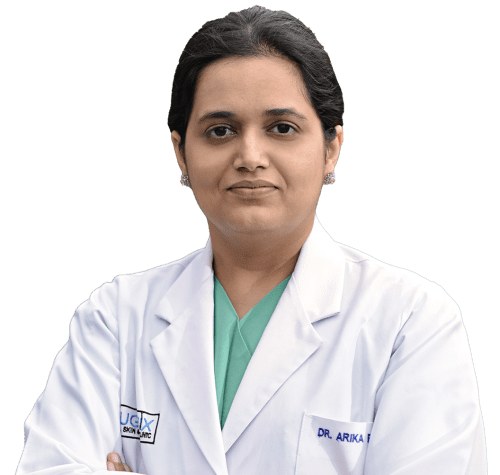
Medically reviewed by Dr. Arika Bansal, Co-Founder, Eugenix Hair Sciences; MBBS, MD Dermatology, Fellow of ISHRS; Reg. No. HN-34095 (Haryana Medical Council).
Dr. Arika Bansal
Dr. Arika Bansal, Co-Founder, Eugenix Hair Sciences. MBBS (Gold Medallist, Lady Hardinge Medical College), MD Dermatology, alumni of AIIMS, New Delhi. Fellow of ISHRS. Reg. No. HN-34095 (Haryana Medical Council).
