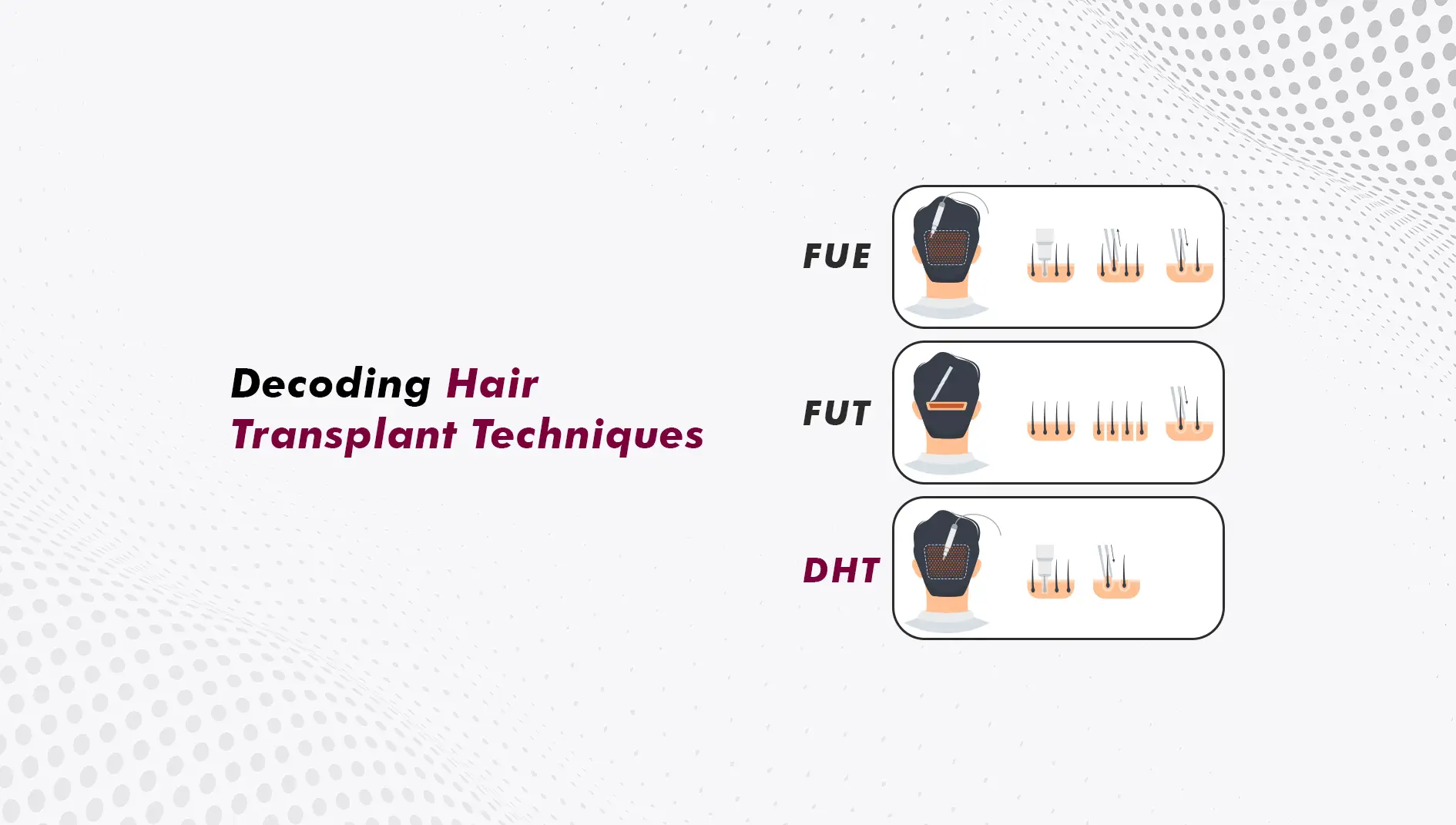

If you have spent a few evenings researching hair restoration, you have probably collected a small vocabulary of technique names. QHT hair transplant, Bio-FUE, Sapphire, DHI, DHT. Each is presented as newer or more advanced than the last, and each seems to promise something the others cannot deliver. It is confusing by design, and it leaves most patients choosing between labels rather than between clinics.
Here is the honest starting point. Almost every hair transplant method marketed today is a variation of one underlying surgery: follicular unit extraction, or FUE. What changes between the branded names is usually a single stage: the tool used to make the recipient sites, the way grafts are placed, or an add-on therapy. Occasionally it is nothing more than a name a clinic has attached to its own workflow.
This guide decodes each term and shows what actually determines your hair transplant results.
Why there are so many hair transplant technique names
From strip surgery to FUE
Modern hair transplantation began with strip surgery, known as FUT, in which a strip of scalp tissue was removed and dissected into grafts. It left a permanent linear scar. Eugenix does not perform FUT. It is mentioned only because it is the starting point of the timeline that produced everything else.
FUE replaced it. Individual hair follicles are removed one by one from the safe donor zone using a small circular punch, leaving minimal scarring beyond tiny dot marks invisible to the naked eye. FUE became the global default for hair transplant surgery, and almost every technique name you now see in advertising is a refinement of one step within it.
Where the branding began
Refining a step is legitimate and often valuable. Presenting that refinement as an entirely new category of surgery is where confusion starts. A hair transplant clinic that improves how it handles grafts has done something real. One that trademarks that improvement and markets it as a different operation has done something else.
QHT hair transplant: what the name describes
The idea behind the name
QHT stands for Quick Hair Transplant. It is a clinic-branded label rather than a recognised surgical category, and it describes an FUE-based workflow built around speed.
The idea underneath the QHT hair transplant name is sound, because time matters. Every minute a graft spends outside the body is a minute of drying, oxygen deprivation and handling. Traditional hair restoration methods often store grafts for several hours before placement, so simultaneous extraction and placement is a genuine improvement wherever it is practised.
What the name does not tell you
What the label does not tell you is how that reduction is achieved, who performs each step, or what the actual out-of-body time is. Two clinics can use the same term and run very different operating theatres.
So the useful question is never whether a hair transplant clinic offers a QHT hair transplant. It is what the measured out-of-body time is, who designs the plan, and who is accountable. The same test applies to every branded name below.
Bio-FUE: standard FUE with a biological add-on
What PRP and GFC actually do
Bio-FUE describes FUE performed alongside a regenerative therapy, usually platelet rich plasma (PRP) or growth factor concentrate (GFC). Both are prepared from your own blood and applied to the scalp around the time of the hair transplant treatment.
The surgery is unchanged. Extraction, site creation and implantation are all standard FUE. What has been added is a biological adjunct intended to support healing and strengthen thinning hair around the treated zone. At Eugenix, intraoperative PRP is used because it helps reduce the risk of shock loss to existing hair.
What a biological add-on cannot fix
Keep this in proportion. PRP and GFC come from your own blood, are not FDA approved for hair restoration, and their benefit is not permanent without maintenance sessions. Growth factors cannot compensate for a weak surgical plan, poor donor management or badly angled recipient sites. If the hair transplant underneath is average, the add-on will not make it a successful hair transplant.
Sapphire: a blade material, not a new procedure
Sapphire refers to the material of the blade used to create the recipient sites, typically in widths between 0.6 mm and 0.8 mm, instead of conventional steel.
Does the blade change your result
This is an instrument difference and nothing more. Extraction is unchanged, implantation is unchanged, planning is unchanged. Sapphire FUE is standard FUE with a different tool at one stage.
Eugenix has sapphire tips available and does not prefer to use them. They are offered to patients who specifically request them, most often patients familiar with clinics abroad where sapphire branding is heavily marketed. What determines whether a graft survives and whether new hair grows at a natural angle is the architecture of the site and how the graft is handled, not the crystal the blade is cut from.
DHI: implantation through a pen
DHI stands for direct hair implantation. Grafts are loaded into a pen-type implanter and placed into the scalp without recipient sites being created in advance. The implanter makes the opening and delivers the graft in one action.
The trade-off inside the pen
The plunger inside the pen pushes the graft down blindly, carrying a risk of the graft being compressed or the root bending on entry. Because sites are not made in advance, the surgeon has less opportunity to design the recipient architecture as a whole before any graft is placed.
DHI and DHT are not the same thing.
The acronyms are separated by a single letter and are constantly confused, including in advertising. They describe different approaches to the same stage of surgery.
DHT: the modification that addressed out-of-body time
DHT, or Direct Hair Transplant, is the technique developed and published by the Eugenix founding surgeons. It is a modified FUE, and the modification is specific: extraction and implantation happen simultaneously, so a graft enters a pre-made recipient slit almost as soon as it is removed.
In standard FUE, grafts can remain outside the body for 3 to 6 hours while harvesting is completed. Under DHT, out-of-body time is held under 30 minutes. Less time outside the body means less desiccation, less deoxygenation and less handling, which supports high graft survival.
Published, not patented
The technique was published in 2013 in the Journal of Cutaneous and Aesthetic Surgery and is indexed on PubMed as “Direct hair transplantation: a modified follicular unit extraction technique. ” A separate 2019 paper, indexed as PMC6967169, examined the use of implanters in premade sites.
DHT is deliberately not patented and is not proprietary. The founding surgeons chose to publish rather than protect it so the wider hair restoration community could adopt it. That is the opposite instinct to trademarking a workflow.
The SAVA Implanter
Placement under DHT uses the SAVA Implanter (no-root-touch): the graft is visible throughout, and it is inserted smoothly into a pre-made slit without a plunger-based blind push. That is a difference in graft handling rather than in marketing.
Who does what during your procedure?
Lead surgeon responsibilities
– Planning and designing, including hairline design, donor assessment and graft estimation
– Creating the recipient slits hands-on using the coronal slit technique
– Setting every technical parameter, including punch size, angle, depth and density, following the ADDD principle of Angle, Depth, Density and Direction or Design
– Supervising the procedure throughout
[H3] Senior the Eugenix medical team responsibilities
– Scoring and punching
– Extraction of the grafts
– Implantation using the SAVA Implanter
This is carried out to the lead surgeon’s parameters and under the lead surgeon’s supervision. The lead surgeon supervises your procedure throughout, taking rounds between active steps and remaining available at all times during your surgery. Accountability sits with the lead surgeon and with Eugenix as an institution.
Any hair transplant clinic can put a technique name on its website. What you want to know is who designs your hairline and who answers for the outcome.
What actually determines your hair transplant results
Donor management
Donor hair is finite. How much is used now and how much is preserved for future hair loss is the decision that most often separates a good long-term result from a difficult one. Male pattern hair loss is progressive, so a plan built only around today’s bald patches is incomplete.
Density and what is realistic
Post-transplant hair density is approximately 50% of your natural original density. That is normal, and it is what allows coverage to look natural rather than artificially uniform. The hairline zone is planned at roughly 35 to 45 grafts per square centimetre, the mid-scalp and crown at roughly 25 to 35. Any clinic promising full restoration of original density is promising more than the donor area can support.
Hairline design
A natural hairline is irregular and softer at the front, built with single healthy hair follicles in the leading rows and multi-hair grafts behind them. That is what makes a corrected receding hairline blend seamlessly rather than sit on the forehead like a drawn line.
What “permanent” actually covers
Donor hair resists the hormone that drives pattern hair loss and keeps that resistance once moved, so transplanted hair grows, is cut and washed like normal hair, and gives permanent results in the treated zone. What is not permanent is the native hair around it, which can keep thinning. A clinic calling a hair transplant a permanent solution without explaining that distinction is giving you half the picture.
Recovery and the growth timeline
Recovery is broadly similar across FUE-based techniques. Gentle walking, office work and household tasks resume the day after the hair transplant, and most patients return to work after 7 days, with the first head wash on Day 7.
The growth timeline is where branded claims most often overreach. Transplanted hair sheds between 30 and 90 days, which is expected. Initial natural growth begins around Month 4, results become visible between Month 6 and Month 8, and final results appear at 10 to 12 months, with the crown taking 12 to 15 months. Anyone promising a full head of new hair in a couple of months is not describing biology.
What a hair transplant costs, and why the technique name is not the driver
Hair transplant cost depends on the number of grafts required, the donor sources used, and the package and centre chosen, not on which acronym appears on the brochure.
A proper Contact Us should produce an itemised quote covering grafts, procedure, medication and follow-up, with clear packages and no hidden costs. Unclear billing at the enquiry stage tends to predict unclear billing later, and because graft requirements vary so widely, no responsible clinic can quote a meaningful figure before assessing your scalp.
Questions worth asking at any clinic
– What is the actual out-of-body time for my grafts?
– Who creates my recipient sites, and who sets the punch size, angle, depth and density?
– How many grafts are planned now, and how much donor reserve remains for future loss?
– What hair density can I realistically expect in the hairline and in the crown?
– What happens if my hair loss continues after the procedure?
– What exactly is included in the quoted cost?
Any clinic confident in its work answers these directly. A clinic that redirects to a technique name is answering a different question. This is how you separate the hair transplant clinic for you from the one with the advertising, and it is the most useful hour you can spend before making an informed decision.
Why patients choose Eugenix
Technique
Eugenix performs DHT only, the technique its founding surgeons developed, published and have refined across more than 15 years and over 22,000 procedures. At Eugenix, major complications are exceptionally rare, supported by that clinical volume.
Credentials and accreditation
Both Co-Founders, Dr. Arika Bansal and Dr. Pradeep Sethi, are Fellows of ISHRS and alumni of AIIMS, New Delhi. Consultations and procedures are carried out by a panel of experienced surgeons, each personally handpicked and trained by the Co-Founders and working to the protocols and oversight standards the founders set. Consultations with either Co-Founder can be arranged by appointment.
The Gurgaon centre is NABH accredited under Certificate No. DE-2026-0004, valid from 12 March 2026 to 11 March 2030, against the NABH Standards for Allopathic Clinics, 2nd Edition, Dermatology Clinics Programme. NABH itself holds international ISQua accreditation.
Frequently asked questions
Is a QHT hair transplant a different surgery from FUE?
No. QHT hair transplant is a clinic-branded name for an FUE-based workflow that emphasises speed. The underlying surgery is follicular unit extraction. What differs between clinics using the term is workflow and staffing, not the category of operation.
What is the difference between DHI and DHT?
DHI places grafts using a pen-type implanter, with the plunger pushing the graft in blindly. DHT extracts and implants simultaneously into pre-made slits using a no-root-touch implanter, with the graft visible throughout and out-of-body time under 30 minutes. The names are similar. The methods are not.
Is Sapphire FUE better than a conventional blade?
Sapphire describes the blade material used to create recipient sites, a tool difference at one stage. Eugenix has sapphire tips available for patients who request them but does not prefer them, because site architecture and graft handling influence natural growth far more than blade material.
Does Bio-FUE improve hair growth?
Bio-FUE refers to FUE combined with PRP or growth factor therapy from your own blood. These can support healing and help protect existing hair from shock loss, and Eugenix uses intraoperative PRP for that reason. They are supportive additions rather than a different surgery, are not FDA approved for hair restoration, and their effect is not permanent without maintenance.
Can a hair transplant be completed in a single session?
Often, but that depends on your donor supply and the area being covered, not on the technique name. Larger areas may be staged to protect the donor zone. Graft numbers are determined by individual donor availability and clinical assessment.
Which technique should I choose?
Choose the surgical plan and the team, not the acronym. Ask who designs your hairline, who sets the parameters, how long grafts spend outside the body, and how your donor area is preserved. Those answers tell you more than any branded name.
The takeaway
QHT hair transplant, Bio-FUE, Sapphire and DHI are not competing surgeries. They are four adjustments to one procedure, and they say little about the quality of the hair transplantation you will actually receive. DHT is a genuine modification with a published, measurable difference in out-of-body time, and even that is only as good as the planning behind it.
A hair transplant is a permanent decision made once, and for most patients it is as much about self-confidence as appearance. Spend your research time on the plan, the team and the accountability.
Book a consultation today with the Eugenix team, or start with a free hair assessment, to have your donor area assessed and a realistic plan explained in plain language before you commit to anything.
Dr. Arika Bansal
Dr. Arika Bansal, Co-Founder, Eugenix Hair Sciences. MBBS (Gold Medallist, Lady Hardinge Medical College), MD Dermatology, alumni of AIIMS, New Delhi. Fellow of ISHRS. Reg. No. HN-34095 (Haryana Medical Council).