

At Eugenix, a hair transplant procedure day usually runs about 8 to 12 hours, from the checks on arrival to the aftercare briefing at the end, with breaks for lunch, coffee and the washroom. The exact time depends mainly on the number of grafts planned for your case, and also on whether the procedure is trim or non-trim and which donor areas are used. You go through it awake, under local anaesthesia.
This guide from Eugenix Hair Sciences walks through the day in order and explains what makes one procedure longer than another.
How long does a hair transplant take?
A hair transplant at Eugenix usually takes a full procedure day of about 8 to 12 hours, so plan for the entire day. That procedure duration covers everything: the checks and photographs on arrival, Planning & Designing with the lead surgeon, the preparation before you enter the operating theatre, the procedure itself, breaks, and the aftercare briefing before you leave. The steps before the operating theatre usually take about 1 to 1.5 hours.
The E-Care team confirms your reporting time before the day. For larger sessions in advanced hair loss, the work may be planned over more than one day.
What happens on the day, step by step?
The day follows a set order, so that every check is complete before the surgery starts.
- Photographs of your scalp are taken before anything begins.
- A nurse checks your blood pressure, oxygen level and pulse, and does a small skin test on your forearm for sensitivity to the local anaesthetic. You sign the general consent form.
- Planning & Designing: the lead surgeon plans and marks the hairline and the complete recipient and donor areas on your scalp.
- Photographs are taken of the markings from all angles, and the plan is explained to you on a screen, including the hairline position, temples and shape. You sign a consent for the markings.
- You are given the first dose of your post-operative medicines.
- For a trim procedure, your hair is trimmed, and photographs are taken again.
- Your scalp is cleaned with an antiseptic shampoo.
- In the operating theatre, local anaesthesia is given, and the Direct Hair Transplant procedure is performed.
- Photographs are taken after the procedure.
- You receive a 7-day medicine pack, and the E-Care team explains your aftercare before you leave.
Your hairline is planned to suit your face and age, and keeping in mind how your hair loss may progress.
What happens inside the operating theatre?
Inside the operating theatre, Eugenix performs Direct Hair Transplant (DHT). Direct Hair Transplant (DHT) is a modified FUE technique described by Eugenix Hair Sciences’ Co-Founders in their 2013 research paper, “Direct hair transplantation: a modified follicular unit extraction technique“, published in the Journal of Cutaneous and Aesthetic Surgery.
DHT changes the order of the steps compared with other hair transplant techniques. The DHT sequence is:
- Planning & Designing by the lead surgeon, done before you enter.
- Recipient site creation: all slits made by the lead surgeon in the recipient area, using coronal slits.
- Graft extraction: the grafts are extracted individually from the donor area by the lead surgeon, assisted by the Eugenix medical team.
- Graft implantation by the Eugenix medical team at the same time, using the SAVA Implanter, a no-root-touch instrument, into the slits already made. The graft stays visible throughout and is placed into the slit that is already made.
The lead surgeon performs the extraction and sets every technical parameter. The Eugenix medical team assists and carries out implantation under the lead surgeon’s parameters and supervision, using the SAVA Implanter, a no-root-touch instrument. The lead surgeon supervises your procedure throughout, taking rounds between active steps and remaining available at all times during your surgery.
Grafts stay outside the body for under 30 minutes with Direct Hair Transplant, compared to 3 to 6 hours with conventional FUE. This is about how long each graft spends outside the body, which matters for graft viability, not how long the whole procedure takes. Eugenix does not perform follicular unit transplantation (FUT), the older strip method.
DHT is different from DHI: in DHT the slits are made first and grafts are placed into them, rather than an implanter pen making the opening and placing the graft in one step.
Why does the number of grafts change the time?
The graft count is the main thing that decides how long a hair transplant takes, because individual grafts are extracted and implanted one at a time into their recipient sites. More grafts mean more extraction and more implantation.
At Eugenix, a single session usually covers 3,000 to 4,500 grafts for Indian hair, and 4,000 to 5,000 for Caucasian hair. The number planned for you is decided after your scalp and donor area are assessed. Our guide to calculating grafts explains how that number is worked out.
Advanced hair loss, Grade 6 and 7, needs 7,000 to 9,000 grafts in total, which is more than one sitting can cover. For most of these patients, coverage is planned in 2 sittings. The first sitting can run over 2 to 3 consecutive days, and the second can be done after 6 to 8 weeks.
How long do 3,000 grafts take?
A session of about 3,000 grafts falls within a single procedure day at Eugenix. There is no single hour figure that fits every patient, because the time also depends on your hair, your donor area and whether the procedure is trim or non-trim. The E-Care team shares your reporting time and plan for the day in advance.
What else affects how long the day takes?
Besides the number of grafts, a few other factors change the length of the day:
- Trim or non-trim: in a non-trim procedure, grafts are placed between your existing long hair. It needs additional skill and time from the surgical team, and it usually suits up to about 1,500 to 2,000 grafts. The donor area is still trimmed. Our guide to a hair transplant without shaving explains who it suits.
- Donor areas: when beard grafts are used alongside scalp grafts, extraction is done from more than one area.
- The areas treated: the hairline, temples, mid-scalp and crown each need their own planning.
Will I be comfortable for so many hours?
The procedure is performed under local anaesthesia, so you are awake but the treated areas are numb. The local anaesthesia is given with a fine insulin syringe, with a massager used alongside the injection to reduce discomfort. For patient comfort, you can listen to music of your choice during the surgery, and scheduled breaks for lunch, coffee and the washroom are part of the day.
What happens at the end of the day?
At the end of the day, photographs are taken, you receive a 7-day medicine pack, and the E-Care team explains your aftercare before you leave. The medicines are a short course, such as an antibiotic, a pain reliever, a probiotic, a stomach protector and an ointment for the donor area, explained in person by the Eugenix team.
The hair transplant recovery process then follows a clear routine: saline spray on the recipient area every 30 minutes to 1 hour during the day for 7 days, no spraying at night, and the first head wash on Day 7. The operating doctor holds a short video consultation with you on Day 8, after your first head wash.
How should I prepare for a long procedure day?
A few simple steps make the day easier:
- Wear a front-open shirt, not a t-shirt pulled over the head.
- Avoid hair oil on the day of the procedure.
- Complete your blood tests at least 15 days before the procedure.
- Do not trim or shave your scalp hair for at least 30 days before the procedure.
- Avoid alcohol and smoking for at least 1 week before surgery.
- Tell the team about any food, drug or other allergies.
For the full checklist, read our guide to preparing for hair transplant surgery, and for the procedure in more depth, our step-by-step guide to the hair transplant procedure.
Frequently asked questions
How many hours does a hair transplant take?
At Eugenix, a hair transplant procedure day usually runs about 8 to 12 hours, from the checks on arrival to the aftercare briefing at the end. This includes Planning & Designing with the lead surgeon, about 1 to 1.5 hours of preparation before the operating theatre, the procedure itself, and breaks for lunch, coffee and the washroom. The number of grafts planned is the main factor in the exact time.
How long do 3,000 grafts take to transplant?
A session of about 3,000 grafts falls within a single procedure day at Eugenix, which usually runs about 8 to 12 hours including preparation and breaks. The exact time also depends on your hair, your donor area and whether the procedure is trim or non-trim. The E-Care team shares your reporting time and the plan for your day in advance, so you can arrange travel and rest.
Is a hair transplant done in one day?
Most hair transplants at Eugenix are done in a single procedure day. A single sitting usually covers 3,000 to 4,500 grafts for Indian hair. Advanced hair loss, Grade 6 and 7, needs 7,000 to 9,000 grafts in total, so coverage is usually planned in 2 sittings. The first sitting can run over 2 to 3 consecutive days, and the second can follow after 6 to 8 weeks.
Am I awake during a hair transplant?
Yes. The procedure is performed under local anaesthesia, so you stay awake while the treated areas are numb. The anaesthesia is given with a fine insulin syringe, with a massager used alongside to reduce discomfort. You can listen to music of your choice, and the day includes lunch, coffee and washroom breaks. The lead surgeon supervises your procedure throughout.
Does a non-trim hair transplant take longer?
A non-trim hair transplant needs additional skill and time from the surgical team, because grafts are placed between your existing long hair rather than into a trimmed area. It usually suits up to about 1,500 to 2,000 grafts, and the donor area is still trimmed. Healing, shedding and growth after a non-trim procedure follow the same phases as after a trim procedure.
How long after the procedure will I see new hair?
Transplanted hair usually starts to grow from Month 4. Before that, between about 30 and 90 days after surgery, the transplanted hair sheds while the roots stay in place; this happens in every patient. Visible hair growth comes from Month 6 to 8, and full results take 10 to 12 months, or 12 to 15 months for the crown. Results vary from person to person.
Eugenix Hair Sciences has worked only in hair restoration since 2009, with centres in Gurugram, Mumbai, Hyderabad, Bhubaneswar and Bengaluru. It was founded by Dermatologists, alumni of AIIMS, New Delhi, and Fellows of ISHRS. Our panel of experienced surgeons is personally handpicked and trained by our Co-Founders.
Read more.
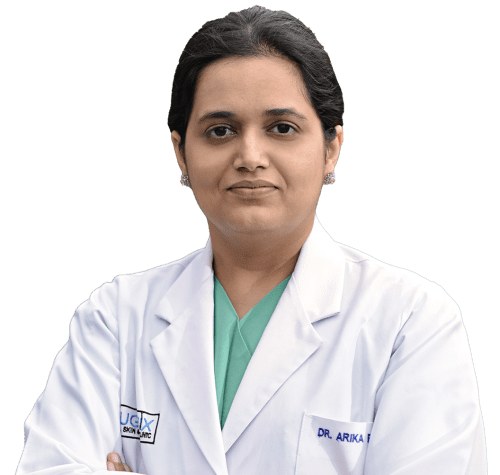
Medically reviewed by Dr. Arika Bansal, Co-Founder, Eugenix Hair Sciences; MBBS, MD Dermatology, Fellow of ISHRS; Reg. No. HN-34095 (Haryana Medical Council).
Dr. Arika Bansal
Dr. Arika Bansal, Co-Founder, Eugenix Hair Sciences. MBBS (Gold Medallist, Lady Hardinge Medical College), MD Dermatology, alumni of AIIMS, New Delhi. Fellow of ISHRS. Reg. No. HN-34095 (Haryana Medical Council).
