If you are researching a plastic surgeon led hair transplant, you are really asking one question: who is in charge of my surgery, and how closely is a qualified doctor involved in the outcome. It is a fair thing to want answered. A hair transplant is a permanent, once-in-a-lifetime procedure for most people, and the hands and judgement guiding it shape how natural and lasting your result will be. In this article we explain what this really means in practice, how doctor involvement works at each stage of a hair transplant, and how Eugenix Hair Sciences pairs an expert medical panel with a closely supervised process so that no critical step happens without a doctor directing it.
What a Plastic Surgeon Led Hair Transplant Actually Means
The phrase plastic surgeon led hair transplant has become popular for an understandable reason. It signals surgical training, precision, and a doctor who takes ownership of the procedure rather than leaving it to support staff. For a patient comparing one hair transplant clinic with another, it is shorthand for confidence that a skilled medical professional is in command.
It helps to know that hair restoration is practised by doctors from several backgrounds. The International Society of Hair Restoration Surgery, of which both Eugenix Co-Founders are Fellows, includes dermatologists, plastic surgeons, general surgeons, and doctors who qualified as MBBS and then specialised exclusively in hair. No single specialty owns the field. What matters most is not the label on a certificate, but the depth of a hair transplant surgeon’s hands-on experience and how involved that doctor stays from the first consultation to the last graft. The real questions are whether a qualified doctor designs and directs the surgery, and whether that doctor is involved at every critical step.
The Eugenix Medical Panel: Expert Doctors, Including Plastic Surgeons
At Eugenix Hair Sciences, every procedure is delivered by a panel of expert and experienced doctors, including plastic surgeons with MS and MCh qualifications in plastic surgery, alongside dermatologists and physicians. Each doctor is personally handpicked and trained by the Co-Founders, and every member of the team works exclusively in hair restoration rather than splitting attention across unrelated cosmetic surgery.
Eugenix was founded by Dr. Pradeep Sethi and Dr. Arika Bansal, both Co-Founders and both Fellows of ISHRS. They are alumni of AIIMS, New Delhi, where they completed their MD in Dermatology, and together they pioneered the DHT technique, or Direct Hair Transplant, first published in a peer-reviewed paper in 2013. Between them they bring more than 30 years of focused experience, with over 15 years each, and Eugenix has completed more than 20,000 procedures for patients from over 90 countries. Eugenix deliberately chose not to patent DHT, so the global hair restoration community could adopt it and patients everywhere could benefit.
Doctor Involvement at Every Stage of Your Procedure
Doctor involvement at Eugenix is not a single moment on the day of surgery. It runs through the entire process, from the first assessment to the design choices that decide how your hairline will look for the rest of your life.
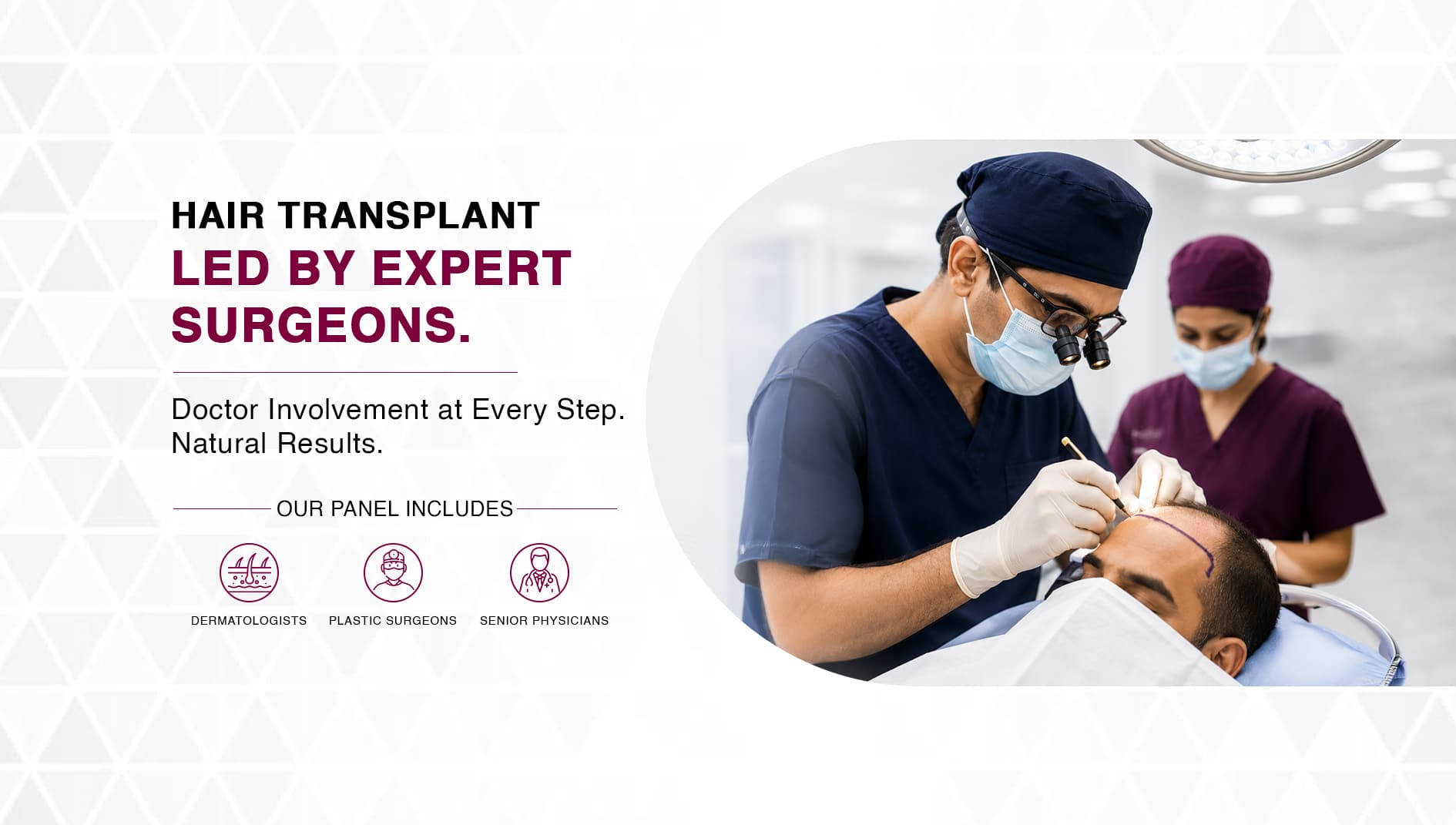
It begins at consultation, where the lead surgeon studies your scalp, your donor area, and your pattern of hair loss, then plans a graft distribution that accounts not only for current loss but for how your hair may change in the years ahead. On the day of the procedure, the lead surgeon carries out the Planning and Designing stage, where your hairline is drawn, your donor area is mapped, and the aesthetic blueprint is set. The surgeon then creates the recipient slits by hand using the coronal slit technique, deciding the angle, depth, density, and direction of every incision. At Eugenix this is the ADDD principle, and it is the foundation of a natural looking result. The same lead surgeon sets all the technical parameters that govern the surgery, including the punch size, angle, and depth used for graft removal.
In the most aesthetically critical zones, the doctor performs the crucial steps personally. The first layers of the hairline and the whorl pattern at the crown are where naturalness is won or lost, so the lead surgeon personally carries out the crucial slits and crucial implantation there. Throughout, the lead surgeon supervises your procedure throughout, taking rounds between active steps and remaining available at all times during your surgery. In short, plastic surgeon led procedures with doctor involvement at every step at eugenix mean that a qualified doctor designs, directs, and oversees your surgery from start to finish.
Extraction and Implantation: Doctor Involvement Without Compromise
To understand doctor involvement during extraction and implantation, it helps to understand the technique. Eugenix performs DHT, a refined form of follicular unit extraction. In conventional FUE, all the grafts are removed first and implanted later, which can leave hair follicles outside the body for three to four hours. With DHT, extraction and implantation happen at the same time, so each graft is placed within minutes of removal and out-of-body time stays under 30 minutes, which protects the follicles and supports strong graft survival. Because grafts are taken individually rather than by removing a strip of scalp, this approach leaves only minimal scarring, unlike older strip surgery, known as follicular unit transplantation, which leaves a linear scar and which Eugenix does not perform.
Within this process the steps are clearly divided. Working under the lead surgeon’s parameters and supervision, senior surgical assistants carry out the scoring, punching, graft removal, and implantation. Implantation uses the SAVA Implanter, a no-root-touch instrument in which the graft stays visible throughout and slides smoothly into the pre-made slit, without the blind plunger-based push used by some other devices. The doctor decides the punch size and angle that govern every extraction, creates the slits that receive every graft, performs the crucial steps, and supervises the full procedure. Extraction and implantation are carried out by a highly trained team, but always inside a framework a doctor has designed and continues to direct.
Designing a Natural Hairline
If there is one place where doctor involvement matters most, it is the hairline. A natural looking hairline is not a straight line. It follows subtle irregularities, uses single hair grafts at the very front for softness, and respects your facial proportions and age. This is why the lead surgeon, not a machine or an assistant, sets the angle, depth, density, and direction of the front rows. The same care applies to corrective work, as Eugenix also treats patients unhappy with a previous hair transplant elsewhere, redesigning the hairline and improving density where an earlier procedure fell short.
Tailoring the Plan: Advanced Cases, Donor Hair, and Ongoing Care
Doctor led planning matters even more in advanced hair loss. Grade 6 and 7 baldness is the most advanced stage, covering the front, mid scalp, and crown, and these cases need careful management of a limited donor area. When scalp donor hair is not enough on its own, the surgeon may plan to use beard hair or body hair, for example from the chest, to add coverage. How many grafts to take from each area is a clinical decision made by the doctor, which is why no responsible clinic gives an exact number of grafts before a proper assessment.
Protecting your existing hair matters too. Platelet rich plasma, or PRP, is prepared from a small sample of your own blood and uses your natural growth factors to support the scalp, though it is not a guaranteed fix on its own and works best as part of a maintenance plan. For medical management, Finasteride can slow hair loss, though it is not a cure, and Minoxidil can support hair growth when used consistently, both only under medical supervision. Your doctor advises the right combination for your hair fall pattern, including for female hair loss, which is often linked to hormonal imbalances and tends to show as diffuse thinning rather than a receding hairline.
What to Expect: Recovery, Results, and Whether It Lasts
A DHT procedure is carried out under local anesthesia, and for most patients the only discomfort is mild and short lived. Serious complications are rare when the procedure is carried out by an experienced surgical team. You can return to most daily activities quickly, with gentle walking, office work, and household tasks the day after, and exercise after about a week. Transplanted hair sheds in the first one to three months, which is completely normal, and new hair growth typically begins around the fourth month. Most of the final result is in place by 10 to 12 months, with the crown taking a little longer. Because transplanted follicles are taken from areas resistant to the hormone that causes hair loss, a hair transplant is a permanent solution. The transplanted hair typically reaches around half of your original native density in a given area, which is enough to look full and natural when designed well.
Why Doctor Involvement Shapes Your Results
A natural hair transplant depends on hundreds of small, precise decisions, and those decisions are clinical, not mechanical. Doctor led design and close supervision hold these details together. Your individual outcome still depends on your donor density, hair characteristics, and how your hair loss progresses, which is why doctor led planning is so important, and no responsible clinic can guarantee a precise figure. These standards are backed by formal accreditation. Eugenix Hair Sciences in Gurgaon is NABH accredited under Certificate No. DE-2026-0004, valid from March 12, 2026 to March 11, 2030, under the NABH Standards for Allopathic Clinics, 2nd Edition, Dermatology Clinics Programme. NABH itself is accredited internationally by ISQua. Accountability for your result rests with the lead surgeon and with Eugenix as an institution.
Frequently Asked Questions
Is the hair transplant performed by a doctor at Eugenix?
Your procedure is led and directed by a doctor at every critical stage. The lead surgeon carries out the Planning and Designing, creates the recipient slits by hand, sets all the technical parameters, personally performs the crucial steps in the hairline and crown, and supervises throughout. Scoring, extraction, and implantation are carried out by senior surgical assistants under the lead surgeon’s parameters and supervision.
Are the doctors at Eugenix plastic surgeons?
Eugenix has a panel of expert doctors that includes plastic surgeons with MS and MCh qualifications, alongside dermatologists and physicians. The Co-Founders, Dr. Pradeep Sethi and Dr. Arika Bansal, are alumni of AIIMS, New Delhi, with MD degrees in Dermatology, and both are Fellows of ISHRS. Every doctor is trained personally by the Co-Founders and works exclusively in hair restoration.
Can a maxillofacial or other specialist surgeon perform a hair transplant?
In principle a qualified surgeon from various specialties can train in hair restoration, because hair transplantation is a super-specialised skill learned through dedicated practice rather than something owned by one branch of medicine. What matters far more than the base specialty is exclusive, hands-on hair transplant experience and genuine doctor involvement at every stage.
What is the doctor’s role in extraction and implantation?
The doctor sets the punch size, angle, and depth that govern extraction, and creates every recipient slit into which grafts are implanted. The doctor also performs the crucial implantation in the most important zones and supervises the procedure, while senior surgical assistants carry out extraction and implantation under this direction using the no-root-touch SAVA Implanter.
How much does a hair transplant cost at Eugenix?
The hair transplant cost depends on the number of grafts you need, the areas treated, and the plan designed for you, so a precise figure is shared only after a proper consultation rather than as a flat rate. This is also the honest way to answer questions like how much 3,000 grafts cost, because the right number of grafts can only be confirmed once a doctor has assessed your scalp.
Is a hair transplant permanent, and will the same surgeon oversee my procedure?
Yes on both counts. A hair transplant is a permanent solution because the transplanted follicles are resistant to the hormone that drives hair loss. And the lead surgeon supervises your procedure throughout, taking rounds between active steps and remaining available at all times during your surgery.
Speak to the Eugenix Team
A plastic surgeon led hair transplant, in the way that truly matters, comes down to whether a qualified doctor designs your surgery and stays involved at every critical step. At Eugenix Hair Sciences, an expert medical panel that includes plastic surgeons with MS and MCh qualifications, all trained by the Co-Founders, delivers exactly that, supported by the doctor led DHT technique and a closely supervised process.
Consultations at Eugenix are conducted by a panel of experienced surgeons, all personally handpicked and trained by the Co-Founders, who remain closely involved in the training and oversight of every procedure. Direct consultations with either Co-Founder are available by appointment. If you would like a clear, honest assessment of your options and a plan designed around your hair, book a consultation with the Eugenix team and take the first step with doctors who lead every stage of your care.
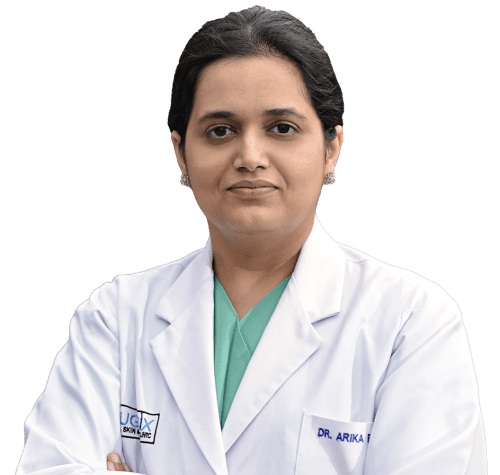
Dr. Arika Bansal
One of only a few female surgeons specializing in hair transplant surgery in India, Dr. Arika Bansal has been voted one of the best doctors in the world. She maintains an active fellowship in the ISHRS and regularly submits research papers to medical journals. 15+ years down the line, 20,000+ surgeries are accomplished under Dr. Bansal’s supervision. She specializes in female hair transplant, density improvement, corrective hair transplantation and hairline design.