

Yes, the front and the crown can often be done in the same hair transplant session, when the total number of grafts both areas need fits within what your donor area can safely give in one sitting. For Indian hair, one sitting usually moves 3,000 to 4,500 grafts. When the front and the crown together need more than that, the plan is split into two sittings, and the front usually comes first. The doctor decides which plan suits you after assessing your scalp and donor area.
This guide from Eugenix Hair Sciences explains how a hair transplant front and crown plan is made and what decides one session or two.
What decides whether the front and crown can be done together?
Three things decide it: how many grafts each area needs, how many grafts your donor area can safely give, and how your hair loss may progress.
- The graft count. The frontal hairline and the zone behind it are planned at a higher hair density, about 35 to 45 grafts per square centimetre. The crown is planned at about 25 to 35, but it is often a larger area, so it can still take many grafts.
- Your donor hair. Grafts are taken from the back and sides of the scalp, where hair is usually less affected by pattern hair loss. As a guide for Indian hair, one sitting usually moves 3,000 to 4,500 grafts, and the donor area can usually give 5,000 to 8,000 grafts over a lifetime. For Caucasian hair, the figures are about 4,000 to 5,000 per sitting and 6,000 to 9,000 over a lifetime.
- Future hair loss. A hair transplant does not stop pattern hair loss in your existing hair, so the plan keeps some donor hair follicles in reserve.
If both areas fit inside one sitting, with donor hair left for the future, they can be treated together. If not, the crown waits for a second sitting. Our guide on how many grafts the crown needs explains the crown number in detail.
Why is the front usually done first?
When the work is split, the front and mid scalp usually come first, for three reasons:
- The hairline frames the face, so restoring a receding hairline gives the most visible change for the grafts used.
- The donor supply has a ceiling. The crown is a rounded area where hair grows in a spiral, called the whorl, and fans out in every direction. The same grafts give less visible coverage there than at the front, so the crown can use a large share of the donor hair.
- Hair loss is progressive. Pattern hair loss usually progresses in the 20s and 30s, and slows down from the mid-40s towards the 50s. Crown thinning and crown baldness can widen over the years, so a younger patient is planned with care before grafts are committed to the crown.
This is a general pattern, not a fixed rule; the doctor decides after assessment.
When is the work split into two sittings?
The most common reason is advanced hair loss. Grade 6 and 7 on the Norwood scale usually needs 7,000 to 9,000 grafts, which is more than the scalp can give in one sitting. In such cases the first sitting usually covers the frontal zone and mid scalp, and the second sitting covers the crown.
The gap between the two sittings depends on where the grafts go:
- A new area next to the first one, not implanted before, such as the crown after the front: after about 1.5 to 2 months.
- Adding density to an area already implanted: a minimum of 11 to 12 months from the first procedure, so the first result has fully grown.
In advanced hair loss, beard grafts may be added as a filler in the mid scalp and around the crown, but never in the hairline, the temple points or the crown whorl. Our guide on how many hair transplant sessions you may need covers additional sessions in more detail.
What happens on the day when both areas are treated?
The procedure is performed under local anaesthesia. The lead surgeon first carries out Planning & Designing: marking the recipient and donor areas, the hairline design at the front and the direction of the whorl at the crown. With both areas, the graft count is higher, so the day is longer. Keep the whole day clear. Our guide on how long a hair transplant takes on the day explains the timings.
How is a hair transplant done at Eugenix?
Every hair transplant at Eugenix is done with Direct Hair Transplant (DHT). Direct Hair Transplant (DHT) is a modified FUE technique described by Eugenix Hair Sciences’ Co-Founders in their 2013 research paper. Grafts stay outside the body for under 30 minutes with Direct Hair Transplant, compared to 3 to 6 hours with conventional FUE.
The lead surgeon performs the extraction and sets every technical parameter. The Eugenix medical team assists and carries out implantation under the lead surgeon’s parameters and supervision, using the SAVA Implanter, a no-root-touch instrument.
Is recovery different when the front and crown are done together?
Recovery usually takes about 7 days, and the first head wash is on Day 7, done as advised by our team. What changes is crown care in the first week:
- Sleeping. Sleep at the edge of the bed so the crown is suspended, with a large neck pillow under the nape, so pressure stays on the nape only. This is most important for the first 2 to 3 nights and continues for all 7 days. Our guide on sleeping after a crown hair transplant shows the position.
- Saline spray. Spray both treated areas every 30 minutes to 1 hour during the day for 7 days, with no spraying at night.
- Smoking and alcohol. Stop both 1 week before and 7 days after surgery.
The gym, yoga and contact sports wait until after 7 days.
When will I see results at the front and the crown?
The transplanted hair usually sheds between Day 30 and Day 90. New hair growth starts from Month 4, and full results take 10 to 12 months. The crown is usually the last area to fill in, so a hairline that looks fuller at Month 7 while the crown still looks thin is usually on schedule. Read why in our guide on why the crown is the last area to fill in.
Finasteride slows the progression of male pattern hair loss. It is not a cure, and it is taken under medical supervision. Results vary from person to person.
Key points
- The front and the crown can often be done in one session when the total graft count fits what your donor area can safely give.
- One sitting usually moves 3,000 to 4,500 grafts for Indian hair; the lifetime donor supply is usually 5,000 to 8,000.
- When the work is split, the front usually comes first and the crown follows in a second sitting.
- Grade 6 and 7 hair loss usually needs 7,000 to 9,000 grafts and two sittings.
- Recovery takes about 7 days; the crown needs extra care when you sleep.
Eugenix Hair Sciences has worked only in hair restoration since 2009, with centres in Gurugram, Mumbai, Hyderabad, Bhubaneswar and Bengaluru. It was founded by Dermatologists, alumni of AIIMS, New Delhi, and Fellows of ISHRS.
Know more: how many grafts the crown needs.
Frequently asked questions
Can the hairline and the crown be done in one session?
Often yes, when the total number of grafts both areas need fits within what your donor area can safely give in one sitting. For Indian hair, one sitting usually moves 3,000 to 4,500 grafts. When the front and the crown together need more, the plan is split into two sittings, usually with the front first. The doctor decides after assessing your scalp and donor area.
Should the front or the crown be done first?
In most cases the front and the zone behind it come first, because the hairline frames the face and the donor supply is limited. The crown is then planned with the grafts that remain, in the same sitting or a second one. Where the crown is the main concern and the front is stable, the doctor may plan differently after assessment.
How many grafts are needed for the front and the crown together?
There is no single number, because it depends on the size of each area, your hair loss grade and your donor hair. The front is planned at about 35 to 45 grafts per square centimetre and the crown at about 25 to 35. Grade 6 and 7 hair loss usually needs 7,000 to 9,000 grafts, which is more than one sitting can give.
How long after the front can the crown be done?
When the crown is a new area that was not implanted in the first sitting, the second sitting can usually follow after about 1.5 to 2 months. Adding density to an area already implanted needs a gap of at least 11 to 12 months from the first procedure, so the first result has fully grown. Your doctor sets the timing for your plan.
Is recovery longer when both areas are treated?
Recovery usually takes about 7 days either way, and the first head wash is on Day 7. The main difference is sleeping: with the crown treated, you sleep at the edge of the bed with a large neck pillow under the nape, so the crown is suspended. Keep up the saline spray on both treated areas every 30 minutes to 1 hour during the day.
Why does the crown fill in later than the front?
New hair growth starts from Month 4 across the scalp, and full results take 10 to 12 months, or 12 to 15 months for the crown, which is usually the last area to fill in. Crown hair grows in a spiral and fans out from its centre, so the same grafts give less visible coverage there. A crown that still looks thin at Month 6 or 7 is usually on schedule.
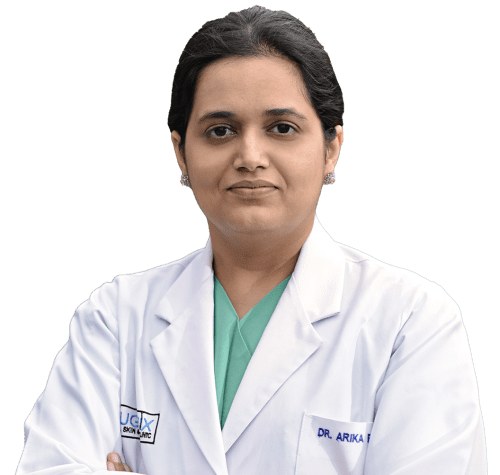
Medically reviewed by Dr. Arika Bansal, Co-Founder, Eugenix Hair Sciences; MBBS, MD Dermatology, Fellow of ISHRS; Reg. No. HN-34095 (Haryana Medical Council).
Dr. Arika Bansal
Dr. Arika Bansal, Co-Founder, Eugenix Hair Sciences. MBBS (Gold Medallist, Lady Hardinge Medical College), MD Dermatology, alumni of AIIMS, New Delhi. Fellow of ISHRS. Reg. No. HN-34095 (Haryana Medical Council).
