

At a hair transplant repair consultation, a doctor examines the result of your earlier hair transplant, your donor area and any scarring. The doctor checks whether the earlier transplant has reached its full result, what can be corrected and how much donor hair is left to do it. If a correction suits you, you receive a written plan; if it does not, you are told why. No decision is expected on the day.
This guide from Eugenix Hair Sciences explains when to come, what to bring and what a repair can and cannot change. For a first hair transplant, read what happens at a hair transplant consultation.
When should you have a repair consultation?
An initial consultation can take place at any time, but a repair is usually planned only once the earlier transplant has reached its full result. Hair transplant results follow a set timeline:
- Shedding: the transplanted hairs usually shed between Day 30 and Day 90.
- Initial growth: new hair growth starts from Month 4.
- Visible change: growth usually becomes clearly visible between Months 6 and 8.
- Full results: 10 to 12 months, or 12 to 15 months for the crown.
An area that looks thin at Month 4 or 5 may still fill in. Our guide on why some transplanted hairs do not grow explains slow growth in more detail.
Signs of infection, such as spreading redness, pus, fever or severe swelling, after any hair transplant surgery need a doctor promptly, before any repair plan.
What should you bring to a repair consultation?
Bring or share:
- Clear, well-lit photos of the front, top, both sides and back of your head, with the hair dry and no cap.
- Photos from before the earlier transplant and from the months after it, if you have them.
- Any records of the earlier procedure: the date, the number of grafts, the areas treated and the technique used.
- The medicines you took for hair loss before and after it, and the ones you take now.
- Your medical conditions, allergies and any blood thinners or supplements such as vitamin E.
If you have no records, the consultation still goes ahead; the focus is on your scalp as it is today.
What does the doctor check?
The hairline and the grafts
The doctor looks at where the hairline sits and how it is shaped. Common reasons people seek a hair transplant correction are a straight, fence-like hairline, thick multi-hair grafts at the front that give a pluggy look, bushy or flared temples, a hairline that is uneven from side to side, and hairs growing at the wrong angle or in the wrong direction. The doctor also checks the skin around the grafts for raised bumps (cobblestoning) or small dips (pitting), and for patches of different density.
Density and growth
Thin areas can come from grafts that did not grow, from too few grafts, or from the hair around them. Shock loss is the loss of existing native hair in or near the transplanted area after surgery. Pattern hair loss can also keep thinning the native hair over the years, which changes how the earlier work looks.
The donor area
The donor area is the back and sides of the scalp, where hair is usually less affected by pattern hair loss. The doctor checks how much donor hair remains, whether it was overharvested or taken in patches, and whether there are scars. These may be a linear scar from follicular unit transplantation (FUT), the strip method, which is not performed at Eugenix, or visible dot scars from extraction. The donor reserve, your remaining donor supply, decides how many new grafts a repair can add. As a guide, Indian and Asian patients can usually give about 5,000 to 8,000 grafts over a lifetime, so grafts already used count against that total. Our guide on overharvesting and safe graft numbers explains why.
Your hair loss and health
Pattern hair loss usually progresses in the 20s and 30s, and slows down from the mid-40s towards the 50s, so a repair is planned for the years ahead, not only today. The doctor also checks for any scalp condition that needs treatment first, and medicine department clearance is mandatory for every patient before surgery.
What can a repair correct, and what can it not?
A corrective hair transplant can often improve an earlier result, but it is planned around what is realistic for your scalp. Depending on your assessment, a repair may:
- Add grafts to areas that were left thin.
- Soften a hard hairline, with single-hair grafts at the front.
- Remove some grafts placed in the wrong place, refine them and place them again.
- Cover a scar with grafts, or with scalp micropigmentation (SMP) for patients who keep their hair short.
- Use body hair, such as beard hair, as a filler when scalp donor hair is limited.
Some things cannot be changed. The direction in which earlier grafts grow cannot be corrected. Not every unwanted transplanted hair can be removed, and some removed hairs can grow back, so removal can take more than one sitting; repeated removal also raises the risk of scarring. An overharvested donor area cannot be fully restored, although its appearance can often be improved. Complete reversal of an earlier hair transplant is rarely possible. Our page on failed hair transplant repair explains the options in more detail.
What happens after the consultation?
If a repair suits you, the doctor explains the plan: what will be corrected, in what order, an estimate of the grafts needed and where they will come from. A repair is often done in stages, for example softening the hairline or removing misplaced grafts first and adding density later, with time between sittings for the scalp to heal and the grafts to grow. Medicines to slow ongoing hair loss may be advised alongside.
The cost depends on the number of grafts planned for your case, which is decided after your scalp and donor area are assessed. Our team explains the costs in full at consultation. You can take time to think before you decide.
How is a repair performed at Eugenix?
Every hair transplant at Eugenix, including a repair, is done with Direct Hair Transplant (DHT). Direct Hair Transplant (DHT) is a modified FUE technique described by Eugenix Hair Sciences’ Co-Founders in their 2013 research paper. Grafts stay outside the body for under 30 minutes with Direct Hair Transplant, compared to 3 to 6 hours with conventional FUE.
The lead surgeon performs the extraction and sets every technical parameter. The Eugenix medical team assists and carries out implantation under the lead surgeon’s parameters and supervision, using the SAVA Implanter, a no-root-touch instrument. The lead surgeon supervises your procedure throughout, taking rounds between active steps and remaining available at all times during your surgery. The procedure is performed under local anaesthesia.
Key points
- A repair is usually planned once the earlier transplant has reached its full result: 10 to 12 months, or 12 to 15 months for the crown.
- The doctor checks the hairline, the grafts, density, the donor area, scars and your health.
- A repair can often soften a hairline, add density and cover scars, but the direction of earlier grafts cannot be changed and complete reversal is rarely possible.
Eugenix Hair Sciences has worked only in hair restoration since 2009, with centres in Gurugram, Mumbai, Hyderabad, Bhubaneswar and Bengaluru. It was founded by Dermatologists, alumni of AIIMS, New Delhi, and Fellows of ISHRS.
Know more about a repair assessment by speaking to our team.
Frequently asked questions
Can I get a second opinion on my hair transplant?
Yes. A second opinion is a doctor’s assessment of your earlier hair transplant, your donor area and any scarring. The doctor explains whether the result is complete, whether anything can be corrected and how much donor hair is left. You are not expected to decide on the day, and you can share photos first so the doctor sees your scalp before you meet.
How long should I wait after a hair transplant before a repair?
A repair is usually planned once the earlier transplant has reached its full result. New growth starts from Month 4, growth becomes clearly visible between Months 6 and 8, and full results take 10 to 12 months, or 12 to 15 months for the crown. You can still speak to a doctor earlier if you are worried, and the doctor explains when a plan can be made.
What photos should I share for a repair consultation?
Share clear, well-lit photos of the front, top, both sides and back of your head, with the hair dry and no cap. The back view shows your donor area, which matters most in a repair. If you have photos from before the earlier transplant and from the months after it, share those too, along with any records of the number of grafts and the areas treated.
Can a repair consultation be done by video?
Yes, a first discussion can take place on a video call, using your photos and what can be seen on camera. This suits patients who live far from a centre. A repair usually needs a closer look at the grafts, the skin and the donor area, so the doctor may advise an in-person examination at one of our centres before the final plan is made.
What if my donor area was overharvested?
An overharvested donor area cannot be fully restored, but its appearance can often be improved. The doctor checks how much donor hair remains and plans the repair within that limit. Beard hair may be used as a filler in the recipient area to reduce further scalp extraction, and scalp micropigmentation (SMP) can help camouflage patchy areas for patients who keep their hair short.
Can every problem from an earlier hair transplant be corrected?
Not always. A repair can often add density, soften a hairline and cover scars, and some misplaced grafts can be removed and placed again. The direction of hair already implanted cannot be corrected, not every unwanted hair can be removed, and complete reversal is rarely possible. The doctor explains what is realistic for your scalp before any plan is agreed.
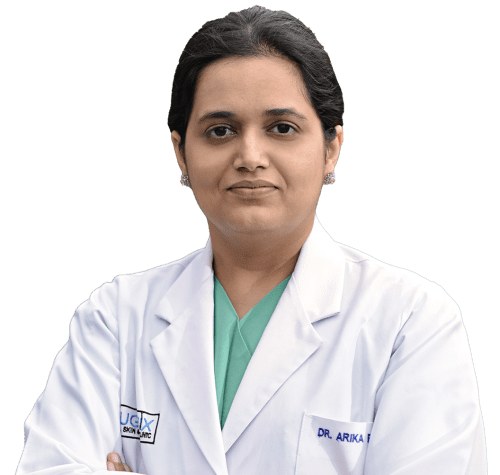
Medically reviewed by Dr. Arika Bansal, Co-Founder, Eugenix Hair Sciences; MBBS, MD Dermatology, Fellow of ISHRS; Reg. No. HN-34095 (Haryana Medical Council).
Dr. Arika Bansal
Dr. Arika Bansal, Co-Founder, Eugenix Hair Sciences. MBBS (Gold Medallist, Lady Hardinge Medical College), MD Dermatology, alumni of AIIMS, New Delhi. Fellow of ISHRS. Reg. No. HN-34095 (Haryana Medical Council).
