

Whether 4,000 or 5,000 grafts is too many depends on your donor area, not on the number alone. For many Indian patients, about 3,000 to 4,500 grafts can usually be taken from the scalp in one sitting and about 5,000 to 8,000 over a lifetime. Overharvesting means taking more grafts than the donor area can safely give, which can leave visible thinning at the back and sides and less hair for the future.
This guide from Eugenix Hair Sciences explains what hair transplant overharvesting is, why the safe graft count is different for every person, and how extraction is planned so the donor area stays even.
What is overharvesting in a hair transplant?
Overharvesting in a hair transplant is when too many hair follicles are taken from the donor area, or too many are taken from one patch of it. The hair around each extraction point no longer covers the scalp evenly, so the donor area looks thin or patchy. Because each follicle is moved and does not grow back in its old place, an overharvested donor area cannot refill itself, and fewer grafts remain for any future hair transplant procedures.
What does an overharvested donor area look like?
The usual sign is visible thinning at the back or sides of the head, often in patches rather than evenly spread, which can look like patchy hair growth. It shows most when the hair is cut very short, under bright light, or when the hair is wet. The remaining hair may look see-through in one area and normal in another. Small extraction marks at the donor site can also become easier to see when too little remaining hair is left around them to cover them.
Why is there no single safe number of grafts?
The safe number of grafts depends on how many follicles your donor area holds and how far your hair loss may progress. The donor area is the back and sides of the scalp, which is usually less affected by pattern hair loss. On an adult scalp there are about 100,000 to 150,000 follicles in all, and the safe donor zone holds roughly 30,000 to 45,000 of them. Only a part of these can be taken without leaving visible thinning.
Several things change how many hair grafts your donor area can give:
- Donor density: how closely the follicles sit in the donor zone.
- Hair characteristics and hair type: hair thickness, colour against the scalp, and whether you have straight hair or curly or wavy hair.
- Hairs per graft: a graft, or follicular unit, is a natural group of 1 to 4 hairs, so donor areas with more multi-hair follicular units give more coverage from the same graft count.
- Your age and pattern of loss: a younger patient may need grafts later, as hair loss can progress.
- Your plans for the future: the donor area has to cover today’s bald area and any area that may thin later, including subsequent hair transplants.
Is 4,000 grafts overharvesting?
For many Indian and Asian patients, 4,000 grafts falls within the usual range for one sitting, which is about 3,000 to 4,500 grafts. Whether it is right for you depends on your donor density and how much donor hair you may need later. If your donor area is thin or your hair loss is likely to progress, the doctor may advise fewer grafts now, so that enough remains for future hair loss.
Is 5,000 grafts overharvesting?
For many Indian and Asian patients, 5,000 scalp grafts is above the usual range for one sitting and close to the lower end of the lifetime range, which is about 5,000 to 8,000 grafts. For Caucasian patients, the usual figures are about 4,000 to 5,000 grafts per sitting and 6,000 to 9,000 over a lifetime. So 5,000 grafts is not automatically too many, but high graft counts use a large share of the donor supply. In advanced hair loss, a larger plan is often split into two sittings or supported with beard grafts, so that the scalp donor area is not taken beyond its safe limit.
How Eugenix plans extraction to protect the donor area
Good donor management starts with Planning & Designing, before the first graft is taken. The lead surgeon marks the complete recipient area and donor area, plans graft distribution across the recipient sites, and sets the number of grafts for your case as part of a personalised treatment plan.
- Safe donor zone only: grafts are taken from the safe donor zone. The zone above it can thin with time, and the zone below it has a reduced blood supply, so extraction is not planned there.
- Even extraction: the donor zone is divided into blocks, and grafts are taken evenly from each block in a wavy, zigzag manner. This avoids heavy extraction from one patch, which causes visible thinning.
- A zigzag lower border: the lower edge of the extraction zone is shaped in a zigzag, which helps the boundary between extracted and non-extracted areas blend when hair is kept short.
- A plan for the future: the graft count accounts for possible future hair loss, not only for today’s bald area, so grafts can still be safely harvested for future hair transplant procedures.
The lead surgeon performs the extraction and sets every technical parameter. The Eugenix medical team assists and carries out implantation under the lead surgeon’s parameters and supervision. The lead surgeon supervises your procedure throughout, taking rounds between active steps and remaining available at all times during your surgery.
Do you need more grafts, or a different plan?
Often the answer is a different plan rather than more grafts. A hairline set slightly higher and in a V shape needs fewer grafts than a low, rounded one, which leaves more grafts for the mid scalp. Medical treatment for male pattern baldness can also reduce how many grafts are needed. Finasteride slows the progression of male pattern hair loss. It is not a cure and is taken under medical supervision. Keeping your native hair helps the grafts that are placed go further.
When the scalp donor area alone is not enough, for example in Grade 6 or Grade 7 hair loss, beard hair is used as a filler alongside scalp grafts. About 500 to 800 grafts can usually be taken from below the chin and jawline without changing how the beard looks, and a healthy beard can give about 3,000 to 5,000 grafts over a lifetime. Beard grafts are mixed with scalp grafts and are never placed in the hairline, temple points or crown whorl. Body hair is a filler, not a primary donor. Our guide on what happens to the donor area after a hair transplant explains healing and body hair in more detail.
What the graft count can cover
A graft count only makes sense next to the area to be covered. Our guides to a 4,000 grafts hair transplant and a 6,000 grafts hair transplant explain coverage at each size. For the cost of a larger plan, see our page on 5000 grafts hair transplant cost in India.
Transplanted density is about 50% of natural density, because transplanted hairs sit about 1.5 mm apart, compared with about 0.5 mm in natural hair. A slight see-through quality in bright light is normal, and placing more grafts in one area than its blood supply can support is not part of the plan. Results vary from person to person.
Short hair and the donor area
Even a well-planned extraction leaves the donor area slightly less dense than before. At normal hair lengths this is usually hard to see. If you plan to keep your hair very short, some donor thinning may be visible, even after a small number of grafts. The recommendation is to keep the hair at the back at least 1 to 1.5 cm long. Scalp micropigmentation (SMP) can be done 1 to 1.5 months after the procedure for patients who want to keep their hair very short.
What the research says
One study of follicular unit extraction measured how much of the donor hair was taken per square centimetre and advised caution, because donor density differs between patients and each later session reduces donor density further. This is why the graft count is set for each person after the donor area is assessed, rather than chosen as a round number.
Frequently asked questions
How many grafts can be taken safely in one sitting?
For Indian and Asian patients, about 3,000 to 4,500 grafts can usually be taken from the scalp in one sitting. For Caucasian patients, the usual figure is about 4,000 to 5,000 grafts. These are guides, not targets. The safe number for you depends on your donor density, your hair characteristics and how far your hair loss may progress, which the doctor assesses at consultation.
Is 6,000 or 7,000 grafts too many?
For most Indian and Asian patients, 6,000 or 7,000 grafts is more than the scalp can give in one sitting, and close to or within the lifetime range of about 5,000 to 8,000 grafts. Plans of this size are usually for advanced hair loss. They are often split into two sittings and supported with beard grafts, so the scalp donor area is not taken beyond its safe limit.
Can an overharvested donor area grow back?
No. Each follicle taken from the donor area is moved to the thinning area, so it does not grow back in its old place. The hair around the extraction points keeps growing, but it cannot fill a patch where too many follicles were taken. In some cases, beard or body hair can be implanted into the thin donor region as a form of corrective surgery, and scalp micropigmentation can help camouflage it.
How long until the donor area looks normal?
The donor area heals quickly. It is nearly healed by Day 5 for most people, and the first head wash is on Day 7. Over the next few weeks, the hair around each extraction point grows and covers the small marks. When grafts are taken evenly from the safe donor zone, the donor area usually looks normal at regular hair lengths.
Can I have another hair transplant later if I use 4,000 grafts now?
Often yes, if enough donor hair remains. A second extraction from the same donor zone needs a gap of at least 2 months for healing. A second sitting in an area that was already implanted needs a gap of 11 to 12 months. How many grafts remain depends on your donor area and how many were used the first time, which the doctor checks before planning.
How can I tell if my donor area has been overharvested?
Look at the back and sides of your head with the hair cut short or wet, ideally in good light. Signs include patches that look clearly thinner than the surrounding hair, uneven density from side to side, or extraction marks that show through. A doctor can assess the donor area properly and tell you how much donor supply is left for any future procedure.
Eugenix Hair Sciences has worked only in hair restoration since 2009, with centres in Gurugram, Mumbai, Hyderabad, Bhubaneswar and Bengaluru. It was founded by Dermatologists, alumni of AIIMS, New Delhi, and Fellows of ISHRS.
Read more.
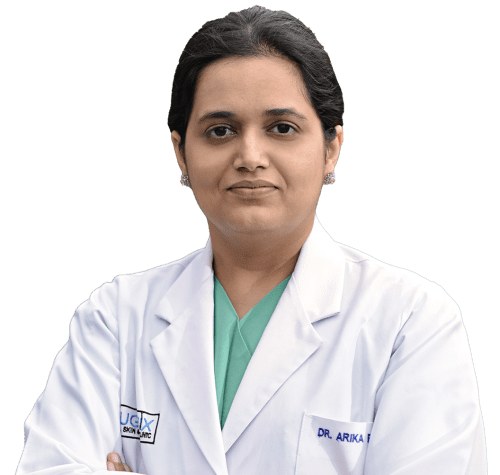
Medically reviewed by Dr. Arika Bansal, Co-Founder, Eugenix Hair Sciences; MBBS, MD Dermatology, Fellow of ISHRS; Reg. No. HN-34095 (Haryana Medical Council).
Dr. Arika Bansal
Dr. Arika Bansal, Co-Founder, Eugenix Hair Sciences. MBBS (Gold Medallist, Lady Hardinge Medical College), MD Dermatology, alumni of AIIMS, New Delhi. Fellow of ISHRS. Reg. No. HN-34095 (Haryana Medical Council).
