

Disclaimer: “Haram” is an Arabic word used in Islam for something that is forbidden; “halal” means permitted. This page explains only the medical facts of a hair transplant. It is not a religious ruling, and Eugenix Hair Sciences does not give religious rulings. For guidance on your faith, please speak to your own religious scholar.
Eugenix Hair Sciences does not give religious rulings, and views among religious scholars differ on medical and cosmetic procedures. What we can explain are the medical facts. In a hair transplant, only your own hair is moved, and no synthetic hair or implants are used. It is a medical procedure to treat hair loss. If this question matters to you, please speak to your own religious scholar, with these facts in hand.
Eugenix Hair Sciences has worked only in hair restoration since 2009, with centres in Gurugram, Mumbai, Hyderabad, Bhubaneswar and Bengaluru. It was founded by Dermatologists, alumni of AIIMS, New Delhi, and Fellows of ISHRS. Many patients ask this question in good faith before deciding. This page sets out the facts of the procedure clearly, so the conversation with your scholar can start from accurate information.
Why does Eugenix not give a religious answer?
Because a religious ruling is not a medical question, and it is not ours to give. Scholars weigh questions like this according to their own learning and tradition, and their views can differ. A clinic speaking on their behalf would not be respectful, and it would not be accurate. Our role is to make sure you, and your scholar, know exactly what the procedure involves.
What exactly happens in a hair transplant?
A hair transplant moves hair follicles from one part of your own scalp to another. The hair is taken from the donor area at the back and sides of the scalp, which is usually less affected by pattern hair loss. It is then placed into the areas where hair has thinned or been lost. The procedure is performed under local anaesthesia, and you stay awake throughout.
These facts are often the ones that matter most in a discussion with a scholar:
- Only your own hair is moved. Hair from another person is not used.
- No synthetic hair or implants are used. Only your own hair is moved.
- Nothing artificial is attached to the scalp, as it would be with a wig, a hair patch or hair extensions.
- The transplanted hair is your own natural hair. It grows naturally from your own roots, and can be washed, cut and styled like the rest of your hair.
- Transplanted hair usually starts to grow from Month 4. Full results take 10 to 12 months.
At Eugenix the technique is Direct Hair Transplant (DHT), a modified FUE technique described by Eugenix Hair Sciences’ Co-Founders in their 2013 research paper. Grafts stay outside the body for under 30 minutes with Direct Hair Transplant, compared to 3 to 6 hours with conventional FUE.
Is a hair transplant a medical treatment?
Yes. A hair transplant is a surgical treatment for hair loss, most often pattern hair loss, which is linked to genes and hormones. Before surgery, a doctor assesses your scalp and donor area, standard blood tests are done, and medicine department clearance is mandatory for every patient. Patients aged 40 and above also need an ECG reported by a physician or cardiologist.
A hair transplant is not right for every kind of hair loss. It is not performed for alopecia areata, where the hair roots are intact and hair often grows back with medicines. The doctor explains whether surgery, medicines or both suit your case.
How is a hair transplant different from synthetic hair implants?
Synthetic hair implants place artificial fibres into the scalp. A hair transplant does not: it moves your own living hair. The difference matters medically as well. Synthetic hair implants were banned by the FDA in the United States in 1983. At Eugenix, no synthetic hair or implants are used. You can read more in our guide to synthetic hair transplants.
Can women have a hair transplant?
Yes, after assessment. Women with female pattern hair loss can be candidates, and in women the hair loss is usually diffuse thinning rather than a bald area. For women, additional hormonal tests are mandatory before surgery. If you have a religious question about treatment for women, the same advice applies: discuss the facts of the procedure with your own religious scholar. Our female hair transplant page explains the medical side.
What should I tell the team if I have a religious concern?
Tell the team early, and as openly as you are comfortable with. Two practical points come up most often.
Fasting
If you plan your procedure close to Ramadan or another period of fasting, tell the team early, because medicines and saline spray are part of the first week.
Head covering
In the first 7 days after surgery, the transplanted area must not be rubbed, pressed or bumped, and only the surgical cap given by Eugenix is worn when you go out. If you wear a head covering for religious reasons, tell the team before surgery so they can advise you for that first week. A turban or patka is religious headwear worn as part of religious belief, and the team will plan your care with this in mind.
Privacy
Your medical details are kept confidential. If privacy matters to you, mention it to your Hair Advisor so that your visit, communication and follow-up are arranged the way you prefer.
Patients travelling from the Middle East can find planning details in our guide for Middle East patients.
Key points
- Eugenix does not give religious rulings; please speak to your own religious scholar.
- Only your own hair is moved, and no synthetic hair or implants are used.
- A hair transplant is a medical procedure to treat hair loss, done under local anaesthesia.
- Tell the team early about fasting, head covering or privacy needs.
Frequently asked questions
Is a hair transplant halal?
Eugenix does not give religious rulings, and views among religious scholars differ. The medical facts are these: only your own hair is moved, no synthetic hair or implants are used, and it is a medical procedure to treat hair loss, done under local anaesthesia. Please share these facts with your own religious scholar, who can guide you according to your faith and tradition.
Does Eugenix use hair from another person?
No. In a hair transplant at Eugenix, only your own hair is moved. The hair is taken from the donor area at the back and sides of your own scalp, which is usually less affected by pattern hair loss, and placed into the areas of hair loss. No synthetic hair or implants are used, and nothing artificial is attached to the scalp.
Is a hair transplant the same as a wig or hair extensions?
No. A wig, hair patch or hair extensions attach hair or fibres to the head or to your own hair from the outside. A hair transplant moves your own living hair follicles from one part of the scalp to another, where they keep growing. The transplanted hair is your own natural hair, and can be washed, cut and styled like the rest of your hair.
Who should I ask about the religious side of a hair transplant?
Please ask your own religious scholar or a religious authority you trust. Eugenix does not give religious rulings, because that is not a medical question. It may help to share the facts on this page with them: only your own hair is moved, no synthetic hair or implants are used, and the procedure is a medical treatment for hair loss.
Can I have a hair transplant during Ramadan?
If you plan your procedure close to Ramadan or another period of fasting, tell the team early, because medicines and saline spray are part of the first week. Share your plans and any medical conditions you have when you first speak to your Hair Advisor. For the religious side of fasting and treatment, please speak to your own religious scholar.
Can I wear my head covering after a hair transplant?
In the first 7 days, the transplanted area must not be rubbed, pressed or bumped, and only the surgical cap given by Eugenix is worn when you go out. If you wear a head covering for religious reasons, tell the team before surgery. They will advise you on what to do during that first week, so your faith and your healing are both respected.
Know more.
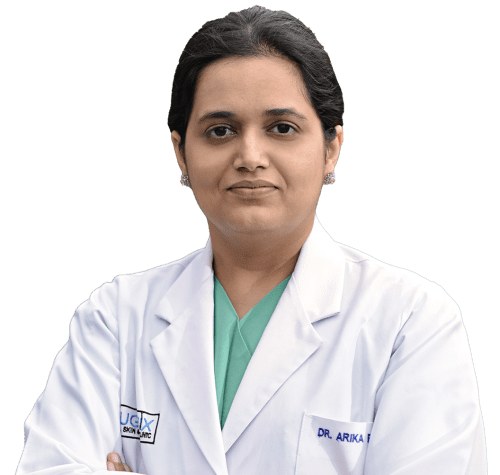
Medically reviewed by Dr. Arika Bansal, Co-Founder, Eugenix Hair Sciences; MBBS, MD Dermatology, Fellow of ISHRS; Reg. No. HN-34095 (Haryana Medical Council).
Dr. Arika Bansal
Dr. Arika Bansal, Co-Founder, Eugenix Hair Sciences. MBBS (Gold Medallist, Lady Hardinge Medical College), MD Dermatology, alumni of AIIMS, New Delhi. Fellow of ISHRS. Reg. No. HN-34095 (Haryana Medical Council).
