
If you have struggled with hair loss for years, been turned away by clinics, or feel you are running out of time before an important event, you may have seen advertisements for a synthetic hair transplant. The promise is hard to ignore. No donor hair needed, instant fullness, and an active lifestyle within days. For anyone told their donor area is too weak or exhausted for a natural hair transplant, an artificial hair transplant can sound like the only door left open. Before you walk through it, it helps to understand what a synthetic hair transplant actually is, how it differs from a natural hair transplant, why one of the world’s most respected medical regulators banned synthetic hair fibers decades ago, and what genuinely safe options exist even in difficult cases. This article lays out the science, the regulatory history, and the honest alternatives, so you can make a fully informed decision about your scalp, your hair, and your long-term health.
What is a synthetic hair transplant?
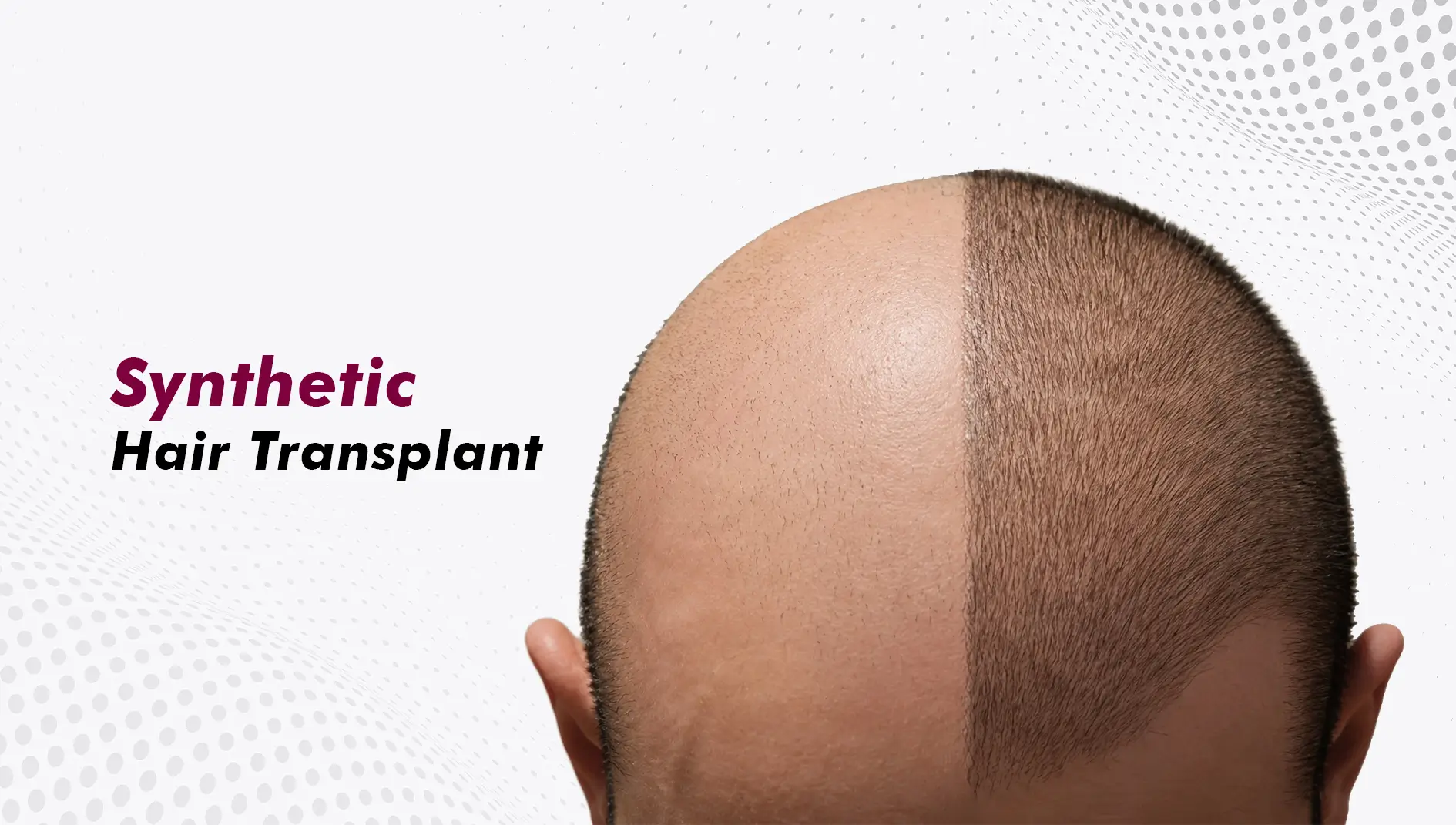
A synthetic hair transplant, also called an artificial hair transplant, involves implanting man-made synthetic hair fibers into the scalp to mimic the look of natural hair. These artificial hair fibers are usually made from polyamide or similar synthetic materials, and they are produced in many colours, shades, and textures so that they closely resemble natural hair at first glance. Marketing often calls the newer versions a bio synthetic hair transplant, suggesting the fibres are friendlier to the body than older designs.
The single most important fact sits underneath all of this. Synthetic hair is not real hair. Unlike natural hair, a synthetic fibre has no root, no blood supply, and no living hair follicles behind it. It does not grow, it does not regenerate, and it never becomes part of you. A natural hair transplant moves your own living hair follicles, complete with their roots, from a donor area to a thinning or bald zone, where they continue to produce natural hair growth for years. A synthetic hair transplant simply anchors dead fibres into the scalp. In plain terms, one relocates living tissue, the other inserts a foreign object under your skin.
How does a synthetic hair transplant work?
Understanding the procedure makes the risks easier to see. Because the body often reacts to artificial fibers, careful providers begin with a tolerance test, sometimes called a fiber compatibility test, in which a small number of synthetic hair fibers are implanted and watched for several weeks to check for allergic reactions or rejection. The very existence of this tolerance test tells you something important. Rejection is common enough that it has to be screened for in advance.
If the tolerance test is passed, the actual implant session is carried out under local anesthesia. Individual synthetic fibers are anchored one by one into the scalp, often into the deeper scalp fascia, using a hooked needle or an automatic hair implant device. No donor hair is required, which is the entire selling point for patients with little or no donor area. Up to a couple of thousand fibres may be placed in a single session, and because the fibres are visible the moment they go in, the result looks instant. That immediacy is real. What the advertisement does not dwell on is everything that follows, which is where a synthetic hair transplant and a natural hair transplant part ways completely.
Why synthetic hair fibers were banned in the United States
This is not a new or fringe concern. As far back as 1983, the United States Food and Drug Administration banned synthetic and artificial hair fibers for scalp implantation. It was one of the earliest occasions on which the FDA removed a medical device from the market entirely.
The regulator’s reasoning was blunt. It concluded that these fibers offered no genuine benefit, that they did not produce hair growth or truly conceal baldness, and that the way they were marketed misled patients about how safe and effective they were. More seriously, it found that synthetic hair implantation could cause infections, illness, and injury. The complaints that triggered the ban included infection, swelling, severe pain, scarring, and permanent loss of the patient’s own existing hair, with many cases needing extensive medical and surgical treatment to put right. Synthetic hair fibers are still sold in some countries, often with a claim that modern synthetic hair has solved the old problems. The underlying issue has not changed. The immune system still recognises the fibre as foreign.
What the global hair restoration authority says
The most authoritative voice in this field is the International Society of Hair Restoration Surgery, the leading global body for hair restoration specialists. In December 2021, its Board of Governors adopted a formal position statement on prosthetic hair fibers, aligning fully with the long-standing FDA position.
This matters for a simple reason. Both Co-Founders of Eugenix, Dr. Pradeep Sethi and Dr. Arika Bansal, are Fellows of the ISHRS. When the professional society that sets the standards for hair restoration worldwide states that an approach misleads patients and carries real risk, that is not one clinic criticising another. It is the considered position of the specialty itself. Eugenix does not perform synthetic hair transplantation, and this is exactly why.
The risks the advertisements do not mention
The marketing sells speed and instant density. What it leaves out is what happens over the following months and years. Because synthetic fibers are a foreign material, the immune system frequently treats them as intruders. This can lead to ongoing inflammation, recurrent scalp infections, allergic reactions, and the formation of cysts or hard nodules around each implant site.
There is also the matter of durability, which is rarely explained honestly. Synthetic hair does not last. A meaningful share of the fibres break and shed within the first year, and more are lost every year after that, which is why ongoing replacement is built into the model. Worse, the constant presence of foreign fibres and the inflammation they cause can trigger loss of the surrounding natural hair, leaving a patient thinner than when they started.
The most serious concern is what synthetic hair implantation can do to your future. The repeated insertion of foreign fibres, combined with chronic low-grade inflammation, can scar and harden the scalp. That scarring can make a future natural hair transplant using your own hair follicles far more difficult, and sometimes impossible. A patient who chooses synthetic fibres because they were told their donor was finished may end up damaging the very scalp that could have received their own grafts. And the headline claim, that synthetic hair closely resembles natural hair forever, does not hold. A static fibre that cannot grow will never behave like living hair over time.
The lifelong maintenance nobody mentions
Even setting the medical risks aside, a synthetic hair transplant is not a one-time event. It is a lifelong commitment. Because the scalp treats the fibres as foreign and produces oil around them, regular scalp cleaning is essential to avoid sebum plugs and infection, often with specialised products and prescribed antibiotics in the early period. Broken and shed fibres have to be replaced through periodic touch-ups, and many providers ask patients to return for follow-up appointments as often as every month to manage the scalp and top up lost fibres.
Compare that with a natural hair transplant. Once your own transplanted hair has grown in, it is simply your hair. You wash it, cut it, and style it normally, with no compatibility tests, no fibre replacement, and no recurring maintenance bill. The honest contrast is stark. One is a permanent result you eventually stop thinking about, the other is a standing appointment for the rest of your life.
What about the cost of a synthetic hair transplant?
Cost is often where these advertisements land hardest, because a synthetic hair transplant can look cheaper upfront than traditional hair transplant procedures. That comparison is misleading for two reasons. First, the upfront price is not the real price. Once you add the tolerance test, the antibiotics and special products, the periodic touch-ups, and the ongoing replacement of fibres that fall out year after year, the lifetime cost climbs steadily and never really stops. Second, a low price means very little if the procedure carries the risks described above and can compromise your scalp for the future.
Eugenix does not quote prices for synthetic hair transplants, because Eugenix does not offer them. For a natural hair transplant, the cost depends on your pattern of hair loss, your donor area, the number of hair grafts required, and your long-term plan, which is why a meaningful figure can only come from a proper consultation rather than a per-strand rate seen online. The right question is not which option is cheapest this month. It is which option is safe, lasting, and genuinely your own hair.
“But I have no donor hair left”: the claim that deserves a second opinion
The advertisements lean on one fear above all. That you have no usable donor hair. For some patients this is partly true, but it is far less often the whole story than the marketing suggests.
The scalp is not the only source of healthy, permanent grafts. The beard is an excellent donor area, with a lifetime capacity of roughly 3,000 to 5,000 grafts in a healthy donor and one of the highest survival rates of any body donor site. Chest and other body hair can serve as supplementary filler. At Eugenix, body hair transplant combines beard and body grafts with whatever scalp donor remains, which means even high grades of baldness, including patients who feel almost completely bald on top, can often be addressed with their own natural hair follicles when the scalp alone would not be enough. A large share of the cases Eugenix handles are corrective and revision procedures, where a previous clinic or poor donor management created the problem. A weak or partly depleted donor is a planning challenge for an experienced hair transplant surgeon, not an automatic dead end. The right next step is a proper donor assessment, not a foreign-body implant.
“But my event is in 10 days”: the honest answer
Urgency is the other big lever in these advertisements. The promise of instant density before a wedding, a shoot, or a big occasion is genuinely appealing when time is short.
Here is the honest position. A natural hair transplant uses your own living hair follicles, and living hair needs time to settle and grow, so it will not deliver full results in 10 days. That is simply biology. But the answer to a deadline is not to implant permanent foreign fibres that carry lifelong risk. Reversible surface camouflage, the kind that sits on top of the scalp and can be removed at any time, can give an immediate appearance of fullness for a single event, without surgery and without placing anything foreign under your skin. It buys you time to plan a permanent solution properly. Trading a 10-day deadline for a lifetime of maintenance and infection risk is rarely a fair exchange, and an honest clinic will tell you so.
The Eugenix approach: your own living hair
Everything above points to a single principle. The safest, most natural, and most durable results come from your own living hair follicles, not from synthetic substitutes.
This is the foundation of the Direct Hair Transplant (DHT) technique, the natural hair transplant approach pioneered and published by Eugenix’s Co-Founders in 2013. With DHT, extraction and implantation happen together, which keeps your grafts outside the body for under 30 minutes and protects their survival. Traditional techniques can leave grafts outside the body for three to four hours. Because the grafts are your own hair, they integrate, grow, and age with you naturally, and the result needs no special maintenance once it has grown in.
Eugenix has performed more than 22,000 procedures across 15 years, for patients from over 90 countries, with both Co-Founders being Fellows of the ISHRS. Just as important, Eugenix believes in honest patient education over hype. We will tell you what a hair transplant can and cannot achieve, and when a different option is right for you. What we will not do is sell you a synthetic fibre that the world’s hair restoration specialists have formally cautioned against.
Frequently asked questions
Is a synthetic hair transplant good or safe?
The global consensus is that it carries serious risk. The U.S. FDA banned synthetic and artificial hair fibers in 1983, and the International Society of Hair Restoration Surgery formally aligned with that position in 2021. The main concerns are infection, allergic reactions, immune rejection, scarring, and steady fibre loss. Eugenix does not offer synthetic hair transplants for these reasons.
Do synthetic or artificial hair transplants look natural and grow like real hair?
They can look full immediately after the procedure, but synthetic hair never grows. With no root and no blood supply, each fibre stays exactly as implanted and tends to break and shed over time, which is why repeated touch-ups are needed. Only your own transplanted hair follicles continue to produce natural hair growth.
What does a synthetic hair transplant cost?
Upfront pricing can look low, but the real cost includes tolerance testing, special products, antibiotics, periodic touch-ups, and lifelong replacement of fibres that fall out. Eugenix does not price synthetic hair transplants because it does not offer them. For a natural hair transplant, the cost depends on your hair loss pattern, donor area, and the number of hair grafts needed, so a proper consultation is the only way to get a meaningful figure.
Can I get a natural hair transplant if my donor area is weak or has been used before?
Often, yes. Beard and body hair can supplement a depleted scalp donor, and the beard alone offers a substantial lifetime graft supply in a healthy donor. The correct first step is a detailed donor assessment with an experienced team, rather than assuming there is not enough donor hair left.
Can synthetic hair implants affect a future natural hair transplant?
Yes. Scarring and chronic inflammation from synthetic fibers can make a later natural hair transplant using your own hair follicles more difficult, and sometimes impossible. This is one of the strongest reasons to avoid them.
The bottom line
A synthetic hair transplant promises speed and instant density, but the regulatory history and the position of the global hair restoration specialty tell a consistent story. No proven benefit, a real risk of infection, allergic reactions and scarring, no genuine hair growth, a lifetime of maintenance, and possible harm to your future options. When a clinic tells you that your donor is finished and that artificial hair is your only choice, that is exactly the moment to seek a second opinion from a team that works with your own living hair. At Eugenix, our Co-Founders pioneered the DHT technique, and our focus is on safe, natural, and honest hair restoration. If you have been told you are out of options, book a consultation with the Eugenix team and find out what is genuinely possible with your own natural hair.
Dr. Arika Bansal
One of only a few female surgeons specializing in hair transplant surgery in India, Dr. Arika Bansal has been voted one of the best doctors in the world. She maintains an active fellowship in the ISHRS and regularly submits research papers to medical journals. 15+ years down the line, 22,000+ surgeries are accomplished under Dr. Bansal’s supervision. She specializes in female hair transplant, density improvement, corrective hair transplantation and hairline design.