

Itching after a hair transplant is a normal part of healing. It usually begins around Day 3 on the transplanted area, as the healing skin dries and small scabs form. Do not scratch or rub the grafts. Keep up the saline spray during the day as advised, have your first head wash on Day 7, and tell the E-Care team if the itch comes with pain, pus, fever or spreading redness.
This guide from Eugenix Hair Sciences explains why itching after hair transplant surgery happens, what helps to relieve itching safely, and which signs need a call to the team.
Why does the scalp itch after a hair transplant?
Scalp itching after a hair transplant is part of wound healing. Tiny wounds in the donor and recipient areas close over the first days, the skin dries, and small scabs form around each graft. A review of hair transplant complications describes drying and crusting as the cause of this itching, and notes that it is common in both the donor and recipient areas.
Some patients also notice tingling, numbness or other itching sensations as the small nerve endings in the scalp recover; numbness settles over 2 to 6 months.
Mild itching in the first week is a sign of the natural healing process and is completely normal. It is not a sign that the hair grafts are failing, and it is not a sign of new hair growth either. The transplanted follicles usually start to grow new hair from Month 4.
When does itching start after a hair transplant?
Most patients experience itching from around Day 3, on the recipient area, the part of the scalp where the grafts were placed. Serum oozing on Days 1 and 2 is normal healing fluid; from Day 2 the scalp begins to dry, and from Day 3 the itch begins. Scab formation peaks around Day 6, so Days 3 to 6 are often when the itch is most noticeable. The first head wash on Day 7 starts to loosen the scabs.
How long does itching last after a hair transplant?
There is no fixed end date for hair transplant itching. In the first week it is linked to dry skin and scabs, and the scabs come away with gentle head washes from Day 7. Two to three washes on consecutive days may be needed to clear all the scabs.
If itching persists beyond the first few weeks, comes back as persistent itching or severe itching, or comes with flakes, redness or small pimples, share photos with the E-Care team so the doctor can assess it. Eugenix patients share photos with the team on Day 13, Day 21 and Day 30, and then every month.
What helps itching in the first 7 days?
The most useful steps to reduce itching in the first 7 days are the saline spray, keeping your hands off the newly transplanted hair and following the aftercare instructions exactly. Excessive dryness makes the itch worse, so the spray matters.
- Spray the recipient area every 30 minutes to 1 hour during the day for the first 7 days: Normal Saline after a trim procedure, and Ringer Lactate after a non-trim procedure. No spraying is needed at night. The spray keeps the area from drying out and stops the scabs from sticking too firmly.
- Do not touch, rub, scratch or fiddle with the transplanted area.
- Avoid direct sun exposure on the transplanted area for the first week.
- Avoid sitting under a strong, direct blow of air from an air conditioner.
- Wear only the surgical cap provided by Eugenix when you go out in the first week.
- Do not apply oils, lotions or any other products to the scalp unless the Eugenix team has advised it.
If the itch troubles you at night, our guide to sleeping after a hair transplant explains the positions to use.
Why should I avoid scratching the grafts?
You should avoid scratching, and above all vigorous scratching, because the grafts placed in the recipient area must not be rubbed in the first week. Scratching puts sideways pressure on the grafts and can rub or dislodge them. It can also tear the healing skin and the scabs around them.
Do not pick at scabs either; let them come away with the head washes. If you scratch by mistake, stop, and tell the E-Care team if you notice bleeding or a graft that looks displaced.
What helps itching after the first head wash?
After you start washing on Day 7, gentle washing is the main help for an itchy scalp, because it clears the scabs and keeps a dry scalp clean.
- Day 7 wash: wet the hair gently with saline water, apply a mild shampoo, foam it up slowly with your fingertips, keep sprinkling saline water every few minutes and leave the lather on for about 20 minutes. Then very gently use your fingertips on the transplanted area to loosen the scabs, and rinse.
- If some scabs remain, repeat the wash the next day.
- After the first wash, a daily head wash with a mild shampoo is fine and good. Alternate days or three times a week is also acceptable.
- Use a shampoo with a pH between 5.5 and 7 for daily use.
- Use lukewarm water only. Never use hot water on the scalp.
- After the first week, minimise prolonged sun exposure on the scalp, as it may cause skin irritation.
Our guide to washing your hair after a hair transplant covers the first 30 days in detail.
Very hard water does not damage the grafts, but it may cause scalp irritation and dandruff. If your scalp feels itchy and flaky weeks later, tell the E-Care team rather than trying a new product.
Is it normal for the donor area to itch?
Yes. The donor area at the back and sides of the scalp can also itch as it heals. It is cleaned once a day with the antiseptic solution given by the Eugenix team, followed by the donor-area ointment, for 7 days, and kept open. Never apply the donor-area antiseptic on the recipient area, as it can harm the grafts.
Can I use a cream, oil or medicine for itching?
Do not take or apply any cream, oil, lotion, medicine or other hair styling products for itching unless the Eugenix team has advised it. After the procedure, you are given a short course of medicines, such as an antibiotic, a pain reliever, a probiotic, a stomach protector and an ointment for the donor area, explained in person by the Eugenix team. If the itching bothers you, the doctor decides whether anything else is needed.
Oil is not recommended at any stage after a hair transplant. If you still want to use it, apply it 1 to 2 hours before a head wash and wash it off thoroughly.
When does itching need the E-Care team?
Itching on its own is normal. Contact the Eugenix E-Care team straight away if itching comes with any of these:
- Severe pain that does not settle with your medicines.
- Signs of infection: excessive redness, pus, fever or severe swelling.
- Bleeding that does not stop.
- A rash, hives or swelling that could be an allergic reaction to a medicine.
- Blackening of the skin.
Small pimples around the grafts are common at 3 to 6 months, when the new hair grows through. Report them to the team. Never squeeze or pick these pimples yourself.
The E-Care team can be reached on WhatsApp, by call or by email from 9 AM to 9 PM, every day of the week. For the full picture of the first week, read our hair transplant recovery guide.
Frequently asked questions
Is itching normal after a hair transplant?
Yes. Itching after a hair transplant is a normal part of healing and usually begins around Day 3 on the transplanted area. It comes from the skin drying and small scabs forming around the grafts. Keep using the saline spray during the day as advised, do not scratch or rub the grafts, and tell the E-Care team if the itch comes with pain, pus, fever or spreading redness.
When does itching start after a hair transplant?
Itching usually starts around Day 3 after a hair transplant, once the early serum oozing has reduced and the scalp has begun to dry. It is often most noticeable between Day 3 and Day 6, when scab formation is at its peak. The first head wash on Day 7 starts to loosen the scabs, and two to three washes on consecutive days may be needed to clear them all.
How long does itching last after a hair transplant?
There is no fixed end date. In the first week, itching is linked to dry skin and scabs, which come away with gentle head washes from Day 7. If itching continues beyond the first few weeks, comes back strongly, or comes with flakes, redness or small pimples, share photos with the Eugenix E-Care team so the doctor can assess your scalp and advise what to do.
Can I scratch my head after a hair transplant?
No. Do not scratch, rub or pick at the transplanted area, because the grafts must not be rubbed in the first week and scratching can dislodge them or tear the healing skin. After your first head wash on Day 7, you can gently touch the area with your fingertips while washing. Avoid picking at scabs or flaking skin after the first week as well.
Does saline spray help with itching after a hair transplant?
The saline spray keeps the recipient area from drying out, and dryness and crusting are what cause the early itch. Spray the area every 30 minutes to 1 hour during the day for the first 7 days, using Normal Saline after a trim procedure and Ringer Lactate after a non-trim procedure. No spraying is needed at night. Keep using it even if small cracks appear on the scalp.
Is it normal for the donor area to itch after a hair transplant?
Yes. The donor area at the back and sides of the scalp can itch as the small extraction sites heal. Clean it once a day with the antiseptic solution given by the Eugenix team, apply the donor-area ointment, and keep it open for 7 days. The donor area is nearly healed by Day 5 for most people. Never use the donor-area antiseptic on the grafts.
Does itching mean my transplanted hair is growing?
No. Itching in the first week is a sign of healing skin, not of new hair growth. The transplanted hairs usually shed between about 30 and 90 days after surgery, while the roots stay in place, and new growth begins from Month 4. Full results usually take 10 to 12 months. If you feel worried about your progress, share photos with the E-Care team.
Eugenix Hair Sciences has worked only in hair restoration since 2009, with centres in Gurugram, Mumbai, Hyderabad, Bhubaneswar and Bengaluru. It was founded by Dermatologists, alumni of AIIMS, New Delhi, and Fellows of ISHRS.
Read more.
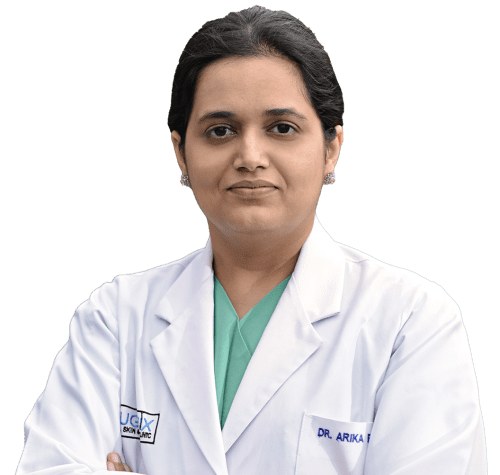
Medically reviewed by Dr. Arika Bansal, Co-Founder, Eugenix Hair Sciences; MBBS, MD Dermatology, Fellow of ISHRS; Reg. No. HN-34095 (Haryana Medical Council).
Dr. Arika Bansal
Dr. Arika Bansal, Co-Founder, Eugenix Hair Sciences. MBBS (Gold Medallist, Lady Hardinge Medical College), MD Dermatology, alumni of AIIMS, New Delhi. Fellow of ISHRS. Reg. No. HN-34095 (Haryana Medical Council).
