Almost every hair transplant patient begins with the same question. How many grafts will I need? That one number decides how natural your result looks, how much donor hair is left for the future, and whether a single hair transplant procedure will be enough.
The calculation has two sides. On one sits the bald area and the hair density it needs. On the other sits your donor area and the number of hair grafts it can safely spare across a lifetime. A sound hair transplant plan is where those two meet.
What Is a Graft, and Is 1 Graft Equal to 1 Hair?
No. A graft is a follicular unit, the natural bundle of one to four hair follicles that grows from the same point in the scalp. Scalp grafts average slightly more than two hairs per graft, beard grafts around one.
So two people can receive the same number of hair grafts and end up with different hair counts. Single hair grafts go across the frontal hairline for a soft, natural hairline, and double and triple grafts sit behind it.
The Formula Behind Every Hair Transplant Graft Calculator
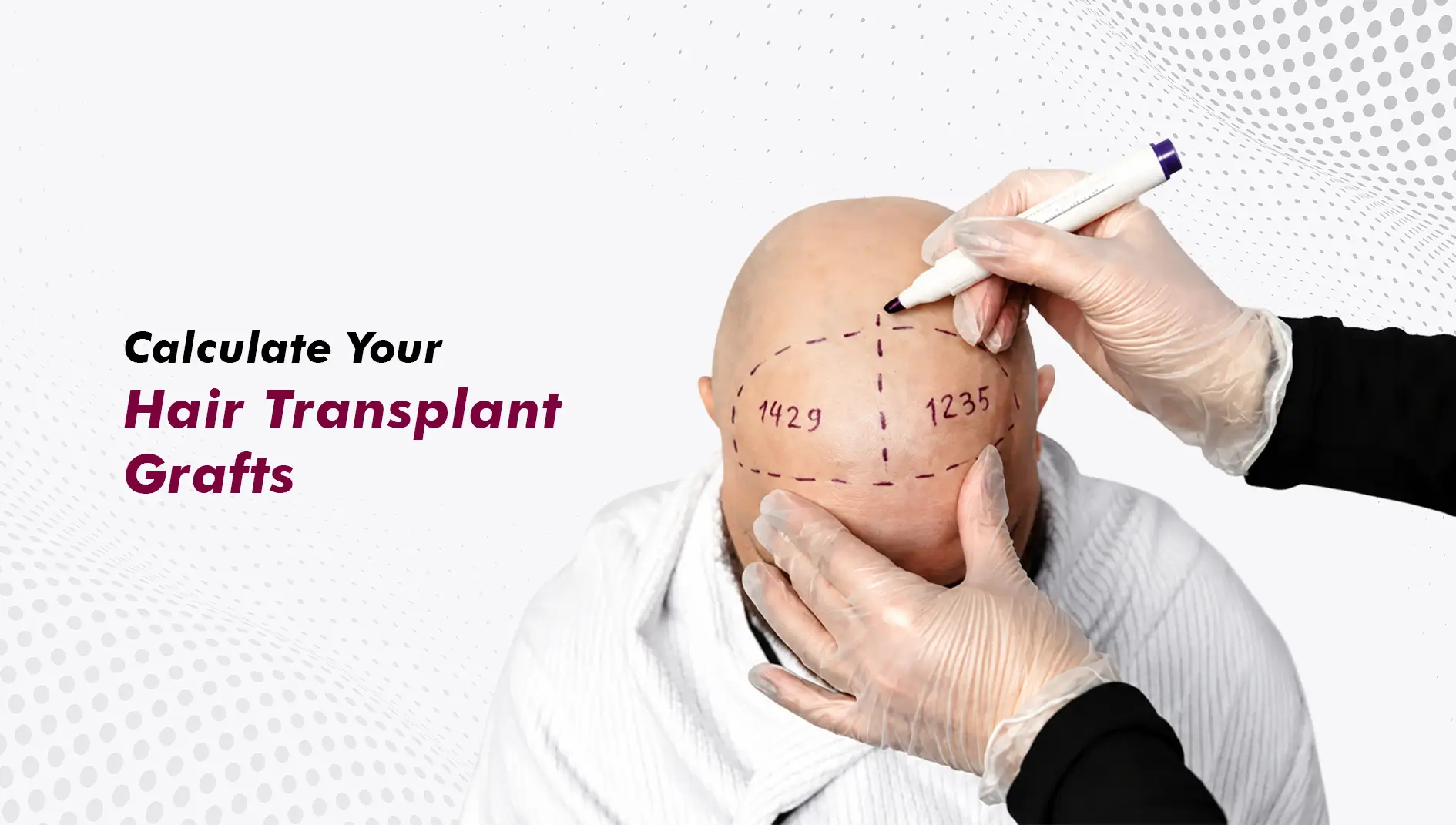
Bald area in square centimetres, multiplied by the target density per square centimetre, gives the number of grafts needed for that zone. The surgeon maps the scalp into zones, measures each, applies the appropriate density, and adds them together.
The density figures used at Eugenix are:
– Hairline zone: 35 to 45 hair grafts per square centimetre
– Mid scalp and crown: 25 to 35 hair grafts per square centimetre
A frontal zone of roughly 50 square centimetres, planned at 40 grafts per square centimetre, works out to approximately 2,000 grafts. Add the zone behind it, add the crown or partial crown if it is being covered, and the total takes shape. That example is illustrative only. Real measurements are taken during the in person Planning and Designing session.
How a hair graft calculator works
A hair transplant graft calculator runs exactly this arithmetic. You enter your hair loss pattern, usually as a Norwood grade, the tool estimates the areas affected by hair loss, and it returns the number of hair grafts required. That tells you roughly how many grafts a pattern like yours needs.
Used properly, a hair graft calculator is a planning aid, giving you an initial estimate before your first Contact Us at a hair transplant clinic.
What it cannot do is examine you. A graft calculator works from averages. A hair transplant surgeon works from your scalp.
Why Hair Density Is Graded, Not Uniform
Higher hair density is not automatically better. The scalp’s blood supply has a limit, and placing more transplanted hair follicles into an area than it can nourish causes graft shock, which compromises survival and affects the surrounding hair. Eugenix plans to optimum density rather than maximum.
Final density after hair transplantation is approximately 50 percent of your original natural hair density. Natural hairs sit roughly 0.5 mm apart, transplanted hair follicles roughly 1.5 mm apart, so a good result shows a slight see through appearance in bright sunlight. Set realistic expectations here rather than fixing on a graft count.
Hair grafts are spent where they buy the most impact. The frontal hairline and mid scalp take the higher end of the range, while the crown is planned more conservatively. Graft placement matters more than graft numbers.
How Many Hair Grafts Does Each Norwood Grade Need?
The number of hair grafts required varies with the grade of hair loss, and each hair loss grade corresponds to a graft range. As a rough scale, around 1,500 grafts is a small hair transplant and around 3,000 grafts is a moderate to large one. These are orientation figures, not benchmarks for any individual.
Grade 6 and Grade 7 patients typically need 7,000 to 9,000 hair grafts for full coverage. That is more than most donors supply at once, so the hair transplant procedure is staged. Splitting the work across two hair transplant sessions also protects the donor area, since hair transplant sessions spaced apart allow the donor to heal.
For these grades the hairline sits conservatively at 9 to 10 cm above the glabella in a V shape, consuming fewer grafts than a rounded hairline design. Density is graded from 40 to 45 grafts per square centimetre at the hairline down to 20 to 25 behind it.
The Donor Area Sets the Ceiling
You can calculate a requirement of any size. A hair transplant can only spend what the donor area safely supplies, and that is decided by the safe donor area, typically the back and sides of the scalp, where follicles resist the hormone that drives hair loss. Transplanted hair follicles from this zone grow naturally in their new location for life.
The reference figures used in planning are:
– Total follicles on an adult scalp: 100,000 to 150,000
– Follicles in the safe donor zone: 30,000 to 45,000
– Per sitting, Indian and Asian patients: 3,000 to 4,500 grafts
– Per sitting, Caucasian patients: 4,000 to 5,000 grafts
– Lifetime capacity, Indian and Asian patients: 5,000 to 8,000 grafts
– Lifetime capacity, Caucasian patients: 6,000 to 9,000 grafts
Read the lifetime figures carefully. Your donor bank is finite. Every graft extracted for a first transplant is one unavailable in fifteen years, when your hair loss pattern may have advanced further. Extraction is spread uniformly across the donor area, never heavily from one patch, and never from the unsafe zones.
When beard and body hair enter the calculation
Where scalp donor capacity falls short in a large hair transplant, beard hair follicles are the strongest supplement, with survivability of 80 to 88 per cent in a healthy donor and a lifetime yield of 3,000 to 5,000 grafts.
Beard and body grafts fill the mid-scalp and crown periphery, mixed with scalp grafts for a seamless blend. They are never used in the hairline, temple points, or crown whorl, where their coarser texture would show.
What a Hair Graft Calculator Cannot See
Two patients with the same hair loss grade and identical thinning areas can need very different graft numbers, because hair characteristics differ. The variables that move the count include:
– Hair characteristics. Thick, coarse hair covers more ground than fine hair, and curly covers more than straight.
– Colour contrast. Dark hair against fair skin shows the scalp more readily, so a higher desired density may be needed.
– Donor supply and scalp laxity. A hair transplant surgeon will assess scalp laxity directly, since both cap what can be harvested.
– Head size. A larger head needs more grafts for the same coverage.
– Age and progression. A 24 year old needs a plan built around future hair loss, not only what exists today.
– Scalp condition and hair type. Both shape graft placement and how existing hair blends with new growth.
– Medical therapy. Oral Finasteride can retain peripheral hair at the crown, reducing the grafts required there. It slows progression, it is not a cure, and should be taken only under medical supervision. Most patients stay on it long term.
This is where a graft calculator stops. A hair transplant graft calculator is only as good as its assumptions, while an in person assessment by an experienced surgeon is a plan.
How Your Hair Transplant Graft Count Is Confirmed at Eugenix
First, a pictorial evaluation from your photographs, carried out by Eugenix trained doctors under the supervision of the founding surgeons. This gives a tentative range so you can plan your hair restoration journey, including timing and hair transplant cost, but it is an assessment made from images.
Second, the in person Planning and Designing session. The lead surgeon measures the bald zones, assesses donor density directly, completes the hairline design against your facial proportions, and sets every technical parameter, following the ADDD principle of Angle, Depth, Density, and Direction or Design. Variation against the initial estimate is usually minor, often a few hundred grafts. Larger cases are planned as multiple sessions from the outset.
Consultations are conducted by a panel of experienced hair transplant surgeons, each personally handpicked and trained by the Co-Founders, Dr. Pradeep Sethi and Dr. Arika Bansal, both Fellows of ISHRS and alumni of AIIMS, New Delhi. Either Co-Founder can be consulted by appointment, subject to their schedule.
During the hair transplant procedure, The lead surgeon performs the extraction and sets every technical parameter. The Eugenix medical team assists and carries out implantation under the lead surgeon’s parameters and supervision, using the SAVA Implanter, a no-root-touch instrument. The lead surgeon supervises throughout, taking rounds between active steps and remaining available at all times during your surgery.
The technique is DHT, Direct Hair Transplant, the flagship hair restoration modification of FUE developed by the Eugenix Co-Founders and published in 2013 as “Direct hair transplantation: a modified follicular unit extraction technique”. Because extraction and graft placement happen simultaneously, out of body time stays under 30 minutes, against the 3 to 6 hours typical of traditional FUE. The Gurgaon hair transplant clinic is NABH accredited, Certificate No. DE-2026-0004.
Frequently Asked Questions
How much will 3,000 grafts cover?
At 25 to 35 grafts per square centimetre, a 3,000 graft hair transplant covers roughly 85 to 120 square centimetres, less where a dense hairline is included. For many patients that is the frontal zone and the area behind it, or a partial crown alongside a smaller frontal restoration.
How much is 4,000 grafts?
In scale, 4,000 grafts is the upper end of what one sitting can safely harvest for most Indian and Asian patients. In money, hair transplant cost is quoted per graft and varies by package, so a figure is meaningful only once a Contact Us confirms the grafts needed.
How many hairs are in 10,000 grafts?
At slightly more than two hairs per graft, 10,000 scalp grafts represent somewhat over 22,000 hairs. That number of grafts exceeds the lifetime scalp donor capacity of most patients, so it would involve beard or body donor across multiple hair transplant sessions and years.
Do more hair grafts always mean a better hair transplant result?
No. Beyond what the blood supply sustains, extra hair grafts reduce survival rather than improve coverage. Distribution, angle, direction, and graft placement decide how natural the outcome looks far more than the raw number of grafts does.
The Right Number, Not the Biggest One
Calculating grafts for hair restoration balances the area to be covered, the density that will look natural, and a donor supply that has to last a lifetime.
Any hair transplant clinic can quote a large number of grafts. A qualified surgeon quotes a sustainable one and holds donor hair back for the hair loss that has not happened yet.
Use a hair graft calculator to orient yourself, then book a Contact Us with a skilled surgeon at a hair transplant clinic for a personalised treatment plan and the graft count that is right for you.
Dr. Arika Bansal
Dr. Arika Bansal, Co-Founder, Eugenix Hair Sciences. MBBS (Gold Medallist, Lady Hardinge Medical College), MD Dermatology, alumni of AIIMS, New Delhi. Fellow of ISHRS. Reg. No. HN-34095 (Haryana Medical Council).