

At Eugenix, the cost of a hair transplant is worked out per graft, so a 1,000-graft plan is priced on its graft count. Hair transplant pricing at Eugenix starts from INR 100 per graft plus 5% GST. The final cost depends on the number of grafts planned for your case, which is decided after your scalp and donor area are assessed. Our team explains the costs in full at consultation.
The more useful question is whether 1,000 grafts is the right number for you. This guide from Eugenix Hair Sciences explains how the cost of a 1,000-graft hair transplant in India is worked out at Eugenix, what 1,000 grafts usually cover, and what else to plan for. For a closer look at coverage alone, read our guide on whether 1,000 grafts is a lot for a hair transplant.
How is the cost of 1,000 grafts worked out?
The hair transplant cost at Eugenix follows a simple rule: the number of grafts in your written plan multiplied by the per-graft price, plus GST. There is no separate price for an area such as the hairline or the temples. Two people who both ask for “1,000 grafts” may in fact need different numbers once their scalp is examined, and so their costs differ.
The graft count comes first; the cost follows from it.
A worked example for 1,000 grafts
Hair transplant pricing at Eugenix starts from INR 100 per graft plus 5% GST.
For example, a plan of 1,000 grafts at INR 100 per graft comes to INR 1,00,000, plus 5% GST (INR 5,000), so INR 1,05,000 in all. This is only an example to show how the estimated cost is worked out; the number of grafts needed in your own plan decides your final cost.
What does 1,000 grafts usually cover?
A graft, also called a follicular unit, is a natural group of 1 to 4 hairs that grow together from the same point in the scalp. Scalp grafts carry a little over 2 hairs each on average, so 1,000 grafts carry a little over 2,000 hairs. Our explainer on grafts, hairs and follicular units covers this in detail.
The area a graft count covers depends on the density planned. At the hairline, grafts are usually planned at 35 to 45 grafts per square centimetre; behind it, in the mid-scalp and crown, at 25 to 35. So 1,000 grafts cover roughly 22 to 29 square centimetres at the hairline, or 29 to 40 square centimetres behind it. That is a small area. It can suit:
- Mild temple recession, where the corners of the hairline have moved back.
- A small part of a receding hairline, with good hair behind it.
- Adding density to a small area treated before, once the earlier result has fully grown.
- A small correction, such as refining one part of an earlier hairline.
When is 1,000 grafts not enough?
With moderate hair loss, a whole receding hairline, a thinning zone behind the hairline or an opening crown, 1,000 grafts are usually spread too thin. A larger plan, or a plan over more than one sitting, is then discussed. Advanced hair loss, Grade 6 and 7 on the Norwood scale, usually needs 7,000 to 9,000 grafts, so 1,000 grafts covers only a very small part of it. If a hairline is your main concern, our guide on whether 1,500 grafts is enough for a hairline explains the next step up.
Why might the doctor suggest a different number?
The graft count cannot be given accurately from a photograph alone. At consultation the doctor examines your scalp and donor area, measures the area to be covered and checks several things that change the number:
- The size of the thinning or bald area.
- The hair you still have in that area.
- Hair thickness and texture: thicker hair, and curly or wavy hair, cover more scalp than fine, straight hair.
- Colour contrast: dark hair on light skin shows the scalp more than hair close to the skin tone.
- Your age and how your hair loss may progress. Pattern hair loss usually progresses in the 20s and 30s, and slows down from the mid-40s towards the 50s.
- Your donor supply, which has to last a lifetime.
A hair transplant moves hair; it does not stop pattern hair loss in the hair you still have. Finasteride slows the progression of male pattern hair loss. It is not a cure and is taken under medical supervision. The doctor explains whether it fits alongside your plan.
Is a 1,000-graft plan easier on the donor area?
Yes, it uses a small share of your donor supply. For Indian hair, about 3,000 to 4,500 grafts can usually be taken in one sitting, and about 5,000 to 8,000 over a lifetime, so 1,000 grafts leaves most of the donor area for the future. That matters because hair loss is progressive and you may need donor hair later.
Small does not mean invisible. If you plan to keep the hair at the back very short, some donor thinning may show even after a small session. The doctor discusses your preferred hair length before the procedure.
What else should you plan for besides the grafts?
Blood tests are planned and charged separately. Every patient has a standard set of blood tests and medicine department clearance before surgery, and patients aged 40 and above also have an ECG.
If your plan is split over more than one sitting, the cost of each sitting depends on the grafts placed in it, and the total cost is the sum of the sittings. Our hair transplant cost page explains pricing in more detail.
What happens in a 1,000-graft hair transplant at Eugenix?
Every hair transplant at Eugenix is done with Direct Hair Transplant (DHT). Direct Hair Transplant (DHT) is a modified FUE technique described by Eugenix Hair Sciences’ Co-Founders in their 2013 research paper. Grafts stay outside the body for under 30 minutes with Direct Hair Transplant, compared to 3 to 6 hours with conventional FUE.
The lead surgeon performs the extraction and sets every technical parameter. The Eugenix medical team assists and carries out implantation under the lead surgeon’s parameters and supervision, using the SAVA Implanter, a no-root-touch instrument. The procedure is performed under local anaesthesia.
Recovery usually takes about 7 days, and the first head wash is on Day 7. Shedding of the transplanted hairs happens in every patient between Day 30 and Day 90. Transplanted hair usually starts to grow from Month 4, and full results take 10 to 12 months. Results vary from person to person.
Key points
- At Eugenix, cost is worked out per graft: hair transplant pricing starts from INR 100 per graft plus 5% GST.
- As an example, 1,000 grafts at INR 100 per graft comes to INR 1,05,000 including 5% GST; your own graft count decides your final cost.
- 1,000 grafts carry a little over 2,000 hairs and suit a small area, such as mild temple recession or part of the hairline.
- Moderate or advanced hair loss usually needs more grafts, sometimes over more than one sitting.
Eugenix Hair Sciences has worked only in hair restoration since 2009, with centres in Gurugram, Mumbai, Hyderabad, Bhubaneswar and Bengaluru. It was founded by Dermatologists, alumni of AIIMS, New Delhi, and Fellows of ISHRS.
Know more about what 1,000 grafts can cover in our guide: is 1,000 grafts a lot?
Frequently asked questions
How much does a 1,000-graft hair transplant cost in India?
At Eugenix the cost is set per graft. Hair transplant pricing at Eugenix starts from INR 100 per graft plus 5% GST. As an example, 1,000 grafts at INR 100 per graft comes to INR 1,00,000, plus 5% GST (INR 5,000), so INR 1,05,000 in all. Your own graft count, decided after your scalp and donor area are assessed, sets your final cost.
Is the cost of 1,000 grafts the same for the hairline and the crown?
Yes. At Eugenix the price is set per graft, not per area, so 1,000 grafts are priced the same way wherever they are placed. What differs is how far they go. The hairline is planned at 35 to 45 grafts per square centimetre and the crown at 25 to 35, and the crown often needs more grafts than people expect.
How many hairs are in 1,000 grafts?
1,000 grafts carry a little over 2,000 hairs on average. A graft is a natural group of 1 to 4 hairs, and scalp grafts carry a little over 2 hairs each on average. At the front of the hairline, single-hair grafts are placed, so a plan with more hairline work carries fewer hairs for the same number of grafts.
Is 1,000 grafts enough for a receding hairline?
It can be enough for mild temple recession or a small part of the hairline. When the whole hairline has receded, or the area behind it is thinning, 1,000 grafts are usually spread too thin and a larger plan is discussed. The doctor measures the area and checks your donor supply before suggesting a number at consultation.
Why can I not get an exact price for 1,000 grafts online?
Because the exact price depends on the exact graft count, and that is set only after your scalp and donor area are assessed. You may need fewer or more than 1,000 grafts once the area, the hair already present, your hair thickness and how your hair loss may progress are checked. Clear scalp photos can give a first, tentative range.
Are there other costs besides the grafts?
Blood tests are planned and charged separately. Every patient has a standard set of blood tests and medicine department clearance before surgery, and patients aged 40 and above also have an ECG. If you travel from another city, plan for your stay. No Cost EMI for up to 12 months is available in India. A processing fee applies, charged by the finance provider.
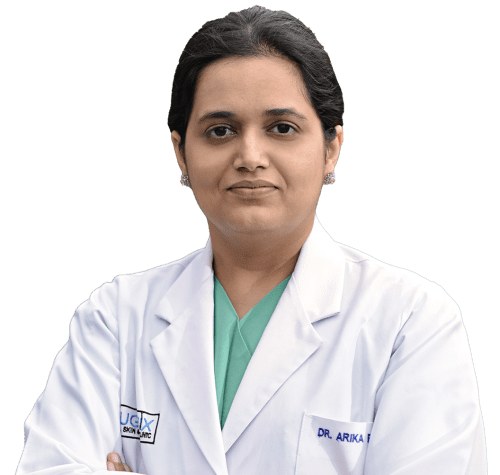
Medically reviewed by Dr. Arika Bansal, Co-Founder, Eugenix Hair Sciences; MBBS, MD Dermatology, Fellow of ISHRS; Reg. No. HN-34095 (Haryana Medical Council).
Dr. Arika Bansal
Dr. Arika Bansal, Co-Founder, Eugenix Hair Sciences. MBBS (Gold Medallist, Lady Hardinge Medical College), MD Dermatology, alumni of AIIMS, New Delhi. Fellow of ISHRS. Reg. No. HN-34095 (Haryana Medical Council).
