

Usually not. Hair shedding after pregnancy, often called postpartum hair loss, is common and is usually temporary. It is a form of telogen effluvium, in which many hairs enter the resting phase at the same time and then fall, and it generally settles once the body recovers. A hair transplant does not treat this kind of shedding. If the hair fall does not settle, or a widening part or a thin area remains, see a doctor to find the cause.
This guide from Eugenix Hair Sciences explains why hair falls after delivery, when to see a doctor, what is checked, and the few cases where a hair transplant may be discussed later. For other causes of hair loss in women, read our page on hair loss in women.
Why does hair fall out after pregnancy?
Hair grows in cycles. At any time, most hairs are in the growth phase and a smaller share are resting before they fall. Stress, illness, surgery and pregnancy, including the time after giving birth, can all push many hairs into the resting phase together. This is called telogen effluvium. A few months later, those hairs fall over a short period.
The result is shedding across the whole scalp, often noticed when washing or combing, rather than a bald patch. Because the roots stay in the skin, the hair usually grows back once the trigger has passed. This is why postpartum hair loss on its own is not a reason for surgery.
Will my hair grow back after pregnancy?
In most women, yes. Shedding from telogen effluvium is generally reversible once the trigger settles. Regrowth starts as short new hairs, often first noticed along the hairline and the parting, and the hair slowly returns towards its earlier fullness.
Daily hair fall can look worrying while it lasts. But losing hair evenly from all over the scalp in this way does not mean you are going bald. What matters is whether it settles with time.
When should I see a doctor?
See a doctor, ideally a dermatologist, if:
- The hair fall does not settle with time, or keeps coming back.
- Your parting is getting wider, or the top of the scalp is thinning, after the shedding has stopped.
- You notice bald patches, or redness, scaling or itching on the scalp.
- You have other symptoms, such as unusual tiredness.
- Pattern hair loss runs in your family and you are worried about it.
Hair loss in women often has other causes than in men, so the doctor first checks the pattern and the cause, sometimes with blood tests.
What does the doctor check?
A scalp examination and your history help the doctor tell temporary shedding apart from other causes. Blood tests may include thyroid function and iron stores, and hormone tests where needed. Conditions the doctor looks for include:
- Female pattern hair loss, where the parting widens and the top of the scalp thins.
- Thyroid disorders.
- Low iron stores or other nutritional deficiencies.
- Hormonal changes such as polycystic ovary syndrome (PCOS).
- Alopecia areata, which causes round, coin-shaped bald patches.
Treatment then depends on the cause. When the cause is treated, hair often recovers without any surgery.
Can I take hair loss medicines while breastfeeding?
Ask your doctor first. Some medicines used for hair loss are not suitable during pregnancy or while breastfeeding, so do not start any tablet, lotion or supplement on your own, including products bought online. Tell every doctor you see that you are breastfeeding.
A balanced, protein-rich diet supports your general health while your hair recovers. The doctor may advise supplements if a test shows a deficiency.
Can pregnancy reveal female pattern hair loss?
Sometimes the shedding settles, but the hair on top does not return to its earlier fullness and the part stays wider. This can mean that female pattern hair loss was already developing and has become easier to see. It is a different condition from shedding after pregnancy, and it is assessed and treated differently.
The doctor checks for it if the thinning remains once the shedding has settled. Female pattern hair loss is usually treated with medicines first. Read more in our guide on a hair transplant for thinning hair.
When might a hair transplant be considered after pregnancy?
A hair transplant moves your own hair from the back and sides of the scalp, where it is usually less affected by pattern hair loss, to an area that is thinning. It does not stop shedding, and it is not used for telogen effluvium. It may be discussed later only when:
- The shedding after pregnancy has fully settled.
- The doctor has found a stable pattern of hair loss, such as female pattern hair loss, and treated any other cause.
- The donor area at the back and sides of the scalp is healthy.
- You are no longer pregnant or breastfeeding, and the doctor agrees the timing suits you.
Women need some additional blood tests before surgery, including hormone tests, and medical clearance is needed for every patient. Shock loss, the loss of some existing hair near the treated area after surgery, is more common in women, and the doctor explains it before any plan is made. Read what is different for female patients.
How is a hair transplant done at Eugenix?
Every hair transplant at Eugenix is done with Direct Hair Transplant (DHT). Direct Hair Transplant (DHT) is a modified FUE technique described by Eugenix Hair Sciences’ Co-Founders in their 2013 research paper. Grafts stay outside the body for under 30 minutes with Direct Hair Transplant, compared to 3 to 6 hours with conventional FUE.
The lead surgeon performs the extraction and sets every technical parameter. The Eugenix medical team assists and carries out implantation under the lead surgeon’s parameters and supervision, using the SAVA Implanter, a no-root-touch instrument. Recovery usually takes about 7 days, new hair usually starts to grow from Month 4, and full results take 10 to 12 months. Results vary from person to person.
Key points
- Postpartum hair loss is common and usually temporary.
- It is a form of telogen effluvium and generally settles once the body recovers.
- A hair transplant does not treat this shedding.
- See a doctor if the hair fall does not settle, or a widening part or thin area remains.
- Do not start any hair loss medicine on your own while pregnant or breastfeeding.
Eugenix Hair Sciences has worked only in hair restoration since 2009, with centres in Gurugram, Mumbai, Hyderabad, Bhubaneswar and Bengaluru. It was founded by Dermatologists, alumni of AIIMS, New Delhi, and Fellows of ISHRS.
Know more: hair loss in women.
Frequently asked questions
Is hair loss after pregnancy normal?
Yes, shedding after pregnancy is common. Pregnancy is one of the triggers of telogen effluvium, in which many hairs enter the resting phase together and then fall across the whole scalp. It is usually temporary and generally settles once the body recovers. If the hair fall does not settle, or a widening part or a thin area remains, see a doctor.
Will my hair grow back after pregnancy hair loss?
In most women, yes. In telogen effluvium the roots stay in the scalp, so hair usually grows back once the trigger has passed, starting as short new hairs. If the hair does not return towards its earlier fullness, or the part stays wider, the doctor checks for another cause, such as female pattern hair loss, thyroid disorders or low iron stores.
Do I need a hair transplant for hair loss after pregnancy?
Usually not. A hair transplant does not treat shedding after pregnancy, which is usually temporary. A transplant may be discussed later only if the shedding has settled, the doctor finds a stable pattern of hair loss, any other cause has been treated and the donor area is healthy. Diffuse thinning in women is usually treated with medicines first.
Can I take hair loss medicine while breastfeeding?
Ask your doctor first. Some medicines used for hair loss are not suitable during pregnancy or while breastfeeding, so do not start any tablet, lotion or supplement on your own, including products bought online. Tell every doctor you see that you are breastfeeding. A balanced, protein-rich diet supports your recovery, and the doctor may advise supplements if a test shows a deficiency.
When should I see a doctor about hair fall after delivery?
See a doctor if the hair fall does not settle with time, if your part is getting wider after the shedding has stopped, if you notice bald patches, redness or scaling on the scalp, or if you have other symptoms such as unusual tiredness. The doctor checks the pattern and cause of your hair loss, sometimes with blood tests, before advising treatment.
Can I have a hair transplant after pregnancy?
It may be possible later, once you are no longer pregnant or breastfeeding, the shedding has settled and the doctor finds a stable pattern of hair loss with a healthy donor area. Women need some additional blood tests before surgery, including hormone tests, and medical clearance is needed for every patient. The doctor advises on timing after assessing you.
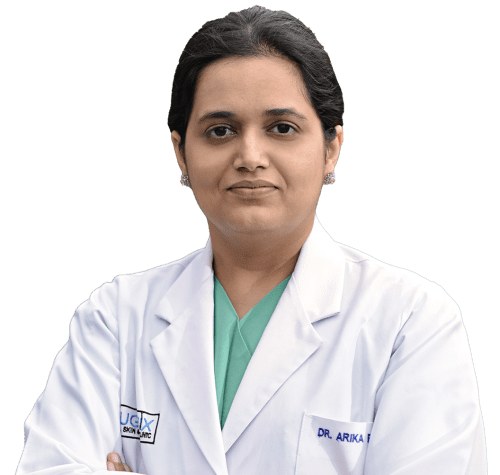
Medically reviewed by Dr. Arika Bansal, Co-Founder, Eugenix Hair Sciences; MBBS, MD Dermatology, Fellow of ISHRS; Reg. No. HN-34095 (Haryana Medical Council).
Dr. Arika Bansal
Dr. Arika Bansal, Co-Founder, Eugenix Hair Sciences. MBBS (Gold Medallist, Lady Hardinge Medical College), MD Dermatology, alumni of AIIMS, New Delhi. Fellow of ISHRS. Reg. No. HN-34095 (Haryana Medical Council).
