

It depends on what was burnt. If only the hair itself was burnt, by a straightener, curling iron, hair dryer or a flame, the hair follicles under the skin are usually not harmed, so new hair keeps growing from the roots. If the scalp skin was burnt, the answer depends on how deep the burn went. A shallow burn may leave the follicles alive and the hair can grow back as the skin heals. A deep burn that leaves a scar can destroy the follicles, and hair does not grow back in that scarred area on its own.
This guide from Eugenix Hair Sciences explains the difference between burnt hair and a burnt scalp, what you can expect in each case, and when it makes sense to have the scar assessed by a doctor.
What is the difference between burnt hair and a burnt scalp?
Each hair has two parts. The hair shaft is the part you see, cut and style. The hair follicle is the root, a small living structure in the skin that makes the hair. Hair growth always starts from the follicle.
- Burnt hair: heat or a flame damages the hair shaft. The shaft has no living cells, so it cannot heal, but the follicle below the skin is usually untouched.
- A burn injury to the scalp: heat, a flame, a chemical or electricity damages the skin itself. Because the follicles sit inside the skin, a deep burn can reach and destroy them.
So the real question is not whether the hair was burnt, but whether the follicles survived.
Does hair burnt by heat or styling grow back?
Yes. Hair burnt by styling tools, a hot hair dryer held too close, or a brief flame usually grows back normally, because the damage stops at the hair shaft. The burnt part may feel dry, rough or brittle, it may break easily or frizz, and its texture can look different from the rest of your hair.
The damaged length itself cannot be repaired. It stays until it breaks off or is trimmed, and new hair grows in from the follicle behind it. Trimming the damaged ends is the usual way to remove them.
If you notice redness, blisters or pain on the scalp after styling, the skin may also have been burnt. A minor scalp burn usually heals on its own, but a blister, an open wound or skin that stays sore should be seen by a doctor.
Does hair grow back after a burn injury to the scalp?
It depends on the depth of the burn:
- Shallow burns: the top layers of skin are injured, but many follicles may survive. Hair can grow back once the skin has healed, sometimes thinner at first.
- Deep burns: the burn reaches the deeper layers of skin and destroys the follicles. The area heals with scar tissue, and hair does not grow back there on its own.
- Skin grafts: where grafted skin was used to treat a burn, the grafted skin usually does not carry hair follicles.
Hair loss in a scar after a burn is called burn scar alopecia. It is one form of scarring alopecia, in which the follicles have been replaced by scar tissue.
Why does hair not grow on burn scar tissue?
Scar tissue is not the same as normal skin. It is firmer, often thinner or tighter, and has a poorer blood supply. Most importantly, the follicles that once made the hair are no longer there. Without follicles, no medicine or hair product can make hair grow in that patch.
This is also why hair restoration in a scar needs more care than a standard hair transplant. Our guide on hair transplantation on scar tissue explains how scars from injuries and surgery are treated.
When should you see a doctor about a burn scar on the scalp?
It makes sense to have a doctor assess the area if:
- A patch of scalp still has no hair long after the burn has healed.
- The skin in the area looks shiny, tight, raised or uneven.
- The scar is visible and you would like to know what can be done for it.
- You are not sure whether the hair loss comes from the burn or has another underlying cause.
The doctor examines the scar and the hair around it, checks whether the scar has fully healed and settled, and looks at your donor area at the back and sides of the scalp. A scar with active inflammation, or one that is still red or changing, is usually left to settle before any hair transplant surgery is planned.
Can a hair transplant help a burn scar?
In many cases a hair transplant can be considered once the scar has matured. Healthy hair follicles are taken from your donor area, usually the back and sides of the scalp, and placed into the scar. The transplanted hair is your own natural hair, and it grows naturally from your own roots.
Because scar tissue has a poorer blood supply, grafts placed into scars are planned at a lower density, and a small test session is often done first to see how the scar responds. More than one session may be needed. A hair transplant may not be advised if the scar is too thin or fragile, or if the donor area cannot spare enough grafts. In some cases scalp micropigmentation (SMP) is discussed as another way to reduce how visible the scar looks. Our page on burn hair transplant explains how burn scar cases are planned.
The donor area sets the limit for any plan, so it is assessed carefully. Our guide on how much donor hair you have explains how this is checked.
How is a hair transplant done at Eugenix?
Every hair transplant at Eugenix is done with Direct Hair Transplant (DHT). Direct Hair Transplant (DHT) is a modified FUE technique described by Eugenix Hair Sciences’ Co-Founders in their 2013 research paper. Grafts stay outside the body for under 30 minutes with Direct Hair Transplant, compared to 3 to 6 hours with conventional FUE.
The lead surgeon performs the extraction and sets every technical parameter. The Eugenix medical team assists and carries out implantation under the lead surgeon’s parameters and supervision, using the SAVA Implanter, a no-root-touch instrument. The procedure is performed under local anaesthesia, and recovery usually takes about 7 days. Results vary from person to person.
Key points
- Hair burnt by heat or styling usually grows back, because the follicles under the skin are not harmed.
- The burnt length cannot be repaired; it grows out or is trimmed.
- After a shallow scalp burn, hair can return as the skin heals.
- A deep burn that leaves a scar can destroy the follicles, so hair does not grow back in scarred areas on its own.
- A doctor can assess a settled burn scar and the donor area and explain whether a hair transplant can be considered.
Eugenix Hair Sciences has worked only in hair restoration since 2009, with centres in Gurugram, Mumbai, Hyderabad, Bhubaneswar and Bengaluru. It was founded by Dermatologists, alumni of AIIMS, New Delhi, and Fellows of ISHRS.
Know more: burn hair transplant at Eugenix.
Frequently asked questions
Can burnt hair grow back?
Yes, if only the hair was burnt. Heat from a straightener, curling iron, hair dryer or a brief flame damages the hair shaft, not the follicle under the skin, so new hair keeps growing from the root. The burnt length itself cannot be repaired. It grows out or is trimmed. Hair may not grow back where a deep burn has scarred the scalp skin.
Does burnt hair grow back thicker?
No. Burning or cutting the hair shaft does not change the follicle, so the new hair grows back the same as before. The burnt ends can feel rough, frizzy or brittle, which can make the hair look different for a while. Once the damaged length has grown out or been trimmed, the hair usually looks and feels as it did before.
Can hair grow on burn scars?
Not on its own when the burn was deep enough to destroy the follicles, because scar tissue has no follicles to make new hair. After a shallow burn some hair may return as the skin heals. For a settled scar with no hair, a doctor can assess whether a hair transplant can be considered, using your own hair from the donor area at the back and sides of the scalp.
How do I know if my scalp, not just my hair, was burnt?
Look at the skin, not only the hair. Redness, soreness, blisters, an open wound or a crust on the scalp suggest the skin itself was burnt. Hair that is only burnt feels dry, rough or brittle while the scalp looks normal. A blister, an open wound or skin that stays painful should be seen by a doctor.
When can a hair transplant be done on a burn scar?
Only once the scar has fully healed and settled, as assessed by the doctor. A scar that is still red, inflamed or changing is left to mature first. The doctor also checks how thick and flexible the scar is and how much donor hair you have. A small test session is often done first, and more than one session may be needed.
Do I need to see a doctor for burnt hair?
Usually not, if only the hair was burnt and the scalp looks and feels normal. The damaged hair can be trimmed and new hair grows from the roots. See a doctor if the scalp has blisters, an open wound or ongoing pain, or if a patch still has no hair long after a burn injury has healed.
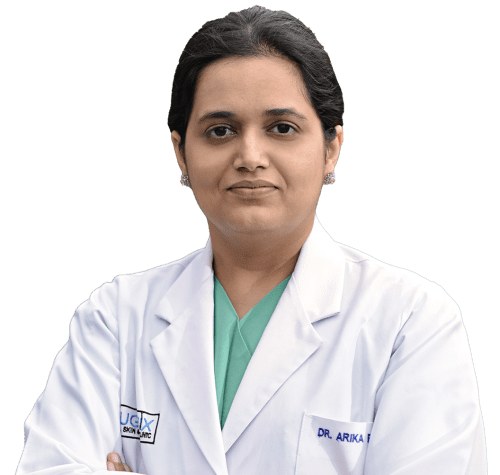
Medically reviewed by Dr. Arika Bansal, Co-Founder, Eugenix Hair Sciences; MBBS, MD Dermatology, Fellow of ISHRS; Reg. No. HN-34095 (Haryana Medical Council).
Dr. Arika Bansal
Dr. Arika Bansal, Co-Founder, Eugenix Hair Sciences. MBBS (Gold Medallist, Lady Hardinge Medical College), MD Dermatology, alumni of AIIMS, New Delhi. Fellow of ISHRS. Reg. No. HN-34095 (Haryana Medical Council).
