

Only a doctor can tell you how much donor hair you have, after looking at the back and sides of your scalp. As a guide, Indian and Asian patients can usually give about 3,000 to 4,500 grafts in one sitting and about 5,000 to 8,000 grafts over a lifetime. Caucasian patients can usually give about 4,000 to 5,000 grafts per sitting and about 6,000 to 9,000 over a lifetime. Where you fall in that range depends on your own donor area and on how your hair loss may progress.
This guide from Eugenix Hair Sciences explains what the donor area is, what decides your donor capacity, how the doctor assesses it, and what happens when donor hair is limited.
What is donor hair?
Donor hair is the hair taken from the back and sides of your scalp and moved to the area that has thinned. Within this hair transplant donor area is the safe donor zone, where hair is usually less affected by pattern hair loss. Follicles moved from this zone usually keep that quality in their new place, which is why a hair transplant gives a long-term result in the treated area.
The safe donor zone, mainly the back of the head (the occipital scalp) and the sides, holds roughly 30,000 to 45,000 hair follicles. Only a part of this can be taken without leaving visible thinning.
What decides how much donor hair you have?
Two people with the same grade of hair loss can have very different donor capacity. These are the main factors:
- Donor density: how closely the hair follicles sit in the donor zone. A donor area with higher hair density can give more grafts before it starts to look thin.
- Hairs per graft: a graft, or follicular unit, is a natural group of 1 to 4 hairs. Scalp grafts carry a little over 2 hairs on average, so a donor area with more multi-hair grafts gives more coverage from the same graft count.
- Hair characteristics: thicker hair covers more scalp per graft than fine hair. Dark hair on a light scalp shows more contrast, so the same density can look thinner.
- Scalp laxity: how easily the scalp skin moves. This affects how comfortably grafts can be taken.
- Your hair loss pattern and age: the donor area has to cover today’s bald area and any area that may thin later. Pattern hair loss usually progresses in the 20s and 30s, and slows down from the mid-40s towards the 50s, so a younger patient’s plan keeps more grafts in reserve.
How is your donor capacity assessed?
The doctor looks at your donor area at consultation, in person or from good-quality photos. Read more about what happens at a hair transplant consultation.
The doctor checks donor density and hair calibre, often under magnification, looks for any thinning within the donor area itself, and notes your grade of hair loss, age and family history. Together, these show your donor strength. From this, you receive an estimate of how many grafts can be used now and how many should be kept for the future. The exact graft count for your case is set on the day of the procedure, during Planning & Designing by the lead surgeon.
If your hair is thinning all over the scalp, including at the back and sides, the doctor may advise medicines first and a review later, because a hair transplant needs a stable donor area to work.
Why is the donor supply limited?
Each follicle taken from the donor area is moved, not copied, so it does not grow back in its old place. The hair around each extraction point keeps growing and covers it, but the donor supply is finite. Every graft used now is one that is not available later, which is why careful, long-term planning matters more than any single number.
Taking too many grafts, or taking them from one patch, is called overharvesting. It can leave visible thinning at the back and sides and less hair for a second hair transplant. Our guide on whether 4,000 or 5,000 grafts is too many explains this in detail.
How many grafts does your hair loss need?
Donor capacity only makes sense next to the area to be covered. A hairline alone needs fewer grafts than the hairline, mid-scalp and crown together. Grade 6 and 7 hair loss usually needs 7,000 to 9,000 grafts, which is more than the scalp donor area of many Indian patients can give over a lifetime. Read more in how many grafts Grade 5, 6 and 7 hair loss needs.
What if your donor hair is limited?
A limited donor area does not always rule out a hair transplant. It changes the plan.
- Front first: framing the face with the hairline and front usually matters most, so the available grafts go there first.
- Hairline shape: a hairline set slightly higher and in a V shape uses fewer grafts than a low, rounded one, which leaves more grafts for the mid-scalp.
- Medical treatment: Finasteride slows the progression of male pattern hair loss. It is not a cure and is taken under medical supervision. By helping keep the native hair you still have, it can reduce how many grafts are needed.
- Beard and body hair: when the scalp donor area alone is not enough, beard hair can be added as a filler. About 500 to 800 grafts can usually be taken from below the chin and jawline without changing how the beard looks, and a healthy beard can give about 3,000 to 5,000 grafts over a lifetime. Beard grafts are mixed with scalp grafts and are never placed in the hairline, temple points or crown whorl. Body hair is a filler, not a primary donor.
How the donor area is protected at Eugenix
Eugenix performs Direct Hair Transplant (DHT). Direct Hair Transplant (DHT) is a modified FUE technique described by Eugenix Hair Sciences’ Co-Founders in their 2013 research paper. In DHT, grafts are taken one at a time, so there is no linear scar.
The donor zone is divided into blocks, and grafts are taken evenly from each block in a wavy, zigzag manner, so no single patch looks thin. The lead surgeon performs the extraction and sets every technical parameter. The Eugenix medical team assists and carries out implantation under the lead surgeon’s parameters and supervision, using the SAVA Implanter, a no-root-touch instrument. For more on healing and long-term appearance, read what happens to the donor area after a hair transplant.
Eugenix Hair Sciences has worked only in hair restoration since 2009, with centres in Gurugram, Mumbai, Hyderabad, Bhubaneswar and Bengaluru.
Key points
- Only an examination can tell you how much donor hair you have.
- As a guide, Indian and Asian patients can usually give 3,000 to 4,500 grafts per sitting and 5,000 to 8,000 over a lifetime.
- Donor density, hairs per graft, hair calibre, age and future hair loss decide your own number.
- A limited donor area changes the plan; it does not always rule out a hair transplant.
Know more about your donor area and your options by speaking to our team.
Frequently asked questions
How much donor hair do I have?
Only a doctor can say, after examining the back and sides of your scalp. As a guide, Indian and Asian patients can usually give about 3,000 to 4,500 grafts in one sitting and 5,000 to 8,000 over a lifetime. Caucasian patients can usually give about 4,000 to 5,000 per sitting and 6,000 to 9,000 over a lifetime. Your own number depends on donor density, hair calibre and how your hair loss may progress.
How many grafts can be taken from the donor area in one sitting?
For most Indian and Asian patients, about 3,000 to 4,500 grafts can be taken from the scalp in one sitting, and for Caucasian patients about 4,000 to 5,000. Taking more than the donor area can safely give, or taking grafts from one patch, can leave visible thinning. The doctor sets the number for your case after assessing your donor area and the area to be covered.
Can my donor area be assessed before I travel to a centre?
Yes. You can share clear, well-lit photos of the front, top, both sides and back of your head, with your hair dry and no cap. The back view shows your donor area. The doctor reviews these photos, and a video consultation can follow, so you receive an estimate of your graft count before you travel. The final count is set on the day of the procedure.
What happens if my donor area is weak?
The plan changes rather than stops. The available grafts usually go to the front first, a V-shaped hairline can be used because it needs fewer grafts, and medical treatment may be advised to protect your native hair. Beard hair can be added as a filler in some cases. If the hair at the back and sides is also thinning, the doctor may advise medicines first and a review later.
Does donor hair grow back after it is taken?
No. Each follicle taken from the donor area is moved to the thinning area, so it does not grow back in its old place. The hair around each extraction point keeps growing and covers the small extraction points. Because the donor supply is finite, the graft count is planned with your future hair loss in mind, not only today’s bald area.
Can beard or body hair add to my donor supply?
Beard hair can. About 500 to 800 grafts can usually be taken from below the chin and jawline without changing how the beard looks, and a healthy beard can give about 3,000 to 5,000 grafts over a lifetime. Beard grafts are mixed with scalp grafts and are never placed in the hairline, temple points or crown whorl. Body hair is used only as a filler, not as the primary donor.
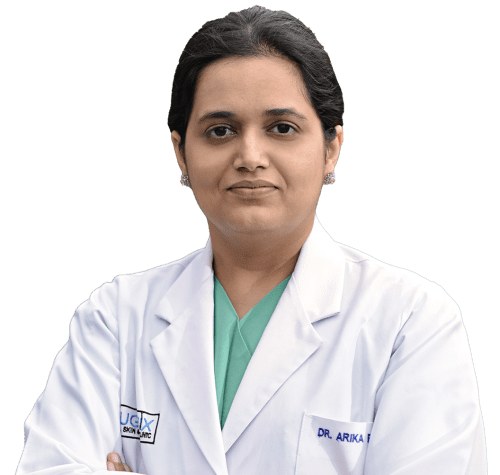
Medically reviewed by Dr. Arika Bansal, Co-Founder, Eugenix Hair Sciences; MBBS, MD Dermatology, Fellow of ISHRS; Reg. No. HN-34095 (Haryana Medical Council).
Dr. Arika Bansal
Dr. Arika Bansal, Co-Founder, Eugenix Hair Sciences. MBBS (Gold Medallist, Lady Hardinge Medical College), MD Dermatology, alumni of AIIMS, New Delhi. Fellow of ISHRS. Reg. No. HN-34095 (Haryana Medical Council).
