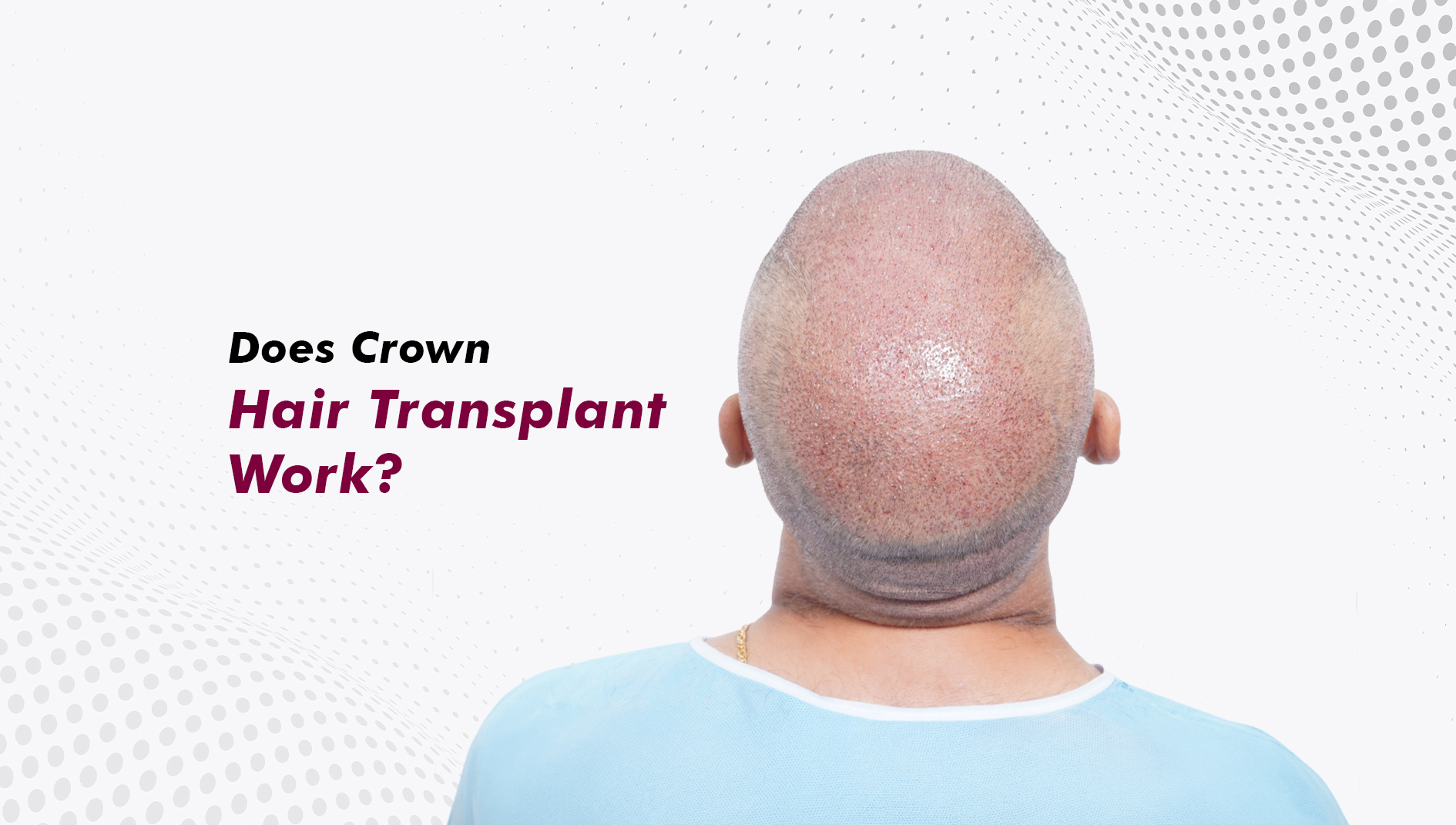

A receding hairline gets noticed first, but crown hair loss is what shows in every overhead photograph. If yours is thinning, you have probably asked one question more than any other: does crown hair transplant work? The short answer is yes. The crown area responds to hair restoration as reliably as the front of the scalp, because the donor hair comes from the back and sides of the head, where hair follicles are genetically resistant to DHT and do not miniaturise. What changes is how the result looks, how long it takes, and how it must be planned. The crown is not the hairline moved backwards. It is a circular zone with a spiral growth pattern, a lower blood supply, and a different relationship with light.
Does Crown Hair Transplant Work? The Honest Answer
Yes, crown hair transplant works. Once transplanted follicles establish, they behave the way donor hair behaves, not the way the surrounding thinning crown hair behaves.
Why crown hair behaves differently
That is the reassuring part. The realistic part is that a crown transplant carries three qualifications a frontal hair transplant does not.
– Crown hair transplant results take longer, typically 12 to 15 months against 10 to 12 months for the frontal zone
– The same number of grafts produces a visually thinner effect in the crown area than at the hairline
– The crown demands more careful long term planning, because hair loss in the native hair around a restored crown can continue
None of this makes crown restoration a poor decision. It means the crown area needs realistic expectations. Patients who expect crown hair to behave like a hairline can be disappointed by a technically excellent result.
The Crown Has a Spiral, Not a Line
A hairline is a boundary. It runs across the front of the scalp, is viewed head on, and the hair behind it falls forward and helps cover it.
The natural whorl pattern
The crown is a different geometry. It has a natural spiral, the whorl, radiating from a central point. Every graft must follow that circular growth pattern, at the correct angle and direction for its position in the swirl. Get the natural whorl pattern right and crown hair reads as natural looking from every angle. Get it wrong and the result looks artificial in a way that is very hard to correct, because the direction of a follicle cannot be changed once it has healed. This is why the crown area is the most technically demanding area of the scalp to restore, and why the spiral pattern governs every decision a hair transplant surgeon makes there. Natural looking results here come from direction before density.
Why light exposes the crown area
There is a second, purely physical reason crown hair looks different. The crown sits on the curve of the skull, facing upwards. Overhead light strikes it directly, and no hair sits in front of it to shadow the bald spot. This is why an identical hair density looks convincing at the front and see through at the crown area. That is a difference in how light reaches the scalp, not in the hair transplant itself.
Why Crown Hair Transplant Results Take 12 to 15 Months
Blood circulation in the crown region is lower than in the frontal and mid scalp zones. Transplanted hair follicles depend on that blood supply to establish, so hair in the crown grows more slowly than hair grows anywhere else on the scalp. This single fact shapes the whole crown hair transplant timeline.
The month by month timeline
Days 30 to 90: the shedding phase. Transplanted hairs fall while the follicles stay in place. This is expected, not failure, and it is different from shock loss, which is temporary thinning of native hair around the treated area.
Month 4: new hair growth begins, building at roughly 10 to 15 per cent density gain month on month.
Months 6 to 8: results become genuinely visible.
Months 10 to 12: full results in the frontal and mid scalp zones.
Months 12 to 15: full crown hair transplant results.
At month six, when a frontal patient is feeling encouraged, a crown transplant patient may still see an apparently empty circle. This is among the most common anxieties our post procedure team hears, and in almost every case the hair in the crown is simply following its own slower schedule.
Hair Density in the Crown: What Is Realistically Achievable
Transplanted hair density is approximately 50 per cent of your original natural hair density anywhere on the scalp. That is a deliberate clinical choice, not a limit of transplant techniques, and it applies at the front as much as in the crown area.
Achievable density depends on hair characteristics such as calibre, and on whether the zone carries thinner or thicker skin:
Hairline zone: 35 to 45 grafts per square centimetre
Mid scalp and crown area: 25 to 35 grafts per square centimetre
Natural hair sits with a gap of roughly 0.5 mm between hairs. Transplanted hair sits at roughly 1.5 mm, so a successful result carries a slight see through quality under direct sunlight, in flash photography, and when hair is wet or oiled.
Why more grafts is not always better
Your desired density has to stay within what the blood supply can sustain. Packing in more grafts than the crown can feed causes graft shock, compromising graft survival and the surrounding native hair. Eugenix therefore chooses optimum density over maximum density. For most patients, a crown transplant aims to erase the visible bald spot and build a natural looking crown rather than recreate teenage density.
The Donor Maths Behind Crown Planning
Your healthy donor area is finite. The safe donor zone holds roughly 30,000 to 45,000 follicles, yielding 3,000 to 4,500 grafts per sitting for an Indian or Asian patient and 5,000 to 8,000 over a lifetime.
When the crown comes second
The crown area is a large circular thinning area. It consumes hair grafts quickly and returns less visible impact per graft than the frontal zone, which is why it is often not the first priority in hair restoration planning. Where the extent of hair loss spans several zones with limited donor supply, spending the donor bank on the frontal hairline first delivers the greatest visible change.
Advanced hair loss and beard grafts
Where the extent of hair loss reaches Grade 6 or Grade 7 on the Norwood Hamilton scale, full coverage typically needs 7,000 to 9,000 grafts and more than one sitting. Beard grafts are then used as filler at the periphery of the crown, never at the whorl, where their thicker, wiry calibre would disrupt the spiral.
The role of Finasteride
By slowing the rate at which hair loss progresses, oral Finasteride supports the peripheral hair around a thinning crown, which can reduce the number of grafts the zone requires. It is not a cure and should only be taken under medical supervision.
Why Younger Patients Are Advised to Be Cautious
Androgenetic alopecia is progressive. Crown hair loss moves aggressively through the twenties and thirties, slows through the thirties and forties, and stabilises from the forties onward. Crown hair transplant surgery is best considered from the mid twenties onward, once the pattern is established.
For a younger patient, restoring a bald crown early carries a specific risk. Hair loss can expand outwards around the restored area, leaving a dense circle of transplanted hair inside a widening band of baldness. This is the isolated island effect, and it looks worse than the original hair thinning did.
That is an argument for sequencing and for a plan that preserves donor supply, not against crown restoration itself. A crown restored at 26 still has to look right at 40.
How Eugenix Approaches Crown Hair Transplant Surgery
Eugenix performs DHT, the Direct Hair Transplant technique developed by our Co-Founders and published in peer reviewed literature in 2013 as a modified follicular unit extraction technique. The defining modification is that extraction and implantation happen simultaneously, bringing out of body time under 30 minutes, against 3 to 4 hours in a traditional FUE hair transplant. In an area as dependent on blood supply as the crown, that window matters, which is why advanced techniques change crown hair transplantation more than they change frontal work.
Who does what during the procedure
Before the crown hair transplant procedure begins, your lead surgeon carries out Planning and Designing, which here means mapping the whorl and establishing spiral direction across the zone. The lead surgeon creates the recipient slits hands on using the coronal slit technique and sets every technical parameter, including punch size, angle, depth and density, per the ADDD principle. Senior surgical assistants then perform scoring, punching, follicular unit extraction and implantation using the SAVA Implanter, under those parameters and that supervision.
These advanced techniques rest on the SAVA Implanter, which works on a no root touch basis. The graft stays visible throughout and is inserted smoothly into a pre made slit, without a plunger based blind push. For crown grafts, which must sit at precise angles inside the whorl, that control matters.
The lead surgeon supervises your procedure throughout, taking rounds between active steps and remaining available at all times during your surgery.
What determines crown hair transplant cost
Crown hair transplant cost is driven by the number of grafts your plan requires, which depends on the surface area of the bald spot, your donor supply, and how much future hair loss the plan must absorb. Eugenix quotes crown hair transplant cost only after a proper assessment, not from a photograph.
Both Co-Founders, Dr. Arika Bansal and Dr. Pradeep Sethi, are Fellows of the ISHRS with 15+ years each devoted exclusively to hair restoration procedures. Our Gurgaon centre is NABH accredited, Certificate No. DE-2026-0004, and major complications are exceptionally rare across over 20,000 procedures in more than 15 years of practice.
Post Procedure Care Specific to the Crown Area
Crown transplant patients receive one instruction frontal patients do not, and in the first week it matters more than any other.
Sleeping position after a crown transplant
Sleep at the edge of the bed so the crown is suspended in the air, using a large, fluffy neck pillow under the nape. Pressure should fall on the nape and occipital area only, never on the crown. This matters most for the first two to three nights and continues through all seven days.
Swelling, activity and the first head wash
Keep the head elevated when resting, which helps fluid drain if forehead swelling appears around Day 3. Do not touch, rub or bump the transplanted zone. Gentle walking, office work and household tasks resume the next day. Yoga, gym, heavy exercise and contact sports are cleared after one week, as are alcohol and smoking. First head wash is Day 7 only. Following your surgical team’s post procedure care instructions is the cheapest contribution you can make to your own hair growth.
Frequently Asked Questions
Are crown hair transplants worth it?
For most patients whose hair loss has stabilised and whose donor area can support the plan, yes. Closing a bald crown changes how you present far more than the graft count suggests. The caveat is patience: this is the slowest zone on the scalp, and the payoff arrives late in the hair restoration journey.
What is the success rate of crown hair transplant?
Graft survival in the crown area is comparable to the frontal zone when a skilled hair transplant surgeon plans it correctly, angles it to the whorl, and keeps density within what the blood supply can sustain. Eugenix does not publish a headline percentage, because natural looking results depend on donor quality, technique and post procedure care rather than one number. Crowns fail aesthetically far more often from wrong direction than from poor survival.
How many grafts will my crown need?
There is no standard number. Crown requirements depend on the surface area of loss, the density of hair surrounding it, your donor supply and future progression. Any graft count quoted without a proper evaluation of your scalp and donor area is guesswork.
Why does my crown still look empty at six months?
Because that is normal. Hair growth begins around month four, and crown hair transplantation completes at 12 to 15 months. At six months you are early in the growth curve, not at the end of it.
Can the crown and the hairline be treated in the same sitting?
Often yes, depending on total graft requirement and donor capacity. Where the combined requirement exceeds what can safely be harvested in one sitting, the hair transplant process is staged, usually frontal zone first. A second sitting in an adjacent, untouched area can follow 1.5 to 2 months later. Adding more grafts to an area already implanted requires a gap of 11 to 12 months.
Will I need medication after a crown hair transplant?
Transplanted grafts are resistant to DHT and do not need medication to survive. The native hair around your crown remains susceptible to ongoing loss, so oral Finasteride is commonly recommended to protect it, under medical supervision. Eugenix does not advise Dutasteride for male pattern baldness, as it is not USFDA approved for this indication.
The Bottom Line on Crown Restoration
So, does crown hair transplant work? It does, provided the plan respects what the crown actually is. A spiral rather than a line. A slower zone with a lower blood supply. A large surface competing for a finite donor bank. An area of the scalp where light exposes hair density honestly.
Handled with those realities in mind, a crown hair transplant delivers natural looking results that hold up over time, and for many patients the return of self esteem is the part they mention first. Handled as though it were more hairline, it disappoints even when the surgery was sound.
Book a consultation with the Eugenix panel of hair transplant surgeons, personally handpicked and trained by our Co-Founders, and you will leave with a clear picture of what your crown hair can achieve and over what timeline.
Dr. Arika Bansal
One of only a few female surgeons specializing in hair transplant surgery in India, Dr. Arika Bansal has been voted one of the best doctors in the world. She maintains an active fellowship in the ISHRS and regularly submits research papers to medical journals. 15+ years down the line, 20,000+ surgeries are accomplished under Dr. Bansal’s supervision. She specializes in female hair transplant, density improvement, corrective hair transplantation and hairline design.