
Most people who research hair transplants expect a straightforward story. Grafts are placed, hair grows, results appear. What they are not always prepared for is the phase that comes between the procedure and the results: a period where transplanted hair falls out, the scalp looks thinner than before, and the natural question becomes, “Did something go wrong?”
The answer, in the vast majority of cases, is no. Shedding after a hair transplant is expected. It is a sign that the hair follicles are doing exactly what they should. Understanding why hair shedding happens, what the timeline looks like, and how it differs from shock loss gives hair transplant patients the clarity they need to stay confident through what can feel like an unsettling phase.
This article explains post op shedding and shock loss after hair transplantation, how to tell them apart, and what warrants a conversation with your doctor.
Why Does Shedding Happen After a Hair Transplant?
When grafts are extracted from the donor area and placed into the recipient area, the hair follicles experience a disruption to their normal hair growth cycle. Transplanted hair shafts respond to this surgical trauma by entering the resting phase simultaneously, a process called forced telogen effluvium.
The telogen phase is the resting stage of the hair growth cycle, during which the hair shaft detaches from the follicle before a new anagen phase begins. After hair transplantation, disruption to blood supply during extraction and implantation pushes transplanted follicles into the telogen phase together. The result is that newly transplanted hair sheds in a concentrated window.
The hair shafts fall, but the hair follicles remain securely in place beneath the scalp. The follicle is dormant, preparing for a new growth cycle. Hair regrowth will follow.
This is fundamentally different from pattern hair loss, where the follicle itself is miniaturising and dying. In post op shedding after hair transplant surgery, the follicle is healthy and intact. This distinction is worth holding on to during the hair transplant shedding phase.
The Complete Shedding and Regrowth Timeline
Weeks 2 to 4: Shedding Begins
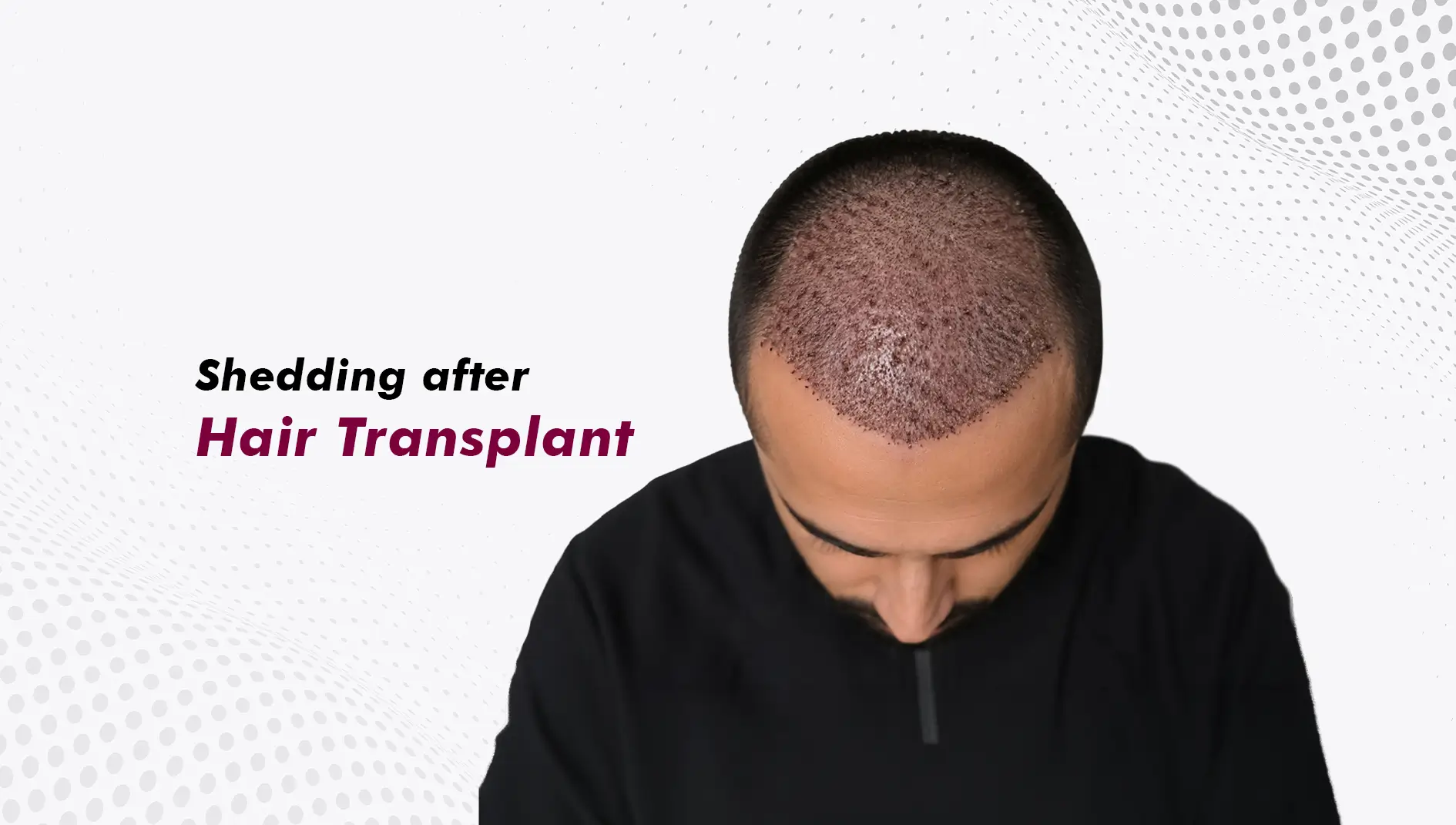
Hair shedding typically begins around 2 to 4 weeks after the hair transplant procedure, with some patients experiencing transplanted hair fall as early as 10 days post-surgery. During this period, blood flow to the recipient area is being re-established and the healing process is underway.
Weeks 4 to 12: The Core Shedding Phase
The hair transplant shedding phase peaks between weeks 4 and 12. Patients may lose 30 to 90% of the transplanted hairs during this window, sometimes called the “Ugly Duckling” phase of hair transplantation. The hair shafts fall; the transplanted hair follicles remain intact. Hair shedding here is the hair growth cycle resetting, not failing.
Month 4: New Hair Growth Begins
From Month 4, new hair begins to emerge from transplanted follicles. Blood supply to the recipient area is fully restored by this point, and new hair shafts appear before gradually thickening. Growth progresses at approximately 10 to 15% additional density per month.
Months 6 to 12: Visible Results Through Full Density
By Month 6, approximately 60% of final hair density is visible. By Month 7, around 70%. Full hair growth is typically visible between 10 and 12 months after hair transplant surgery. For the crown area, which receives blood supply last, results extend to 12 to 15 months.
Months 14 to 15: Anagen Desynchronisation
At 10 to 12 months, all transplanted hair is in the growth phase simultaneously, producing peak hair density. By months 14 to 15, the hair naturally returns to a staggered hair growth cycle, with approximately 18 to 20% of transplanted hair follicles entering the resting phase at any given time. The result is a modest reduction of around 20% in hair mass.
This is not a reversal of results. It is the hair restoration process settling into its permanent natural rhythm, mirroring the way healthy hair behaves on any scalp. This density level is stable and long-term. It does not return to the 100% synchronisation peak, nor does it decline further. Patients who are not counselled about this transition phase often interpret it incorrectly as hair loss.
Shedding vs Shock Loss: Understanding the Difference
These two terms are often confused, but they describe distinct events.
Temporary shedding refers to the loss of transplanted hair shafts. It occurs in every patient after hair transplantation without exception. The transplanted follicles remain intact, and hair regrowth begins from Month 4.
Shock loss refers to the loss of pre-existing native hairs in or around the recipient area due to surgical trauma. Unlike post operative shedding, shock loss does not occur in every patient. Whether it does, and whether it is temporary or permanent, depends on specific factors.
Both can occur in the same patient. Post operative shedding of transplanted hair is universal; native hair shock loss is not.
What Causes Shock Loss After Hair Transplant Surgery?
Shock loss occurs as a reaction to the hair transplant surgery itself. The trauma of creating recipient sites near existing hair follicles, combined with a temporary reduction in blood flow and the physiological stress of cosmetic surgery, can push native hairs into a dormant period.
Shock loss of native hair is more likely when:
– The transplanted area was less than 70 to 100% bald at the time of the procedure, meaning grafts are placed near existing thinning hair.
– Significant miniaturization of existing hair was already present.
– The gap between native hairs was less than 2.5 mm during the hair transplant procedure.
– The patient was not on Finasteride prior to surgery (male patients with androgenetic alopecia).
When shock loss affects thick, terminal native hairs in a patient who was on Finasteride, recovery is expected within 8 to 9 months. When it affects heavily miniaturised existing follicles in a patient not on Finasteride, shock loss permanent outcomes are more likely. This is why pre-operative medication and area selection decisions carry real consequences for the native hairs around the transplanted area.
Can Shock Loss Be Prevented?
Several measures significantly reduce the risk of shock loss during the healing phase.
Starting Finasteride before the procedure is the most effective step for male patients with pattern hair loss. Post operative support through Finasteride and Minoxidil continues to protect existing hair from ongoing hair fall. Proper post operative care also includes a diet rich in protein, iron, zinc, and biotin to support hair follicle health through the hair restoration process.
Intraoperative PRP, administered during the hair transplant procedure itself, promotes blood flow to the recipient area and reduces the stress response on existing follicles in the transplanted zone. Careful surgical planning, including thin-gauge needles for anaesthesia and avoiding high-risk placement near dense existing hair, is standard practice at Eugenix Hair Sciences.
Normal vs Concerning: A Post Operative Reference
Normal experiences after hair transplantation:
– Transplanted hair fall beginning 2 to 4 weeks post-surgery and continuing through week 12. This is post op shedding. It is a normal part of the process.
– A patchy appearance during months 4 to 7 as transplanted follicles re-enter the growth phase at different rates.
– A modest reduction in hair density at months 14 to 15. This is anagen desynchronisation: permanent, stable, and expected.
Hair fall that warrants a conversation with your doctor:
– Significant loss of native hairs continuing beyond 6 months without recovery.
– No new hair growth by Month 6.
– Persistent redness, infection signs, or crusting beyond the initial healing phase.
– Accelerating hair loss in non-transplanted areas.
Frequently Asked Questions
Does shedding mean the transplanted hair follicles have not survived?
No. Hair shedding is the loss of the shaft, not the follicle. Transplanted hair follicles remain intact beneath the scalp. Graft survival is determined by extraction quality, out-of-body time, and implantation technique. At Eugenix, the DHT (direct hair implantation) technique keeps graft out-of-body time under 30 minutes, preserving hair follicle viability throughout the hair transplant procedure.
Does shedding occur with beard and body hair transplants?
Yes. Beard grafts and body hair transplanted grafts follow the same post op shedding pattern, with adjusted timelines. Beard grafts reach full density at 12 to 13 months. Chest hair transplantation results take approximately 15 months. The hair shedding and regrowth sequence applies across all graft types.
What can I do to support hair regrowth after a hair transplant?
Post operative care plays a meaningful role. Take prescribed medications consistently, maintain a protein-rich diet with adequate iron, zinc, and biotin, and follow proper aftercare instructions for the recipient area and donor area. Male patients should be on Finasteride as directed. Intraoperative PRP during the procedure and follow-up PRP sessions from Month 8 onwards provide additional support to hair follicles through the hair restoration process.
Understanding the Full Picture Before Your Hair Transplant
Shedding after a hair transplant is a temporary phase with a predictable timeline. Shock loss, where it occurs, is manageable with the right preparation and proper aftercare. The density adjustment at months 14 to 15 is not a setback but the transplanted hair settling into its permanent growth cycle.
At Eugenix Hair Sciences, patient education is central to every Contact Us. Founded by Dr. Pradeep Sethi and Dr. Arika Bansal, both Fellows of ISHRS and alumni of AIIMS, New Delhi, with over 30 years of combined experience in hair transplantation, Eugenix has performed more than 22,000 hair transplant procedures for patients from over 90 countries.
To understand what the full hair restoration process looks like at every stage, speak with a Hair Advisor at Eugenix. Consultations are available in Gurugram, Mumbai, Hyderabad, and Bhubaneswar, as well as online.
Dr. Arika Bansal
Dr. Arika Bansal, Co-Founder, Eugenix Hair Sciences. MBBS (Gold Medallist, Lady Hardinge Medical College), MD Dermatology, alumni of AIIMS, New Delhi. Fellow of ISHRS. Reg. No. HN-34095 (Haryana Medical Council).