If you are weighing a hair transplant in Dubai vs India, you are asking exactly the right question. The two destinations represent very different propositions: Dubai offers proximity and convenience for residents of the Gulf, while India offers a depth of surgical specialisation that has drawn international patients from over 90 countries. Understanding the real difference requires looking beyond cost, at technique, surgeon credentials, clinical track record, and what your post-procedure care actually looks like when you return home.
This guide gives you the full picture. Whether you are an Indian expatriate based in the UAE or a GCC national exploring hair restoration options abroad, by the end of this article you will know what each destination genuinely offers, and what to ask before choosing a clinic.
Why Dubai Patients Are Choosing India for Hair Transplants
The Middle East has a large and growing base of patients seeking hair restoration procedures. Dubai in particular has positioned itself as a regional hub for cosmetic surgery and elective medical care. However, for hair transplant surgery specifically, a significant number of Dubai residents, both Indian expatriates and other nationalities, are choosing India over local clinics.
The reasons go beyond price.
Surgical Depth and Specialisation
Leading Indian hair transplant clinics have built specialised infrastructure around hair restoration alone. Several of the world’s most referenced innovations in hair transplant technique, including the DHT (Direct Hair Transplant) technique, were developed and published by Indian surgeons. This level of focused specialisation over 15 years produces a surgical depth that is difficult to replicate at general cosmetic surgery clinics operating in a broader market like Dubai.
The Role of Medical Tourism in This Decision
India is one of the world’s top medical tourism destinations, particularly for hair transplants. Affordable costs, high-quality care, and a large pool of qualified surgeons have made India a preferred choice for international patients from across the Middle East, Europe, and beyond. Indian clinics handle large patient volumes each year, which directly translates into greater surgeon experience and more refined clinical protocols.
How Close Is India, Really?
Direct flights from Dubai to Delhi or Mumbai take approximately two to three hours. For Dubai residents, India is closer than many European hair transplant destinations and requires less total time away. Most patients complete their hair transplant procedure and return to Dubai within five to seven days.
Hair Transplant Cost in Dubai vs India: Understanding the Gap
Cost is one of the most significant differentiators when comparing hair transplant clinics in India and Dubai. The gap is substantial, even when you include the cost of flights and accommodation.
What Does a Hair Transplant Cost in Dubai?
Hair transplant procedures in Dubai typically fall in the range of AED 10,000 to AED 35,000 for standard graft counts, with costs varying based on the clinic, the number of grafts, and the technique used. High-cost factors include the city’s real estate and operating costs, staff salaries, and the premium associated with Dubai’s medical market positioning. Hair transplant surgery at the upper end of this range can reach USD 9,000 to USD 12,000 for larger procedures.
What Does a Hair Transplant Cost in India?
Hair transplant cost in India is significantly lower for comparable procedures. Leading Delhi clinics and specialist centres charge a fraction of Dubai prices for the same procedure, even accounting for the difference in technique quality and infrastructure. For international patients, India represents cost savings of 50 to 70% on the procedure cost alone, before factoring in travel. Specific procedure costs are discussed during a Contact Us rather than quoted as fixed rates, since pricing at any reputable clinic depends on the number of grafts required, the hair loss grade, and the technique used.
Total Cost When You Factor in Travel
For most patients requiring 2,500 grafts or more, the cost difference between Dubai and India more than covers the return flight and a five to seven day stay in India. The total cost, including travel and accommodation in Gurgaon or Mumbai, remains significantly lower than the procedure cost alone at most Dubai hair transplant clinics.
Does Lower Cost Mean Lower Quality? What the Evidence Says
This is the most important question for any Dubai patient considering hair transplant surgery in India, and it deserves a direct answer.
No. Lower cost in India does not reflect lower quality. It reflects a fundamental difference in the economics of delivering medical care in India compared to the UAE.
India’s Medical Education System
India’s medical education is among the most rigorous globally. Qualifying as a dermatologist in India requires approximately ten years of training: five and a half years for the MBBS degree, one year of internship, and three years of postgraduate specialisation for the MD. Surgeons trained at institutions like AIIMS, New Delhi, have completed some of the most demanding postgraduate programmes in the world.
Surgeon’s Experience and Patient Volume
Reputable Indian hair transplant clinics handle high patient volumes, which directly translates to greater surgeon experience compared to lower-volume cosmetic surgery practices. Many qualified surgeons at leading Indian clinics are Fellows of ISHRS, the International Society of Hair Restoration Surgery, the world’s most respected professional body for hair restoration specialists. This credential is a globally recognised mark of clinical excellence.
What the Corrective Cases Tell You
A meaningful indicator of clinical quality is expertise in corrective hair transplants. The most experienced Indian hair transplant clinics regularly perform corrective procedures for patients who had their first hair transplant procedure done at higher-cost clinics abroad, including in the UAE and Europe. The most common issues seen in corrective cases are poor hairline design, incorrect graft angulation, low graft survival, and visible scarring, all of which are technique failures, not a function of what a clinic charges.
Hair Transplant Techniques: What India Offers and Why It Matters
Technique is the single most important factor in any hair transplant procedure. The right clinic will be transparent about the technique used, who performs each stage of the surgery, and why their approach produces the results it does.
FUE: The Industry Standard
Follicular Unit Extraction, or the FUE method, is the most widely used hair transplant technique globally. In FUE, individual hair follicles are extracted from the donor area and implanted into the recipient area. The FUE method leaves no linear scar and allows for a faster recovery compared to older strip surgery approaches.
It is the baseline against which more advanced hair transplant techniques are measured.
DHT: The Eugenix Advance on Standard FUE
At Eugenix Hair Sciences, the technique used is DHT, Direct Hair Transplant. This is not a variation of the FUE method. It is a fundamentally different approach to managing graft viability, invented by the founding surgeons at Eugenix and published in a peer-reviewed international journal in 2013.
The critical difference is graft out-of-body time.
In standard FUE, all hair follicles are extracted from the donor area over several hours, stored outside the body, and then implanted. Total graft exposure time commonly runs to three to six hours. During this period, hair follicles are vulnerable to desiccation, temperature fluctuation, and cellular oxygen deprivation. Every additional minute outside the body increases the risk of compromised viability.
In the DHT technique, extraction and implantation happen simultaneously. As each graft is extracted, it is immediately placed into a premade recipient slit. Grafts are outside the body for a maximum of 30 minutes. The result is a graft survival rate that approaches 100%.
This is a published, peer-reviewed, verifiable clinical difference. It is the reason patients choose Eugenix for their hair transplant procedure specifically, not simply because it is an Indian clinic.
What This Means for Your Hair Transplant Results
The practical outcome of reduced graft out-of-body time is that more of the transplanted hair follicles survive and grow. Each hair follicle that survives produces permanent, naturally growing hair. A higher survival rate from each procedure means fewer grafts wasted, better density outcomes, and a reduced likelihood of needing a corrective procedure. The number of grafts required and the long-term result of the hair transplant surgery both depend directly on how well each follicle is preserved during the procedure.
ADDD: The Principle Behind Eugenix’s Hairline Design
Slit-making at Eugenix follows the ADDD principle: Angle, Depth, Density, and Direction. This governs every recipient site created during the hair transplant procedure, ensuring that transplanted hair grows in the correct direction, at the correct angle, and at the right density for the specific zone being treated. The hairline zone requires 35 to 45 grafts per cm², while the mid-scalp and crown receive 25 to 35 grafts per cm². This precision is what produces natural-looking results.
Instruments and Infrastructure at Leading Indian Hair Transplant Clinics
World-class hair transplant surgery requires world-class instruments. The quality of the tools used in a hair transplant procedure directly affects graft survival, donor area scarring, and the precision of hairline design.
Magnification, Punches, and Implanters
At Eugenix Hair Sciences, every procedure uses Carl Zeiss loupes at 6X and 8X magnification, imported directly from Germany. Surgical punches are imported from Atlanta, Georgia, USA, and feature a thin-walled design that minimises trauma to the donor area. The SAVA implanter allows each graft to be placed with full visual guidance, eliminating the blind insertion risk associated with standard plunger-based implanters. This instrumentation is available at Eugenix because the clinic’s exclusive focus on hair restoration, for over 15 years, has built the institutional knowledge and supply relationships to sustain it.
Accreditation and Quality Standards
Eugenix Hair Sciences Gurgaon is NABH Accredited (Certificate No. DE-2026-0004, valid March 2026 to March 2030). NABH, the National Accreditation Board for Hospitals and Healthcare Providers, is itself ISQua Accredited, the international benchmark for healthcare accreditation bodies. This accreditation means that the Gurgaon clinic meets nationally recognised standards for patient safety, infection control, and clinical quality. It is a formal, independently verified quality credential that most hair transplant clinics in any country do not hold.
For international patients, NABH accreditation provides a level of institutional assurance equivalent to internationally recognised quality standards.
Planning Your Hair Restoration Journey from Dubai
For Dubai residents, the logistics of a hair transplant procedure in India are more manageable than most people expect. Planning ahead ensures that your trip is clinically productive and personally comfortable.
How Long Will You Need to Be in India?
Most international patients plan for five to seven days total. This includes arrival, a physical pre-procedure Contact Us on day one or two, the hair transplant surgery itself, which is a full-day procedure under local anaesthesia, and two to three days of initial recovery during which the clinical team reviews healing, demonstrates the washing protocol, and provides departure instructions.
The e-Medical Visa Process
UAE residents of Indian origin usually travel on Indian passports and require no visa. Other nationalities can apply for an e medical visa to India online in advance. The e medical visa is specifically designed for medical tourism and is straightforward to obtain. Many Indian clinics provide assistance with the e medical visa application and documentation as part of their international patient services.
Virtual Consultations Before You Travel
Most leading hair transplant clinics in India, including Eugenix, offer virtual Contact Us for international patients before travel. A virtual Contact Us allows the clinical team to review your photographs, assess your hair loss grade, provide a preliminary graft estimate, and confirm procedure suitability before you commit to travel. This makes the physical Contact Us on arrival more focused and efficient, and allows you to compare clinics and treatment options before making any decision.
Follow-Up Care After You Return to Dubai
A common concern for Dubai-based patients is post-procedure follow-up care. At Eugenix, the E-Care team provides structured remote follow-up care for all international patients, with daily monitoring during the first seven days post-procedure and a five-year structured follow-up plan. Photograph reviews and video Contact Us replace in-person visits for routine monitoring throughout the 10 to 12 months it takes for full hair transplant results to develop. Crown results can take up to 15 months.
Follow-up care at this level means that returning to Dubai after your procedure does not disrupt the continuity of your post-procedure care.
How to Evaluate a Hair Transplant Clinic, Whether in Dubai or India
Choosing the right clinic is the most consequential decision in your hair restoration journey. The following questions apply regardless of which country you are considering.
Who Performs Each Stage of the Procedure?
At reputable clinics, the doctor designs the hairline and creates all recipient slits. Ask directly: does the qualified surgeon perform the slit-making, or is it delegated? Who performs extraction and implantation, and under what level of supervision?
What Technique Does the Clinic Use and Is It Published?
Ask for documentation. The hair transplant techniques are supported by peer-reviewed research, not just marketing language. At Eugenix, both the 2013 DHT technique paper and the 2019 implanter methodology paper are publicly accessible on PubMed.
What Do Long-Term Results Look Like?
Request photographs at 12 months and beyond, not immediate post-operative images. Hair transplant results take 10 to 12 months to fully develop, and 12-month photographs are the most honest representation of what a clinic consistently achieves.
What Is the Clinic’s Track Record With International Patients?
Clinics with significant experience treating international patients will have structured remote follow-up protocols and clear processes for managing queries after you return home. A clinic that does not have a defined post-procedure care pathway for international patients is not the right clinic for a Dubai resident.
Why Eugenix Hair Sciences Is the Choice for International Patients from Dubai and the Middle East
Eugenix Hair Sciences has performed over 22,000 hair transplant procedures over 15 years of exclusive specialisation in hair restoration. The clinic has received patients from 90+ countries, including a significant patient base from the Middle East and UAE.
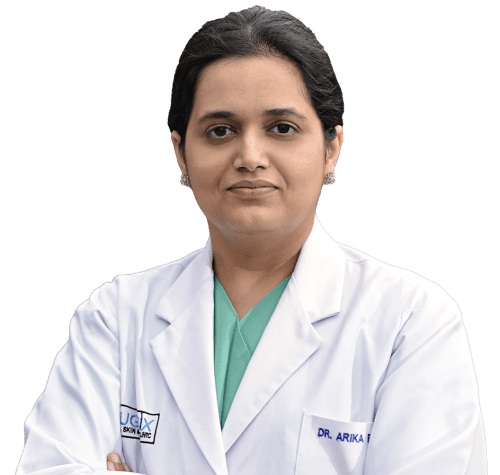
Dr. Pradeep Sethi and Dr. Arika Bansal, the founding surgeons, are alumni of AIIMS, New Delhi, and both are Fellows of ISHRS. Their published PubMed-indexed research, the 2013 DHT technique paper and the 2019 paper on implanter methodology in premade sites, represents the scientific foundation of every hair transplant procedure performed at Eugenix.
For patients from Dubai and the broader Middle East, Eugenix offers a published, peer-reviewed technique with nearly 100% graft survival, NABH-accredited facilities in Gurgaon, structured virtual Contact Us before travel, five-year remote follow-up care with daily monitoring in the first week, and a clinical team with over 15 years of experience treating international patients. The philosophy at Eugenix is one of honest expectation-setting, with no overpromising on density, coverage, or timelines.
Frequently Asked Questions: Hair Transplant in Dubai vs India
Is it safe to travel by air after a hair transplant procedure?
For most patients in good general health, air travel within five to six days of a hair transplant procedure is safe. The procedure is performed under local anaesthesia with no general sedation. Your clinical team will confirm travel clearance based on your individual recovery progress before you depart.
How do I know how many grafts I will need?
The number of grafts required for any hair transplant depends on your grade of hair loss, the density of your donor area, and the coverage goals discussed with your surgeon. A preliminary estimate can be provided during a virtual Contact Us based on photographs. A precise graft count is confirmed at the in-person Contact Us before the procedure.
What happens to my follow-up care when I return to Dubai?
At Eugenix, remote follow-up care for international patients is structured across five years. The E-Care team monitors your recovery via photographs and video Contact Us, provides medication guidance, and manages the full post-procedure period from Dubai. You do not need to return to India for routine follow-up appointments.
Can I speak with a doctor before deciding?
Yes. Eugenix offers virtual Contact Us specifically for international patients. During this Contact Us, a member of the clinical team reviews your photographs, assesses your hair loss profile, and provides a treatment plan outline before you commit to travel. Consultations with Dr. Pradeep Sethi or Dr. Arika Bansal directly are available subject to their schedule and must be booked in advance.
Is India a recognised hair transplant destination for GCC residents?
Yes. India has become one of the most established medical tourism destinations for hair transplant surgery among GCC residents. The combination of qualified surgeons, advanced technology, significantly lower procedure costs, and direct flight connectivity from Dubai makes India a practical and clinically sound choice for patients from across the Middle East.
Making the Right Decision for Your Hair Restoration Journey
The decision between a hair transplant in Dubai vs India ultimately comes down to this: do you want proximity, or do you want the possible outcome from your hair transplant procedure?
For most patients, a five to seven day investment in travel to India delivers access to a higher level of surgical specialisation, a published technique with near-100% graft survival, NABH-accredited facilities, and a structured five-year follow-up programme, at a total cost that remains significantly below what the same hair transplant would cost in Dubai.
At Eugenix Hair Sciences, we have spent over 15 years building a clinical programme specifically designed for patients who have made this decision carefully. If you are ready to take the next step in your hair restoration journey, book a virtual Contact Us today and speak with our international patient team.
Dr. Arika Bansal
Dr. Arika Bansal, Co-Founder, Eugenix Hair Sciences. MBBS (Gold Medallist, Lady Hardinge Medical College), MD Dermatology, alumni of AIIMS, New Delhi. Fellow of ISHRS. Reg. No. HN-34095 (Haryana Medical Council).