For patients in Saudi Arabia exploring hair transplant options, the choice often comes down to two destinations: having the procedure done locally or travelling to India. Both countries have qualified doctors and modern facilities, but they differ significantly in the cost of hair transplant treatment, the depth of surgical specialisation available, and the standard of end-to-end patient support. This article gives you a clear comparison so you can make a well-informed decision about your hair restoration journey.
Why Saudi Patients Are Travelling to India for Hair Transplants
India has become one of the most prominent medical tourism destinations in the world for hair transplant procedures. Patients from the Middle East, Africa, Southeast Asia, and western countries including Australia choose India for hair transplantation because of the combination of advanced techniques, highly skilled surgeons, and affordable cost. The medical tourism industry in India has grown substantially over the past decade, and hair restoration is one of the most in-demand procedures among foreign patients.
Affordable Cost Without Compromising Quality
The cost of hair transplant in Saudi Arabia typically ranges from USD 2,500 to USD 10,000, depending on the clinic, the technique used, and the number of grafts required. In comparison, the price of hair transplant in India is significantly lower, with many leading clinics offering the same or higher standard of care at a fraction of the price. Even when travel and accommodation are factored in, most patients find that a hair transplant in India costs considerably less than the same transplant procedure in Saudi Arabia. For patients requiring larger graft counts, this cost difference is substantial.
Skilled Surgeons and Extensive Clinical Experience
Indian clinics, particularly those with exclusive focus on hair transplantation, manage high patient volumes each year. This translates directly into greater surgeon experience and more refined clinical protocols compared to lower-volume markets. Indian surgeons trained at premier institutions like AIIMS, New Delhi, undergo approximately ten years of rigorous medical education before specialising in hair restoration. Many leading Indian clinics are recognised internationally, with surgeons who hold fellowship in global professional bodies and have published peer-reviewed research on hair transplant techniques.
Hair Transplant Cost Comparison: Saudi Arabia vs India
Cost of Hair Transplant in Saudi Arabia
Saudi Arabia offers premium healthcare infrastructure, with luxurious clinics focused on patient privacy and high standards. However, this level of amenity, combined with the country’s higher cost of living, results in hair transplant costs that are among the highest in the region. The cost of hair transplant treatment in Saudi Arabia reflects overheads rather than a meaningful difference in clinical outcomes. Most patients considering Saudi Arabia as a destination will find that the procedure cost does not translate into a proportional advantage in technique or results.
Cost of Hair Transplant in India
India’s affordability as a medical tourism destination for hair transplants is well established. The average cost of hair transplant in India is significantly lower than in Saudi Arabia and also lower than popular destinations such as Turkey, which typically ranges from USD 1,500 to USD 4,500. Indian clinics offer comprehensive packages for international patients that include Contact Us, the procedure itself, post-procedure care, and follow-up support. For Saudi patients, the cost savings achieved by choosing India, even after accounting for flights and accommodation, are meaningful.
At Eugenix Hair Sciences, the cost of hair transplant treatment is provided after a full clinical assessment, since the number of grafts required varies by patient. Specific pricing is discussed during Contact Us rather than quoted as a fixed rate.
Hair Transplant Techniques: What India Offers
Follicular Unit Extraction and Follicular Unit Transplantation
Follicular unit extraction, or FUE, is a minimally invasive hair transplant technique in which individual hair follicles are extracted from the donor area and implanted into the recipient area without leaving a linear scar. It is the most widely used method globally and the baseline against which more advanced transplant procedures are measured. Follicular unit transplantation, or FUT, is an older technique involving strip removal from the donor area and is associated with a permanent linear scar and longer recovery. Eugenix does not perform FUT.
Direct hair implantation, or DHI, is another technique used by some clinics in which a pen-like device is used to implant hair follicles directly without premade channels. It is offered by various clinics across India, Saudi Arabia, and Turkey. Eugenix does not use DHI.
DHT: The Eugenix Approach to Hair Transplantation
At Eugenix Hair Sciences, the technique used is DHT, Direct Hair Transplant. This is a fundamentally different approach to managing graft viability, invented and published by the Eugenix founding surgeons in a peer-reviewed international journal in 2013. A second PubMed-indexed paper in 2019 further validated the combined methodology of premade slits and no-root-touch SAVA implanters.
The defining difference between DHT and standard FUE is graft out-of-body time. In standard FUE, all grafts are extracted over several hours and stored outside the body before implantation. Total exposure time commonly reaches three to six hours, during which grafts are vulnerable to desiccation, oxygen deprivation, and temperature fluctuation. In the DHT technique, extraction and implantation happen simultaneously. Grafts are outside the body for a maximum of 30 minutes, and the graft survival rate approaches 100%. This is a published, verifiable clinical difference, not a marketing claim.
Quality of Care and Success Rates at Indian Hair Transplant Clinics
Indian hair transplant clinics are known for providing personalised patient care and high success rates. Top clinics adhere to stringent safety protocols and quality control standards, ensuring patient safety throughout the transplant procedure. The higher success rates seen at leading Indian clinics are a direct result of well-trained surgeons, advanced techniques, and modern instrumentation used during the procedure.
At Eugenix Hair Sciences, every procedure uses Carl Zeiss loupes at 6X and 8X magnification imported from Germany and surgical punches imported from the USA. The SAVA implanter allows each graft to be placed with full visual guidance. The Gurgaon clinic is NABH Accredited (Certificate No. DE-2026-0004, valid March 2026 to March 2030). NABH is itself ISQua Accredited, the international benchmark for healthcare accreditation bodies. This formal quality credential is one that most hair transplant clinics globally do not hold.
The founding surgeons at Eugenix, Dr. Pradeep Sethi and Dr. Arika Bansal, are alumni of AIIMS, New Delhi, and both are Fellows of ISHRS, the International Society of Hair Restoration Surgery. Eugenix has performed over 22,000 hair transplant procedures over 15 years of exclusive specialisation in hair restoration, receiving patients from 90+ countries.
Cultural Considerations and Patient Support for Saudi Patients
Saudi patients travelling to India for hair transplant treatment have specific expectations around privacy, comfort, and continuity of care. At Eugenix, all procedures are performed in private, enclosed operating theatres with a consistent clinical team. Patient dignity and comfort are maintained throughout every stage of the transplant procedure.
Female hair transplant patients from Saudi Arabia are well served at Eugenix. The clinic is one of very few centres in the world that routinely performs female hair transplantation using high-magnification implantation techniques. Female patients receive the same clinical standards and privacy protocols as all patients.
For Saudi patients concerned about language barriers, the Eugenix international patient coordination team manages every stage of the journey: virtual Contact Us before travel, visa documentation support, arrival logistics, in-clinic coordination, and remote follow-up after departure. Patients undergo relevant medical tests and a thorough diagnosis during the pre-procedure Contact Us to confirm suitability. Most international patients plan for a six to eight day stay in India to complete the transplant procedure and initial recovery before returning home. Halal dining options are widely available in Gurgaon and Mumbai.
Post-procedure, the Eugenix E-Care team provides structured remote follow-up care for international patients, with daily monitoring during the first seven days and a five-year follow-up plan managed entirely through photograph reviews and video Contact Us. Saudi patients do not need to return to India for routine follow-up appointments.
Frequently Asked Questions: Hair Transplant in Saudi Arabia vs India
Is hair transplant surgery in India safe for Saudi patients?
Yes. A hair transplant is a minimally invasive day procedure performed under local anaesthesia. Most patients are comfortable for the return flight within five to six days of the procedure. Eugenix’s NABH-accredited facilities and stringent clinical protocols ensure patient safety throughout.
What is the success rate of hair transplants at Eugenix?
Using the DHT technique, the graft survival rate at Eugenix approaches 100%. Full results develop over 10 to 12 months, with the crown area taking up to 15 months. Post-transplant density reaches approximately 30 to 35% of natural original density, which is the medically accurate expectation communicated to every patient.
How long will I need to stay in India?
Most Saudi patients plan for six to eight days. This covers arrival, the pre-procedure Contact Us, the transplant procedure itself, and two to three days of initial recovery before departure. All follow-up care after that is managed remotely.
Making the Right Choice for Your Hair Transplant
The comparison between a hair transplant in Saudi Arabia vs India comes down to this: Saudi Arabia offers premium local convenience at a high cost, while India offers greater surgical specialisation, internationally published technique innovation, NABH-accredited facilities, and significantly lower procedure costs. For most patients, particularly those requiring larger graft counts, the clinical case and the cost case both point clearly towards India.
At Eugenix Hair Sciences, over 15 years of exclusive hair transplant focus, 22,000+ procedures, and a structured international patient programme make the journey from Saudi Arabia straightforward and the outcome worth it. Book a virtual Contact Us today to take the first step in your hair restoration journey.
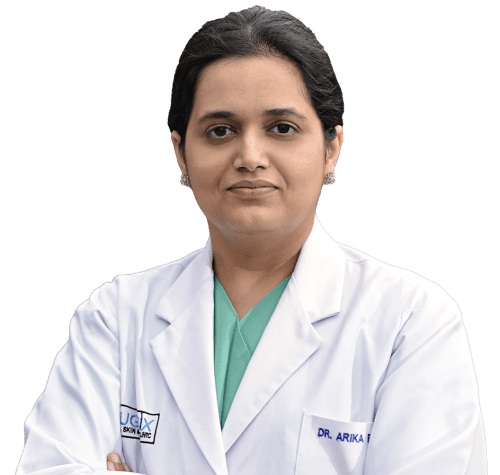
Dr. Arika Bansal
Dr. Arika Bansal, Co-Founder, Eugenix Hair Sciences. MBBS (Gold Medallist, Lady Hardinge Medical College), MD Dermatology, alumni of AIIMS, New Delhi. Fellow of ISHRS. Reg. No. HN-34095 (Haryana Medical Council).