

It depends on whether the hair in the area is thinning or already lost. PRP (platelet rich plasma) is a non-surgical treatment that works on hair follicles that are still present, so it is considered for thinning hair. A hair transplant moves your own hair from the donor area at the back and sides of the scalp into bald areas. After an assessment, some patients need medicines, some a transplant, and some both.
Eugenix Hair Sciences has worked only in hair restoration since 2009, with centres in Gurugram, Mumbai, Hyderabad, Bhubaneswar and Bengaluru. It was founded by Dermatologists, alumni of AIIMS, New Delhi, and Fellows of ISHRS.
What is the main difference between PRP and a hair transplant?
PRP supports hair you still have. A hair transplant places hair where it has been lost. PRP cannot create a follicle where none is left, and a hair transplant does not by itself stop the thinning of the native hair around it. That is why the two are not rivals: they answer different problems.
How PRP works
Platelet rich plasma therapy uses your own blood. A small sample is drawn from the arm and processed in a centrifuge, which separates the platelet rich plasma from the rest of the blood. The plasma is then injected into the areas of the scalp that are thinning. Numbing cream may be applied before the injections, and a session takes about 1 to 1.5 hours. PRP is meant to increase the blood supply to the hair follicles and the thickness of the hair shaft, so it can only act on follicles that are still there. GFC (growth factor concentrate) is a similar treatment made with a more advanced centrifuge process, which concentrates growth factors to a higher level.
How a hair transplant works
A hair transplant is a surgical procedure. The procedure is performed under local anaesthesia. Hair follicles are taken from the donor area at the back and sides of the scalp, which is usually less affected by pattern hair loss, and placed into the bald or thinning areas. The transplanted hair is your own natural hair. It usually starts to grow from Month 4, and full results take 10 to 12 months.
At Eugenix the technique is Direct Hair Transplant (DHT), a modified FUE technique described by Eugenix Hair Sciences’ Co-Founders in their 2013 research paper, “Direct hair transplantation: a modified follicular unit extraction technique“. Conventional FUE (follicular unit extraction) is the technique it modifies. Grafts stay outside the body for under 30 minutes with Direct Hair Transplant, compared to 3 to 6 hours with conventional FUE.
PRP and a hair transplant side by side
- What it treats: PRP is for thinning hair where follicles are still present; a hair transplant is for areas where hair has been lost.
- How it is done: PRP is a course of scalp injections; a hair transplant is a surgical procedure under local anaesthesia.
- Number of sessions: PRP needs multiple sessions, usually 6 initial sessions 4 to 6 weeks apart, then maintenance every 3 to 6 months; a hair transplant is usually planned in one sitting for the area treated, and advanced hair loss may need more than one sitting.
- How long the effect lasts: PRP results fade without maintenance sessions; transplanted hair comes from the donor area and keeps growing in its new place over the long term.
- Approval: PRP and GFC are not USFDA approved. Their results are temporary without maintenance and cannot be guaranteed.
When is PRP considered?
PRP is considered when hair is thinning rather than gone. In early stage hair loss, such as early androgenetic alopecia (pattern hair loss), the follicles are still present but weakening, and PRP is aimed at these follicles to support hair density. The International Society of Hair Restoration Surgery (ISHRS) notes that PRP suits people with thinning hair rather than complete baldness, and that treatments need to be repeated to keep any benefit.
Clinical evidence for PRP is still limited, and results vary from person to person.
For men with male pattern hair loss, medicines usually come first in the plan. Finasteride slows the progression of male pattern hair loss. It is not a cure and is taken under medical supervision. Your doctor explains whether PRP adds anything for your scalp, or whether medicines alone are the right start.
When is a hair transplant considered?
A hair transplant is considered when an area has lost most of its hair and there is enough good donor hair to cover it. It is the treatment that places hair into a bald area, because it moves living follicles there.
Timing and area selection matter. Transplanting into an area that still has a lot of existing hair can raise the risk of shock loss, which is the loss of native hair in and around the treated area. Shock loss is more likely without Finasteride before surgery. This is one reason the doctor checks how bald the area is, and the gap between the existing hairs, before advising surgery.
Age is part of the plan too. Pattern hair loss usually progresses in the 20s and 30s, and slows down from the mid-40s towards the 50s. Your hairline is planned keeping in mind how your hair loss may progress, so the result still suits you as you grow older. Our aim is a natural-looking result.
Before any hair transplant surgery, standard blood tests are done, and medicine department clearance is mandatory for every patient. Patients aged 40 and above also need an ECG reported by a physician or cardiologist.
Can PRP and a hair transplant be used together?
Yes. At Eugenix, PRP is given on the recipient area during the hair transplant itself, to support healing. After surgery, PRP can be given on the non-transplanted area after 1 month, and on the transplanted area after 8 months, or as assessed by the doctor. Some patients with a mix of bald and thinning areas get a transplant for the bald zone and medical treatment for the thinning hair around it.
Is PRP necessary after a hair transplant?
No. PRP is not mandatory after a hair transplant. Finasteride for men, multivitamins for 6 months and a protein-rich diet are enough for most patients. PRP is an optional additional treatment that some patients choose after discussing it with the doctor.
How do I know which one I need?
A doctor’s assessment answers this. You share clear photos of your scalp from the front, top, both sides and the back, together with your medical history. The doctor looks at your hair loss pattern, the grade of your hair loss (the Norwood scale for men, the Ludwig scale for women), how much hair is thinning compared with how much is lost, and the quality of your donor area.
The plan then usually falls into one of three paths:
- Thinning hair with follicles still present: medicines first, with PRP or GFC as an option.
- A bald area with good donor hair: a hair transplant, with medicines to protect the native hair.
- Both bald and thinning areas: a hair transplant for the bald zone and medical treatment for the rest.
Women with female pattern hair loss usually have diffuse thinning rather than a bald area, so the assessment is different. For women, additional hormonal tests are mandatory before any hair transplant. No clinic should promise a result in advance, whichever path you take.
Frequently asked questions
Is PRP better than a hair transplant?
Neither is better in general, because they treat different problems. PRP works on hair follicles that are still present, so it is considered for thinning hair. A hair transplant moves your own hair into areas where it has been lost. If an area is bald, PRP cannot bring hair back to it. A doctor’s assessment of your scalp and donor area shows which one, or which combination, suits you.
Can PRP grow hair on a bald area?
PRP is not used to grow hair on a fully bald area. It works on follicles that are still there, by supporting their blood supply and the thickness of the hair shaft. Where a follicle has been lost, there is nothing for PRP to act on. For a bald area with good donor hair, a hair transplant is the option that places hair there, because it moves your own living follicles into it.
Is PRP necessary after a hair transplant?
No, PRP is not necessary after a hair transplant. Finasteride for men, multivitamins for 6 months and a protein-rich diet are enough for most patients. PRP is an optional extra. If you choose it, PRP can be given on the non-transplanted area after 1 month and on the transplanted area after 8 months, or as your doctor advises after reviewing your growth.
How many PRP sessions are needed?
For hair thinning without a transplant, PRP sessions are usually given as 6 initial sessions spaced 4 to 6 weeks apart. After that, maintenance sessions are needed every 3 to 6 months, as the doctor advises, because the effect of PRP fades without them. Each session takes about 1 to 1.5 hours. The exact plan depends on your hair loss pattern and how your scalp responds.
What is the difference between PRP and GFC?
Both are made from your own blood and injected into the scalp. GFC uses a more advanced centrifuge process, so it carries a higher concentration of growth factors than PRP. The process is similar, and the timing after a hair transplant is the same for both. Neither is USFDA approved for hair loss, and both need maintenance. Your doctor decides which one is more suitable for your scalp.
Can PRP and a hair transplant be done together?
Yes. At Eugenix, PRP is given on the recipient area during the hair transplant to support healing. After surgery, further PRP is optional: on the non-transplanted area from 1 month and on the transplanted area from 8 months. For patients with both bald and thinning areas, a transplant for the bald zone and medical treatment for the thinning hair are often planned together.
Does a hair transplant stop further hair loss?
No. A hair transplant places hair in the treated area, but the native hair around it can keep thinning over time. This is why medical management is part of the long-term plan. For men, Finasteride slows the progression of male pattern hair loss. It is not a cure and is taken under medical supervision. Your doctor explains how to protect the hair you still have.
Know more.
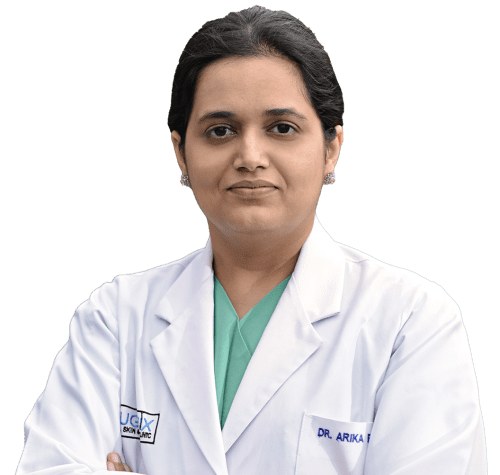
Medically reviewed by Dr. Arika Bansal, Co-Founder, Eugenix Hair Sciences; MBBS, MD Dermatology, Fellow of ISHRS; Reg. No. HN-34095 (Haryana Medical Council).
Dr. Arika Bansal
Dr. Arika Bansal, Co-Founder, Eugenix Hair Sciences. MBBS (Gold Medallist, Lady Hardinge Medical College), MD Dermatology, alumni of AIIMS, New Delhi. Fellow of ISHRS. Reg. No. HN-34095 (Haryana Medical Council).
