

A hair transplant moves your own hair follicles from the back and sides of the scalp to areas of hair loss. No synthetic hair or implants are used. Cancer is not among the complications described in medical reviews of hair transplant surgery. It is still surgery, though, and it carries real risks, such as infection, bleeding, allergic reactions and scarring. That is why every patient’s health is checked before the procedure.
Eugenix Hair Sciences has worked only in hair restoration since 2009, with centres in Gurugram, Mumbai, Hyderabad, Bhubaneswar and Bengaluru. It was founded by Dermatologists, alumni of AIIMS, New Delhi, and Fellows of ISHRS.
Can a hair transplant cause cancer?
In a hair transplant done with a follicular unit extraction (FUE) based technique, small groups of hair follicles are taken from your own donor area and placed into tiny openings in the recipient area. What is moved is your own living tissue. No foreign material is left in the scalp, and the donor and recipient areas heal as small wounds. This is the basis of hair transplantation for pattern hair loss.
A review of complications in hair transplant procedures in the Indian Journal of Plastic Surgery (Garg and Garg, 2021) describes the problems that can occur: pain, swelling, infection, bleeding, folliculitis, scarring, numbness, changes in skin colour and shedding of hair. Cancer is not among the complications it lists.
Synthetic hair implants (artificial hair implantation) are a different procedure
Some reports of cancer on the scalp relate to synthetic hair implants, where artificial fibres are pushed into the scalp. This is not a hair transplant. In the United States, the FDA banned synthetic hair implants in 1983. A published case report describes squamous cell carcinoma, a type of skin cancer, in a man who had artificial hair fibres implanted into his scalp again and again over about 10 years. The tumour was surrounded by scar tissue that still held buried fibres. The authors note that the cause is difficult to prove, but they point to the possible harm of artificial hair implants.
At Eugenix, no synthetic hair or implants are used. Only your own hair is moved. The transplanted hair is your own natural hair. You can read more in our guide to synthetic hair transplants.
Can a hair transplant cause death?
A hair transplant is done under local anaesthesia, not general anaesthesia, and you stay awake throughout. Serious, life-threatening events during hair transplant surgery are uncommon, but no surgery is without risk. The review above lists rare events during surgery, such as a severe allergic reaction, fainting, uncontrolled bleeding or a heart event. This is why the health checks before surgery are not optional, and why your full medical history matters.
What are the real hair transplant risks?
A hair transplant is a surgical procedure, so it has risks like any other. Most of what patients notice in the first weeks is normal healing. Serious complications are uncommon, but they need a doctor’s attention.
Normal parts of healing
- Serum oozing from the treated areas in the first 1 to 2 days.
- Swelling on the forehead around Days 3 to 4, which settles with gentle massage and keeping the head raised.
- Itching from Day 3, as the scalp heals.
- Scabs, which clear with the head washes from Day 7.
- Numbness, which usually settles over 2 to 6 months.
- Mild redness in the recipient area for 4 to 8 weeks.
- Shedding of transplanted hair between Day 30 and Day 90, which happens in every patient and is not a failure.
Medical complications
- Infection, which the antibiotic course and donor area cleaning help prevent.
- Bleeding that does not stop with gentle pressure.
- Allergic reactions to the local anaesthetic or to medicines.
- Raised scars (keloids), which are rare.
- Necrosis, the death of skin tissue in the donor or recipient area. It is serious, happens in rare cases, and is linked to a damaged blood supply.
Problems with the result
- Shock loss, the loss of existing hair around the treated area.
- Poor growth in some grafts, or less density than expected.
- An unnatural hairline design, raised bumps or small pits at graft sites.
- Visible thinning in the donor area if too many grafts are taken from one zone.
Our guide to hair transplant side effects covers each of these in detail.
What is checked before a hair transplant?
Before any procedure, the team records your medical history: bleeding or clotting problems, high blood pressure, diabetes, heart conditions, drug allergies, supplements that thin the blood such as Vitamin E, any past heart surgery or major procedure, and every medicine you take.
Tests and clearance
- Standard blood tests: haemogram, PT INR, aPTT, RBS, HbA1c, HIV 1 and 2 antibody test (Anti-HIV), HBsAg and Anti HCV.
- An ECG reported by a physician or cardiologist for patients aged 40 and above.
- A blood pressure check for every patient.
- Additional hormonal tests for women, which are mandatory.
- Medicine department clearance, which is mandatory for every patient, healthy or not.
If you have had heart surgery in the past 6 months and take Aspirin, written clearance from your cardiologist is needed first. No procedure is planned until it is received. Our guide on diabetes, thyroid and high blood pressure explains how these conditions change planning.
In the weeks before surgery
Stop smoking and alcohol 1 week before surgery and for 7 days after it. Stop applying Minoxidil at least 7 to 30 days before. Painkillers and Aspirin are stopped 4 to 7 days before, except for cardiac patients, who follow their cardiologist’s advice. Do not stop Finasteride. Tell the team about any food, drug or other allergy.
How is the procedure kept safe on the day?
On the day of surgery, your blood pressure, oxygen level and pulse are checked, and a small allergy test for the local anaesthetic is done on the forearm. The procedure is performed under local anaesthesia, given through fine insulin syringes. The lead surgeon supervises your procedure throughout, taking rounds between active steps and remaining available at all times during your surgery.
After surgery you go home the same day with a short course of medicines, such as an antibiotic, a pain reliever, a probiotic, a stomach protector and an ointment for the donor area, all explained in person by the Eugenix team. The first head wash is on Day 7, and the doctor holds a video call with you on Day 8 and again at Month 1.
Warning signs that need the doctor at once
- Severe pain that does not settle with the medicines given.
- Spreading redness, pus, fever or severe swelling.
- Darkening or blackening of the skin.
- A rash, swelling of the face or lips, or difficulty breathing after a medicine.
- Bleeding that does not stop.
Who should not have a hair transplant?
A hair transplant is not right for everyone, and saying no is part of keeping patients safe. It is not performed for alopecia areata, because the hair roots are intact and the hair often grows back with medicines. It is not done in active, progressing scarring hair loss, because surgery can make the condition worse. Patients whose medical conditions are not under control, or who have very limited donor hair, need careful evaluation first. No clinic should promise a result in advance.
Frequently asked questions
Does a hair transplant cause cancer?
A hair transplant moves your own hair follicles within your scalp, and no synthetic hair or implants are used. Cancer is not among the complications described in medical reviews of hair transplant surgery. The known risks are those of surgery, such as infection, bleeding, allergic reaction and scarring. Share your full medical history with the team before surgery, so the doctor can plan your procedure safely.
Can a hair transplant cause death?
A hair transplant is done under local anaesthesia and you stay awake throughout. Serious, life-threatening events are uncommon, but no surgery is without risk; a severe allergic reaction or a heart event can occur during any procedure. This is why blood tests, a blood pressure check, an ECG for patients aged 40 and above, and medicine department clearance are done before surgery.
Is a hair transplant dangerous?
A hair transplant is a surgical procedure, so it carries risks: infection, bleeding, allergic reactions, scarring, shock loss and, rarely, necrosis of the skin. Most of what patients notice, such as oozing, swelling, scabs and numbness, is normal healing. Careful patient selection, pre-operative tests and clearance, correct planning and following the aftercare instructions all reduce the risk.
Is local anaesthesia safe for a hair transplant?
Local anaesthesia numbs only the scalp, and you remain awake and can talk to the team. Before it is used, your medical history is reviewed and a small allergy test is done on the forearm on the day of surgery. Tell the team about any past reaction to an anaesthetic, any heart problem and every medicine you take, so your anaesthesia can be planned safely.
Are synthetic hair implants the same as a hair transplant?
No. Synthetic hair implants place artificial fibres into the scalp, while a hair transplant moves your own hair follicles. Synthetic hair implants were banned by the FDA in the United States in 1983, and a published case report describes skin cancer of the scalp after repeated artificial fibre implants. At Eugenix, no synthetic hair or implants are used. Only your own hair is moved.
Can a hair transplant affect my health in the long term?
Most side effects are temporary. Numbness usually settles over 2 to 6 months, and redness over 4 to 8 weeks. Every extraction leaves a tiny mark, which is usually not visible at normal hair length. Rarely, raised scars or necrosis can leave lasting changes, which is why warning signs need early attention. The transplanted hair keeps growing in its new place over the long term.
When should I contact the doctor after a hair transplant?
Contact the team at once if you have severe pain that does not settle with your medicines, spreading redness, pus, fever or severe swelling, darkening of the skin, bleeding that does not stop, or a rash, facial swelling or difficulty breathing after a medicine. Small pimples in the transplanted area in the months after surgery should also be shown to the doctor. Never squeeze or pick these pimples yourself.
Read more.
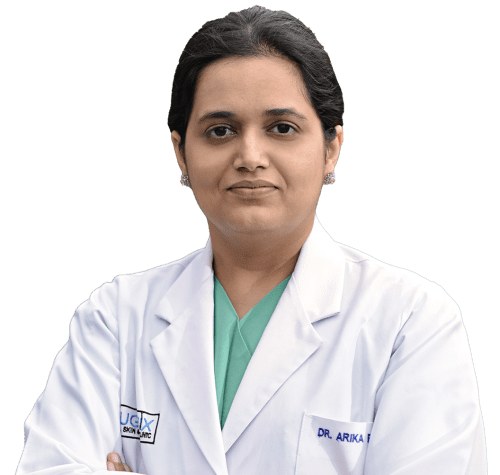
Medically reviewed by Dr. Arika Bansal, Co-Founder, Eugenix Hair Sciences; MBBS, MD Dermatology, Fellow of ISHRS; Reg. No. HN-34095 (Haryana Medical Council).
Dr. Arika Bansal
Dr. Arika Bansal, Co-Founder, Eugenix Hair Sciences. MBBS (Gold Medallist, Lady Hardinge Medical College), MD Dermatology, alumni of AIIMS, New Delhi. Fellow of ISHRS. Reg. No. HN-34095 (Haryana Medical Council).
