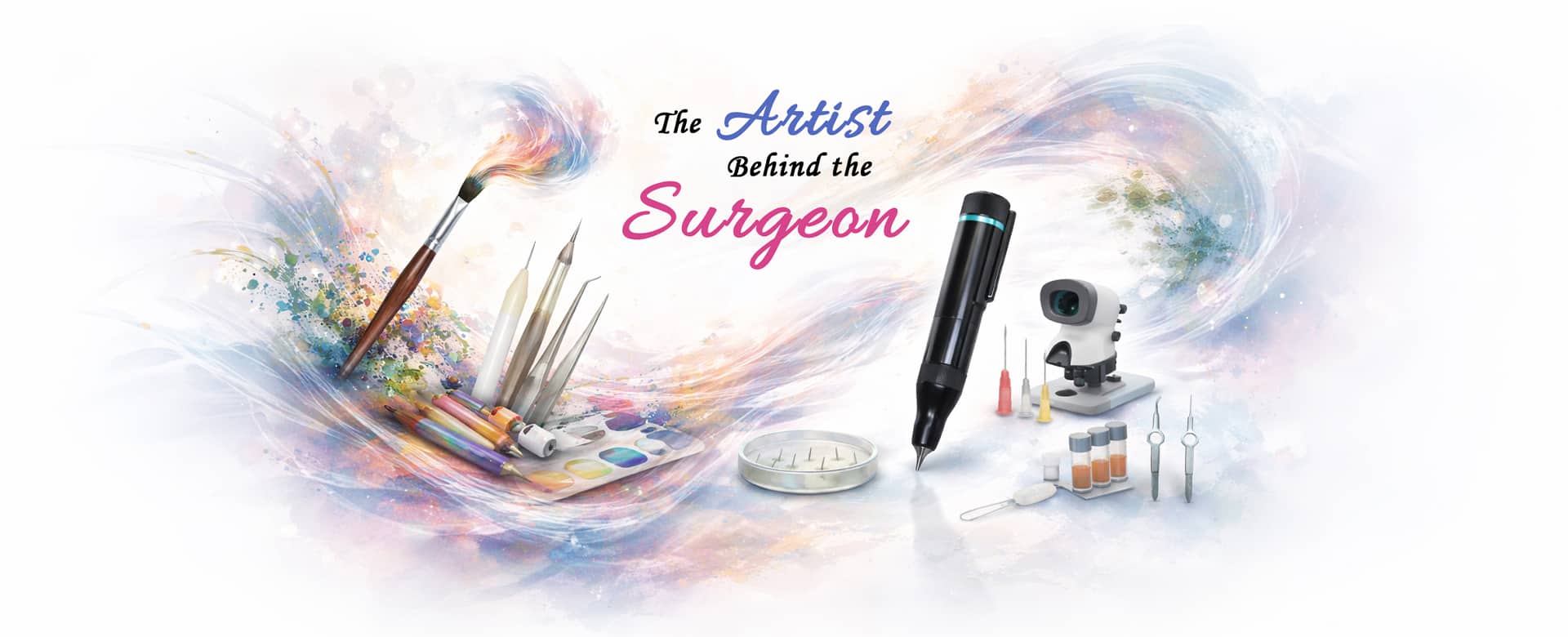

There is a moment in every hair transplant procedure that no scan can detect and no algorithm can replicate. It is the moment a surgeon looks at a face, not as a set of measurements to be corrected, but as a composition to be understood.
This is where the science ends and the art begins.
Hair transplantation is often discussed in numbers: graft counts, session durations, survival rates, square centimetres of coverage. These numbers matter. But they are not what separates a result that looks natural from one that looks like it happened. They are not what makes a patient look in the mirror eighteen months later and forget, finally, that they ever had a procedure at all.
What does that? Artistry does.
The Face as a Canvas
When a human being enters a room, attention travels first to the face. Within the face, it gravitates toward the hairline. Not because we consciously study it, but because the hairline is the frame of the face and the human eye is, instinctively, drawn to frames.
This is why hairline design is the most consequential decision in any hair restoration procedure. Not graft count. Not extraction method. The design.
A poorly designed hairline is immediately visible, even to someone who cannot articulate why. It looks too straight, too symmetrical, too low, or too perfectly geometric. The brain registers it as wrong before the mind can name the reason. A beautifully designed hairline, by contrast, registers as nothing at all. It simply looks like the person’s hair.
Nature never draws a straight line. Your original hairline, if you study it closely, is irregular. It has micro-variations, small peaks and recesses, tiny pyramidal projections that create the visual impression of organic growth. The right side of a natural hairline is not a mirror image of the left. It is subtly different, as all natural things are.
Replicating this is not a technical task. It is an artistic one.
At Eugenix, hairline design begins long before the first graft is placed. It begins with the surgeon studying the patient’s face: the proportions, the bone structure, the angle of the brow, the relationship between the glabella and the forehead. It involves understanding not just where the hairline is today, but where it needs to be in five, ten, twenty years from now as the patient ages and hair loss continues. A great hairline does not just look right today. It must look right across a lifetime.
The Principles That Cannot Be Taught in a Weekend Course
Surgical skill can be trained. Artistic judgment takes years to develop. At Eugenix, the guiding framework for all slit-making and graft placement is known as the ADDD principle: Angle, Depth, Density, and Direction.
Each of these four variables is decided individually, for each recipient site, in each zone of the scalp. The hairline zone demands angles between ten and twenty degrees so that transplanted hair lies flat and flows naturally with gravity. The temple point demands angles approaching zero, so that the hair almost skims the skin. Every zone has its own topography. Every graft has its own role.
Coronal slits, the technique Eugenix uses along the hairline, allow for the kind of acute angulation that sagittal slits cannot achieve. This means that hair at the hairline can be placed at angles that are indistinguishable from the way hair grows natively out of the scalp. Over time, as the transplanted hair grows and thickens, it behaves exactly as natural hair would. It moves the same way. It falls the same way. It responds to the same brush.
This is not a feature you will find described on most clinic websites. It is a detail that only matters if you care deeply enough to care about details.
And then there is the question of density. A common misconception is that more grafts always means better results. In reality, placing grafts at the wrong density in the wrong zone creates a result that looks artificially uniform, because nature never distributes hair uniformly. A skilled surgeon distributes grafts the way a painter distributes light: with intention, with gradient, with an understanding of where the eye will travel and what it will see.
The Instruments Are Not Incidental
Great art requires great tools. And while the hands that hold an instrument matter more than the instrument itself, the quality of the tool shapes what those hands can achieve.
At Eugenix, the commitment to instrumentation goes beyond standard clinical procurement. Carl Zeiss magnification loupes from Germany allow our surgical team to work with a level of precision that the naked eye cannot approach. Imported surgical punches from Atlanta, Georgia are thin-walled by design, creating extraction wounds that heal faster and leave no visible scarring. SAVA implanters allow every graft to be directly visualised during placement, eliminating the blind handling that causes damage in conventional techniques.
There is a principle at Eugenix that reflects this commitment plainly: if an instrument provides even a marginal improvement in outcomes, it is worth investing in. Not because it is impressive to list, but because the patient on the table deserves everything that can possibly be done in their favour.
The Direct Hair Transplant (DHT) technique, invented and described by our Co-Founders in their 2013 research paper at Eugenix and published in peer-reviewed international journals in 2013 and 2019, is itself a product of this philosophy. In traditional techniques, all grafts are extracted first and then implanted, meaning follicles spend three to six hours outside the body. In DHT, recipient sites are created first and extraction and implantation happen simultaneously. Grafts are outside the body for a maximum of thirty minutes. The difference in graft survival is not incidental. It is the difference between a graft that reaches its destination with full viability and one that arrives compromised.
When a surgeon designs a beautiful hairline but the grafts that populate it do not survive at the rate they should, the artistry is wasted. The technique exists to protect the art.
What “Good” Looks Like Versus What “Great” Looks Like
A technically competent hair transplant achieves coverage. A great hair transplant achieves the illusion that nothing happened.
The difference shows up in the details that patients themselves often cannot fully articulate when they look at their own results. It shows up in whether the hairline has the micro-irregularities that make it look native or the rigid uniformity that makes it look placed. It shows up in whether the frontal temporal angle is sharp and natural or flared and wide. It shows up in whether the crown, that most technically demanding zone of all, has been restored with a whorl pattern that mirrors the organic spiral of natural hair or filled in with rows that reveal their surgical origin.
It shows up eighteen months after a procedure when a patient stops thinking about their hair, because they simply look like themselves.
This is the standard Eugenix has pursued for eighteen years and over eighteen thousand procedures. Not coverage. Not satisfactory. But undetectable.
The Art Is Institutional, Not Individual
One of the most important things to understand about Eugenix is that the artistry described here is not the exclusive possession of any one surgeon. It is, by design, institutional.
Dr. Pradeep Sethi and Dr. Arika Bansal, Fellows of the International Society of Hair Restoration Surgeons and the founders of Eugenix, have spent eighteen years not just performing procedures but systematically transferring what they have learned to every surgeon and senior the Eugenix medical team in the Eugenix system. The ADDD principle is not a personal preference. It is a standard, taught and applied consistently across every procedure, at every Eugenix clinic.
This matters because great art, when it depends entirely on one person, is fragile. Great art, when it has been encoded into a system, becomes something more durable: a standard of care.
Every patient at Eugenix, regardless of which surgeon performs their procedure, benefits from eighteen years of accumulated clinical learning. From two PubMed-indexed research publications. From the kind of institutional knowledge that only comes from doing one thing exclusively and doing it better, year after year.
The artistry is in the system. And the system is the reason the results are consistent.
The Outcome You Cannot Fake
There are many ways to make a hair transplant look good in a photograph. There are very few ways to make it look good every day, in every light, to every person who sees it, for the rest of a patient’s life.
That is the only standard worth pursuing. Not the before and after results image. Not the review. The life that comes after, when a patient simply gets on with the business of living and their hair is the last thing on their mind.
That is what the artistry is for. That is what the science is built to protect. And that is what, at Eugenix, we have been working toward since the first day we opened.
Interested in understanding what a personalised hairline design could look like for you?
Book a Contact Us with the Eugenix team today at https://eugenixhairsciences.com/book-an-appointment/
Dr. Arika Bansal
Dr. Arika Bansal, Co-Founder, Eugenix Hair Sciences. MBBS (Gold Medallist, Lady Hardinge Medical College), MD Dermatology, alumni of AIIMS, New Delhi. Fellow of ISHRS. Reg. No. HN-34095 (Haryana Medical Council).