
When people think about a hair transplant, they usually think about the end result.
They think about the hairline. The density. The photographs they may finally stop dreading. They think about whether they will look fresher, younger, more like themselves again. That is the part most people understandably hold onto.
What they are not usually thinking about is magnification.
But the surgeon is.
Because for all the emotion and anticipation attached to a hair transplant, the procedure itself comes down to detail. Very small detail. A tiny change in angle. A little more space here. A little more restraint there. The kind of thing most people would never notice while it is happening, but absolutely notice months later when the result either looks natural or it does not.
That is where surgical loupes come in.
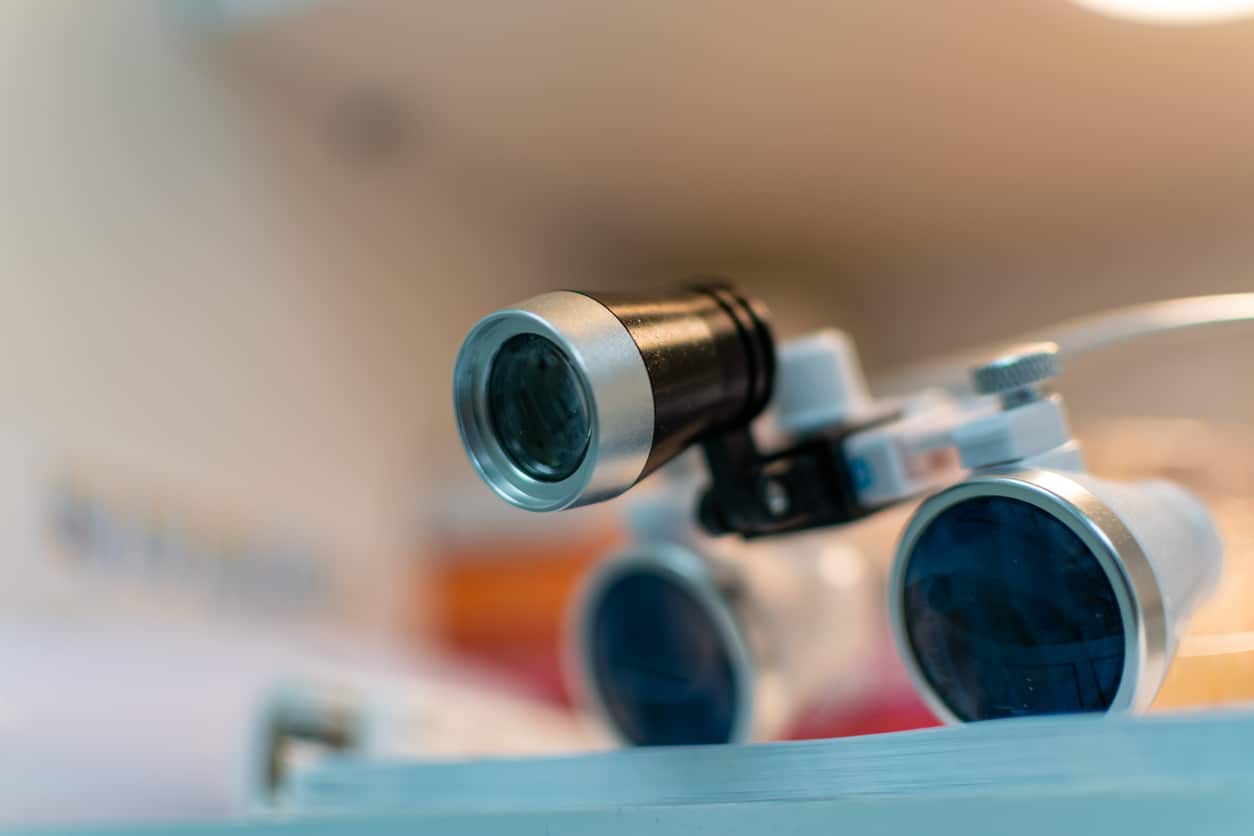
If you have ever seen them in a clinic, they are the magnifying lenses surgeons wear over their glasses. To a patient, they may seem like just another medical instrument. Useful, perhaps. Technical, certainly. But in a procedure like hair transplantation, they are not decorative equipment. They are part of what allows a surgeon to work with consistency for hours, without losing sharpness.
And that matters more than people realise.
A hair transplant is not one dramatic act of medicine. It is not a single heroic moment. It is a long, patient sequence of careful decisions. Extraction after extraction. Placement after placement. Attention held steadily over many hours. That kind of work can be exhausting, not physically in some grand theatrical way, but quietly. The eyes tire. Concentration softens. Fatigue creeps in without asking permission.
Anyone who has ever done delicate work for long stretches will understand this. You do not suddenly stop knowing what you are doing. It is subtler than that. The edge blunts a little. The precision you had in the first hour becomes harder to hold in the fifth or sixth unless you are properly supported.
Loupes help with exactly that.
They bring the field closer. They make fine structures clearer. They reduce the need to strain. They allow the surgeon to keep seeing what needs to be seen with the kind of clarity the hair transplant procedure demands. They do not replace skill, judgment, or experience. But they help good surgeons stay exact for longer, and in hair restoration that is not a small advantage.
It affects extraction first.
Every graft taken from the donor area matters. There is a finite supply. That alone should make anyone take the process seriously. A follicle cannot be treated casually, because once it is damaged, that loss is real. During extraction, the surgeon has to pay close attention to how the hair exits the scalp, how the follicle sits beneath the skin, and how to remove it with as little trauma as possible. This is not guesswork. It is precision work.
Magnification makes that precision easier to maintain.
Then comes implantation, which is where the technical and the aesthetic become inseparable. Natural hair does not grow in obedient straight lines. It bends. It softens. It changes direction. It behaves differently at the temples, differently at the frontal hairline, differently in areas of existing density. If the surgeon does not respect that, the result may still grow, but it may not look believable.
And that is the difference people care about most in the end. Not just whether hair grows, but whether it belongs.
To create that effect, grafts have to be placed with care, with attention to angle, direction, spacing, and flow. There has to be restraint. There has to be taste. And in many patients, there is another layer of complexity: existing native hair. That means the surgeon is not working on an empty scalp, but navigating between living hairs that must be preserved. Adding density without damaging what is already there requires more than confidence. It requires control.
Real control. Millimetre-level control.
That is one of the reasons tools like surgical loupes are so important in a serious practice. Not because they look advanced. Not because they help create a futuristic image. And certainly not because technology alone can produce a good outcome. They matter because they support attentiveness. They support discipline. They support the kind of careful, unshowy work that often separates an average result from one that looks soft, natural, and entirely at home on the face.
At Eugenix, that distinction matters.
The point is never to impress a patient with equipment for example the Mantis microscope or similar tools. The point is to respect the hair transplant procedure enough to use every sensible advantage that improves precision and protects graft quality. Hair restoration is too personal, too visible, and too lasting for casual shortcuts. Patients live with these results for years. Many live with them for life. That should make any responsible surgeon slower, more thoughtful, and less interested in rushing through the small things.
Because the small things are not small here.
They are the procedure.
Months later, when someone looks in the mirror and the hairline feels natural, when the density sits well, when the transplant does not announce itself to the world, that result is built on many invisible decisions. Better visibility. Steadier focus. Cleaner extraction. More thoughtful placement. Patience, repeated again and again.
That is what surgical loupes really contribute to.
Not glamour. Not marketing language. Just the ability to see clearly and work carefully, for as long as the job demands.
And in a field like this, that can make all the difference.
Dr. Arika Bansal
Dr. Arika Bansal, Co-Founder, Eugenix Hair Sciences. MBBS (Gold Medallist, Lady Hardinge Medical College), MD Dermatology, alumni of AIIMS, New Delhi. Fellow of ISHRS. Reg. No. HN-34095 (Haryana Medical Council).