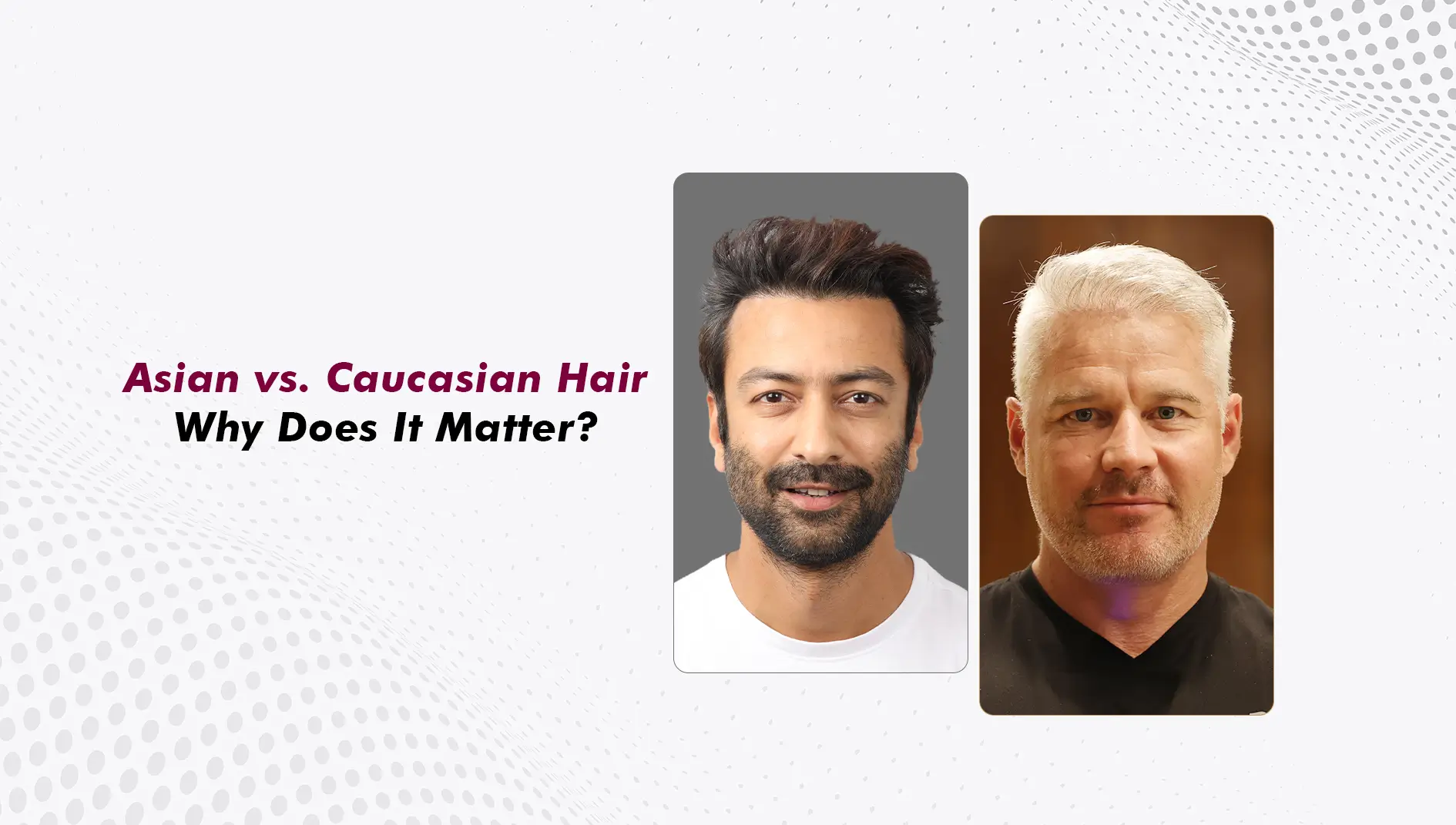

If you have ever compared hair transplant results between patients from different parts of the world, you may have noticed that outcomes can look quite different even when the number of grafts is similar. The reason lies in the hair itself. Caucasian and Asian hair differ in diameter, cross-section shape, cuticle structure, colour contrast, and growth angle, and each of these differences changes how a hair transplant should be planned. Understanding these hair types is not an academic exercise: it directly shapes donor planning, hairline design, and the density decisions your surgeon makes.
This matters enormously for Indian patients too, because Indian hair broadly shares the characteristics of Asian hair while showing wide individual variation. In this article, we give you a better understanding of how Asian and Caucasian hair compare, where Indian and African hair fit into the picture, and what these differences mean for the result you can realistically expect from your procedure.
Why Hair Characteristics Matter in Hair Transplant Planning
A hair transplant is not a standardised product. It is a surgical procedure planned around the unique characteristics of your hair and scalp. Two people with an identical balding pattern can need very different plans if one has thick, straight, jet black hair and the other has fine, wavy, light brown hair.
Hair morphology influences four core planning decisions:
– How many grafts can safely be harvested from the donor area, per sitting and over a lifetime?
– How the hairline is designed and positioned relative to the facial structure and head shape
– What density is placed in each zone of the scalp
– How the extraction itself is performed, since the follicle’s shape and growth angle under the skin affect the risk of damaging grafts
This is why an experienced surgical team always evaluates hair diameter, curl pattern, colour contrast, and donor density before finalising any plan, rather than quoting a fixed graft number for every person.
Caucasian and Asian Hair: The Core Structural Differences
Human hair looks superficially similar across the world, yet under magnification the differences between ethnic hair types are striking. The underlying keratin structure is similar across hair types, but the geometry of the fibre, its diameter, its shape, and its cuticle layering vary significantly between Asian and Caucasian hair.
Diameter and cross-section shape
Asian hair is the thickest of the major hair types. It typically has a diameter of 80 to 120 micrometres (µm) and a round cross-section, giving it the greatest cross-sectional area among hair types. It grows predominantly straight, and genetics play a key role here: The EDAR gene, common in East Asian populations, influences hair thickness and contributes to the robust, straight hair seen widely across East Asia, including among Chinese and Japanese populations.
Caucasian hair has an average diameter of 60 to 80 µm, noticeably thinner than Asian hair, with an oval cross-section. It ranges from straight to wavy, and the oval shape is part of why waves form so readily.
African hair sits at the other end of the spectrum: tightly coiled, with an elliptical cross-section and the finest calibre of the major hair types, which makes each strand more fragile despite the hair often appearing very dense when styled in its natural state.
Why this matters for planning: a thicker diameter means each graft contributes more visible coverage. A thinner diameter means more grafts may be needed for the same visual effect, but finer strands also blend more softly at the hairline.
Cuticle layers, strength, and chemical behaviour
The cuticle is the outermost layer of the hair shaft, made of overlapping scales that protect the fibre. Asian hair usually possesses more layers of cuticle than Caucasian hair, and this thicker cuticle armour gives it higher tensile strength and stronger resistance to breakage and mechanical stress.
Caucasian hair, with fewer and thinner cuticles, is more delicate. It is more susceptible to environmental factors, more prone to frizz in humidity, and it can break more easily under aggressive brushing or heat. The same thin cuticle also means Caucasian hair absorbs dye and bleach faster, while Asian hair requires longer processing times for chemical treatments because the dense cuticle resists penetration.
There is a styling trade-off hidden in this strength. Caucasian hair holds shapes, waves, and blowouts more readily. Asian hair tends to resist holding a curl or lasting volume, and heavy, thicker strands often lie flat against the head rather than lifting. Asian hair also reflects light exceptionally well, which produces its characteristic glossy appearance.
Colour and scalp contrast
Asian and Indian hair is usually black or very dark brown, creating high contrast against the scalp. This has an important and often misunderstood consequence for transplant patients: high contrast makes density appear lower than it actually is, because every gap between black hair strands stands out against lighter skin.
Caucasian hair varies enormously in colour, from black hair and dark brown through lighter brown, blonde, and red hair, which is the rarest colour worldwide. Lighter shades create moderate to low scalp contrast, which is visually forgiving. This is one reason similar transplanted densities can look fuller on many Caucasian patients than on patients with dark hair and pale skin.
Why this matters for planning: for Asian and Indian patients, expectation setting around contrast is a critical part of honest counselling. The transplanted density may be clinically excellent, yet appear less dense under harsh light simply because of contrast. A good surgical team explains this before the procedure, not after.
Growth angle and follicle path
One difference that patients rarely hear about is the angle at which hair grows. Asian hair follicles tend to grow vertically, almost straight down into the scalp. Caucasian hair follicles typically grow at an angle relative to the scalp surface, and African hair follicles curve beneath the skin.
For extraction, this is significant. A punch aligned to a vertical follicle behaves differently from one that must follow an angled or curved path. For implantation, the angle at which each graft is placed must recreate how that person’s hair naturally emerges, or the result will not look right. This is one of many reasons hair transplantation across different ethnicities demands individual assessment rather than a template.
Hair Density in Different Ethnicities
Density is where the comparison becomes counterintuitive. Despite having the thinnest individual strands of the three groups, Caucasian hair has the highest density: published averages are around 200 to 240 hairs per square centimetre. Asian hair density averages around 160 to 170 hairs per square centimetre. So while a person with Asian hair has fewer hairs on the head, each strand is substantially thicker, and the two factors partially offset each other in overall appearance.
In practical terms, higher density gives Caucasian hair more natural volume and scalp coverage, while Asian hair achieves its coverage through the sheer diameter of every strand. Someone with fewer hairs but thicker fibres can appear to have more hair than the raw count suggests, and vice versa.
Two cautions belong with these numbers. First, they describe original hair density on an untreated scalp, not transplanted density, which is a different measurement entirely. Second, density comparisons between different ethnicities are not directly comparable as a measure of outcome quality. Comparing your result with a person of a different hair type is comparing two different clinical situations.
Where Indian Hair Fits in This Comparison
Indian hair is generally classified within the Asian hair family for transplant planning: predominantly straight to gently wavy, dark brown to black, thick in diameter, with a round to slightly oval cross-section. However, India’s population is genetically diverse, and variation is wide. Some Indian patients present with finer or wavier hair that behaves closer to Caucasian norms in planning terms, while others have hair as thick and straight as any East Asians’.
This is exactly why Eugenix does not plan by ethnicity alone. The ethnic group provides the starting framework, and the individual assessment of your donor area, hair diameter, and curl pattern provides the final plan. Two Indian patients can receive meaningfully different graft plans for the same grade of baldness, and that is a sign of careful planning, not inconsistency.
African Hair: The Most Demanding Extraction Profile
Although the primary comparison in this article is between Caucasian and Asian hair, African hair deserves its own section because it represents the most technically demanding extraction profile in hair transplantation.
African hair is tightly coiled, elliptical in cross-section, and fine in calibre, which makes individual strands more fragile and more prone to dryness, since scalp oils struggle to travel down tight curls. Critically, the curl continues below the skin: the follicle itself follows a curved path. A straight punch applied to a curved follicle carries a much higher risk of transection, which means damaging the graft during extraction.
For patients with African hair, surgical experience is not a preference; it is a requirement. The extraction approach, punch handling, and graft assessment all need to be adapted to the curved follicle path. Patients with this hair type should specifically ask any clinic about its experience with tightly curled hair before booking.
How Hair Characteristics Change Donor Planning
Donor planning is where the differences between hair types have their most concrete effect. The plan must answer two questions: how many grafts can be taken safely today, and how many must be preserved for the future?
Because Caucasian scalps carry higher follicular density, safe harvesting figures differ. At Eugenix, the reference figures used in planning are:
– Grafts harvestable per sitting for Indian and Asian patients: 3,000 to 4,500
– Grafts harvestable per sitting for Caucasian patients: 4,000 to 5,000
– Lifetime donor capacity for Indian and Asian patients: 5,000 to 8,000 grafts
– Lifetime donor capacity for Caucasian patients: 6,000 to 9,000 grafts
These are reference points, not promises. Actual capacity depends on your individual donor density, hair diameter, and scalp laxity, all assessed by the doctor during consultation.
For Indian and Asian patients, the lower per-sitting capacity means large restorations, such as advanced grades of baldness, are sometimes planned across two sittings rather than forced into one. Harvesting beyond safe limits to chase a single-sitting result thins the donor area permanently and compromises future options.
In every case, Eugenix plans for future hair loss, not just the current pattern. Hair loss is progressive, and a plan that spends the entire donor reserve on today’s baldness leaves nothing for the years ahead. This is a core reason no responsible clinic should quote a final graft count without a full consultation. The same individualised thinking applies when facial hair is used: beard grafts can supplement scalp donor supply in selected cases, and beard characteristics also vary by ethnicity.
How Hair Characteristics Change Hairline Design and Density
Hairline design at Eugenix follows the ADDD principle: Angle, Depth, Density, and Direction, or Design. Every one of these parameters interacts with the person’s hair characteristics.
Angle and direction: straight hair with a thick diameter is less forgiving of angle errors because each strand is individually visible. Wavy Caucasian hair softens minor irregularities on its own. The lead surgeon sets these parameters for every case.
Density placement: at Eugenix, the hairline zone is typically planned at 35 to 45 grafts per square centimetre, with the mid-scalp and crown at 25 to 35 grafts per square centimetre. Within those ranges, the exact figure is tuned to diameter and contrast. Thick, dark hair can achieve strong visual coverage at the middle of the range, while thin, fine hair may be planned toward the upper end in the frontal zone.
Facial framing: skull shape also differs across ethnic groups. Caucasian heads tend to be longer and narrower with more prominent frontal projection, while Asian heads tend to be shorter and wider. The hairline position, generally planned 7 to 10 cm above the glabella for men, is adjusted to the individual facial structure so the restored line frames the face properly rather than following a template.
It is also worth understanding a universal principle: transplanted density is approximately half of natural original density in the treated zone, for every ethnicity. This is a deliberate clinical choice. Placing more follicles than the local blood supply can support puts grafts at risk. Optimum density, planned around your hair characteristics, delivers better long-term results than maximum density.
Caring for Different Hair Types After a Hair Transplant
The structural differences between Caucasian and Asian hair carry over into aftercare and everyday grooming once your scalp has healed.
At Eugenix, the first head wash after a procedure is on Day 7 only, for every patient and every hair type. Beyond that point, your hair’s own characteristics guide daily care. Thicker Asian hair tolerates a firm comb and daily handling well, thanks to its strong cuticle layering. Finer Caucasian strands need a gentler comb and lighter handling, since fragile, thin fibres break more readily under tension. Tightly curled hair should never be forced through a dry comb at all, as coiled strands snap where they bend and suffer from dryness.
Styling habits deserve honest discussion too. Aggressive daily styling, chemical straightening, frequent heat treatment, and tight pulled-back styles all stress hair over time. Tight, high-tension styling is a recognised cause of traction thinning across all hair types, and it is discussed frequently among Black women because tight braiding styles are common. If you are recovering from a transplant, ask your surgical team before resuming any chemical treatment or heat straightening, and let transplanted grafts establish themselves before subjecting them to styling stress. Hair that grows from transplanted follicles is your own hair, and it responds to care and neglect exactly as the rest of your hair does.
What This Means for Your Expectations
Bringing the comparison of Asian and Caucasian hair together, here is what each group should keep in mind:
– Indian and Asian patients: your thick strand diameter works in your favour, giving strong coverage per graft. Balance this against high scalp contrast, which can make density appear lower in harsh lighting. A see-through appearance under direct sunlight or flash photography is normal for all transplant patients and is more noticeable with dark hair on lighter skin.
– Caucasian patients: your higher density in the donor zone and softer colour contrast are advantages, while finer strands mean graft numbers and frontal density are planned accordingly.
– Patients with tightly curled hair: prioritise surgical experience with curved follicles above every other factor when choosing a clinic.
Across all groups, hair grows on its own schedule after a transplant, and patience through the shedding and regrowth phases matters as much as the surgical plan itself.
Why Patients Across Hair Types Choose Eugenix
Eugenix Hair Sciences has performed over 22,000 procedures across more than 15 years of clinical practice, treating Indian patients as well as international patients across the full range of hair types discussed in this article. Every procedure uses DHT (Direct Hair Transplant), the technique pioneered by co-founders Dr Pradeep Sethi and Dr Arika Bansal, both alumni of AIIMS, New Delhi, and published in the 2013 PubMed-indexed paper “Direct hair transplantation: a modified follicular unit extraction technique“.
DHT is a modified form of FUE in which extraction and implantation happen simultaneously, keeping grafts outside the body for under 30 minutes compared to the 3 to 4 hours typical of traditional FUE. Shorter out-of-body time is valuable for every hair type, and particularly for finer and curlier grafts that are more vulnerable to handling.
In every Eugenix procedure, your hairline is designed, the slits are created hands-on, and all technical parameters are set by the lead surgeon. Scoring, extraction, and implantation are performed by senior surgical assistants under the lead surgeon’s parameters and supervision. The lead surgeon supervises your procedure throughout, taking rounds between active steps and remaining available at all times during your surgery.
Frequently Asked Questions
Is there really a difference between Asian and white hair?
Yes. Asian hair is typically thicker in diameter, round in cross-section, straighter, and darker, with more cuticle layers and greater resistance to breakage. Caucasian hair is finer, oval in cross-section, more varied in colour and curl, and grows at a denser rate per square centimetre. Both respond excellently to hair transplantation when the plan respects these differences.
What is Caucasian hair called?
Caucasian hair is also commonly called European hair. In curl typing systems used by stylists, it most often falls under the straight and wavy categories, though Caucasian hair spans everything from poker straight to tightly curled. The differences described in this article between Asian and European hair are the same comparison under a different name.
Do Asians usually have thick or thin hair?
Individually thick, collectively fewer. Asian hair strands are the thickest of the major hair types, at roughly 80 to 120 µm in diameter, but there are fewer hairs per square centimetre than on a typical Caucasian scalp. The thick fibre compensates for the lower density, which is why Asian hair generally looks full and heavy.
Do Indian patients need more grafts than Caucasian patients?
Not necessarily. Indian and Asian patients typically have fewer harvestable grafts per sitting, but each thick strand provides more visible coverage. The graft count is decided by your balding pattern, donor capacity, and hair diameter together, which is why a consultation is essential before any number is quoted.
Why does my transplanted hair look less dense in bright light?
A slight see-through appearance under direct sunlight, flash photography, or with wet or oiled hair is normal for every transplant patient. It is more noticeable with black hair against a lighter scalp because of contrast. This does not mean the transplant has underperformed.
Conclusion
The differences between Caucasian and Asian hair, and where Indian and African hair sit alongside them, ultimately tell a story about personalised planning. Diameter, cross-section shape, cuticle structure, color contrast, growth angle, and density all shape the right plan for you, from donor harvesting limits to hairline design and density placement. No single template fits every head of hair, and the best results come from a team that plans around your characteristics rather than around averages.
If you are considering a hair transplant and want a plan built around your specific hair type, book a free consultation with an Eugenix Hair Science Advisor. Your photo evaluation is always free, and it is the first step toward understanding what your hair can realistically achieve.
Dr. Arika Bansal
One of only a few female surgeons specializing in hair transplant surgery in India, Dr. Arika Bansal has been voted one of the best doctors in the world. She maintains an active fellowship in the ISHRS and regularly submits research papers to medical journals. 15+ years down the line, 22,000+ surgeries are accomplished under Dr. Bansal’s supervision. She specializes in female hair transplant, density improvement, corrective hair transplantation and hairline design.