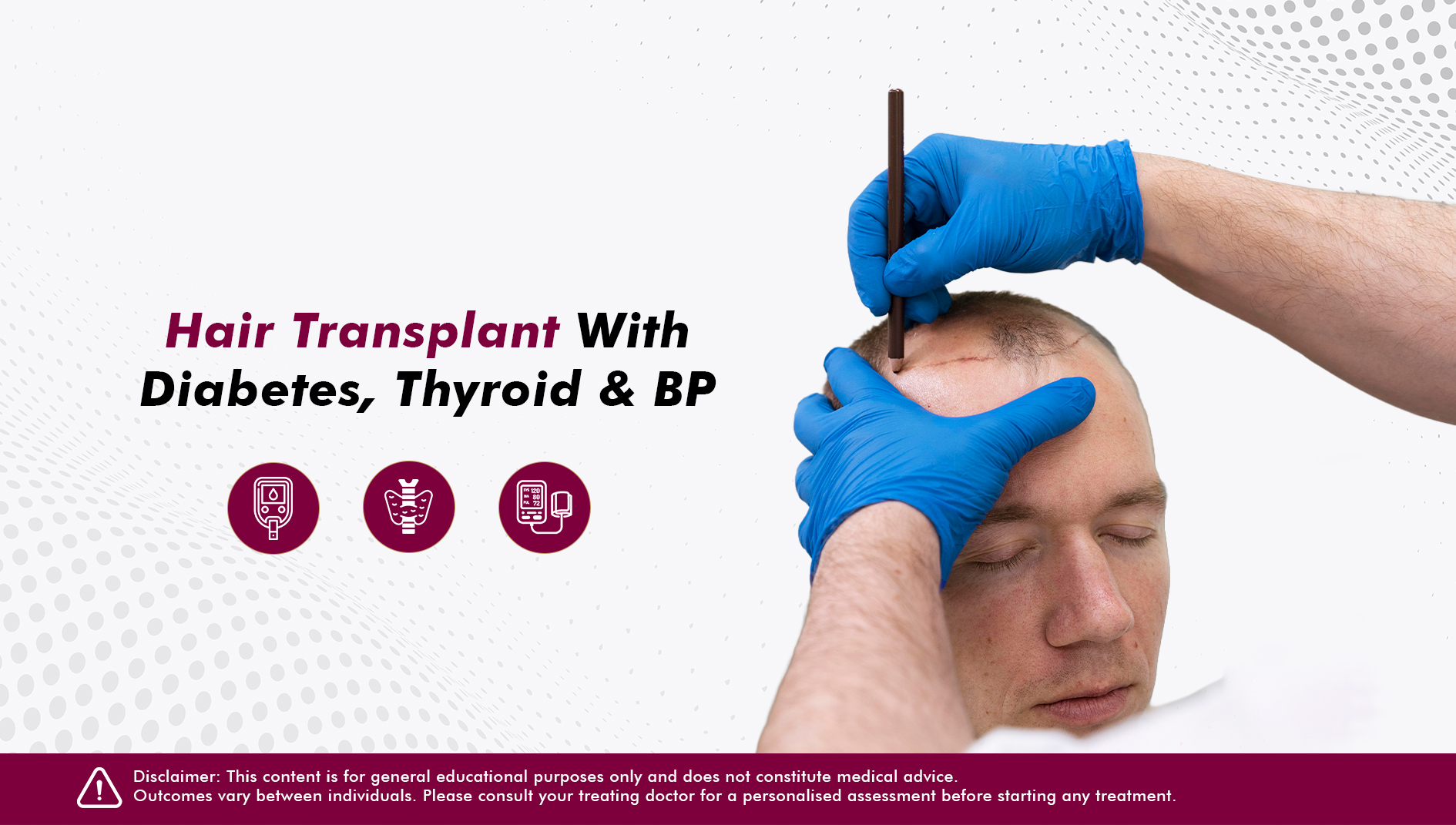
If you are considering a hair transplant with diabetes, a thyroid disorder or high blood pressure, the question on your mind is probably simple: will a clinic even accept me? The answer is more encouraging than most people expect. A medical condition is not an automatic disqualification. What matters is whether it is well controlled, what your doctor says about your overall health, and what your pre-operative investigations show.
At Eugenix Hair Sciences, no patient reaches surgery without medicine department clearance. That applies to everyone, so you are not being singled out. You go through the same screening as every other patient, with closer attention on the numbers that matter for you.
A Medical Condition Is Not an Automatic No
Hair restoration is elective surgery, and that shapes how a responsible clinic thinks about it. There is no clinical urgency, so no reason to proceed while a patient’s underlying health is unsettled. A date can be moved. A complication cannot be undone.
What we assess is not the label of your diagnosis but the state of your control. Two diabetic patients can both have type 2 diabetes. One has stable blood sugar on a settled medication routine with regular follow up. The other has fluctuating readings and has not seen a doctor in two years. Those are different clinical pictures leading to different decisions. Which one describes you is a call the medicine department makes after a full medical history review.
Does Diabetes Cause Hair Loss?
This is worth answering first, because it changes what a transplant can realistically do for you. Diabetes can contribute to hair thinning in its own right, separately from pattern baldness.
Sustained high blood sugar levels damage small blood vessels. When blood circulation to the scalp is reduced, hair follicles receive less oxygen and fewer nutrients, and hair growth slows. Poorly controlled diabetes is also associated with hormonal imbalance and with physiological stress that pushes more follicles into the resting phase than usual.
Can type 1 diabetes cause hair loss?
Yes. The mechanism is broadly the same: unstable blood glucose affects blood flow and the body’s ability to support normal growth. Type 1 diabetes is autoimmune in origin, and people with one autoimmune condition are more likely to have another, including thyroid disease and alopecia areata, which cause hair loss by a different route.
Can insulin resistance or prediabetes cause hair loss?
Insulin resistance can contribute to hair thinning before a formal diagnosis is made, which is one reason unexplained hair loss is worth investigating rather than assuming it is genetic. In women it often sits alongside PCOS, itself a recognised cause of female pattern hair loss.
What does diabetes-related hair loss look like?
It tends to be diffuse rather than patterned. Hair thins broadly across the scalp, sometimes the body too, rather than receding at the temples or opening at the crown. Regrowth is slower than expected. Only a dermatological evaluation separates what is diabetes related from what is genetic, and that affects whether hair transplant surgery is the right answer for you.
Hair Transplant With Diabetes: What Gets Assessed
Diabetes matters in hair transplantation for two practical reasons, and neither is about the hair itself.
Healing and the blood supply to the scalp
A hair transplant creates thousands of very small extraction points in the donor area and thousands of recipient slits in the implanted zone. These are tiny wounds, but they need to close cleanly, and high blood sugar weakens cell repair and causes slow healing.
Poor blood circulation compounds this. Reduced blood flow can starve newly transplanted follicles of oxygen and nutrients in their first days in place, and that is the window in which graft survival is determined. Stable blood sugar in the weeks leading up to your procedure supports proper tissue repair.
Infection risk
A weakened immune system raises infection risk at any surgical site, and uncontrolled diabetes is associated with both. Post operative antibiotics are prescribed for every Eugenix patient regardless of history, but your diabetes control still needs to be in a reasonable place before we operate.
The tests that show where you stand
Every patient completes a standard pre-operative blood panel. Two tests speak directly to diabetes:
– Random Blood Sugar, a snapshot of your blood glucose on the day
– HbA1c, or glycosylated haemoglobin, which reflects average blood sugar control across the preceding three months
HbA1c is the more meaningful of the two for planning hair transplant surgery. One good reading on one morning tells us little. A three-month average tells us whether your sugar control is managed.
The rest of the panel is the same for diabetic patients and non-diabetic patients: haemogram covering haemoglobin, total leucocyte count, differential leucocyte count and platelet count; Prothrombin Time INR; aPTT; HIV 1 and 2 antibody test (Anti-HIV); HBsAg; and Anti-HCV. If you are aged 40 or above, an ECG reported by a physician or cardiologist is required, with a blood pressure check. Reports are valid for three months from your procedure date and should be done at least 15 days beforehand.
We do not publish a target HbA1c figure. Whether you are a suitable candidate is not a number you can look up. It is judged on a full medical evaluation rather than one value read in isolation.
If your diabetes is not yet well controlled
The procedure is deferred, not cancelled. You would be advised to work with your primary physician or endocrinologist on your diabetes management, then return with fresh investigations. Diabetic patients who have done exactly this have gone on to have their procedures.
Which Technique Suits a Patient With Diabetes
Eugenix performs DHT, or Direct Hair Transplant, exclusively. DHT is a modified follicular unit extraction technique developed and published by our Co-Founders, Dr. Pradeep Sethi and Dr. Arika Bansal, in a PubMed indexed paper in 2013. Extraction and implantation happen simultaneously, keeping graft out of body time under 30 minutes against the 3 to 4 hours typical of traditional follicular unit extraction.
Two features matter for diabetic patients. Minimally invasive extraction takes individual follicular units rather than a strip of scalp, so tissue trauma is limited and recovery quicker. And shorter out of body time returns grafts to a living blood supply sooner.
Eugenix does not perform follicular unit transplantation, the older strip method, which leaves a larger wound and a linear donor scar.
Thyroid Disorders and Hair Transplant
Thyroid function is directly connected to hair health, not only to surgical safety. Hypothyroidism is associated with a high rate of hair loss across the body, hyperthyroidism with increased thinning. When thyroid levels are imbalanced, hair loss can occur regardless of genetic predisposition.
So if an untreated thyroid disorder is contributing to your hair loss, some of what you are seeing may improve with medical management alone, and operating first risks surgery you did not need. Thyroid function is therefore investigated before eligibility is confirmed, particularly in female patients. Once a thyroid condition is diagnosed, treated and stable, it is generally not a barrier. The requirement is stability and a physician’s assessment, not a perfect medical history.
High Blood Pressure and Hair Transplant
Hypertension is one of the most common conditions our patients disclose, and in most cases it is managed well on prescribed medications. Its relevance is direct. The procedure involves local anaesthesia, several hours in the chair and thousands of small incisions. Blood pressure that is elevated and unmanaged makes bleeding harder to control, which affects the working field and the quality of graft placement.
On the day, your vitals are checked before anything begins. For patients aged 40 and above, medical clearance including an ECG report and a blood pressure check is collected in advance, and cardiovascular health forms part of that medical evaluation.
If you have a cardiac history or take Aspirin
Patients are normally asked to stop painkillers and Aspirin for 4 to 7 days before a hair transplant. That instruction does not apply automatically to patients with a cardiac history. If you have had heart surgery in the past 6 months and take Aspirin as part of your cardiac care, you must obtain written clearance from your cardiologist confirming you are fit to undergo the procedure, before any question of stopping Aspirin is discussed. No procedure is planned until that clearance is received. If you take a blood thinner of any kind, or high dose supplements such as Vitamin E, say so at the first conversation.
The Screening Every Eugenix Patient Goes Through
Medicine department clearance is mandatory for every Eugenix patient before any procedure, whether they are entirely healthy or living with several conditions.
Your Hair Science Advisor records bleeding or coagulation disorders, hypertension, diabetes mellitus, cardiac conditions, drug allergies, current medications, supplement use and any history of major surgery. Once your date is confirmed, you complete a pre-surgical form covering your conditions, your medications and your signed acknowledgement of the pre-operative instructions.
Additional investigations for female patients
Female patients require a hormonal panel in addition to the standard tests, not instead of them. This is mandatory. Pre-menopausal women complete these between Day 3 and Day 5 of the menstrual cycle: CBC, T3, T4 and TSH, serum ferritin, serum prolactin, serum testosterone free and total, 17 OH progesterone, FSH and LH, serum DHEA and DHEAS, and serum AMH. Post-menopausal women complete the first five of those.
Post operative care matters more, not less
Post operative instructions are not a formality for diabetic patients. Do not touch or scratch the treated areas, since irritation invites infection. Keep to the medication schedule you are given. Your first head wash is on Day 7, following the method you are shown. Careful monitoring of your blood sugar through recovery supports the healing process as much as anything done in theatre.
Why This Level of Screening Is Worth It
Knowing when not to proceed is as much a part of good hair restoration practice as knowing how to perform a procedure. Both Co-Founders are alumni of AIIMS, New Delhi and Fellows of the ISHRS. The Gurgaon centre is NABH accredited under Certificate No. DE-2026-0004, valid from 12 March 2026 to 11 March 2030. Consultations are conducted by a panel of experienced surgeons, personally handpicked and trained by the Co-Founders. At Eugenix, major complications are exceptionally rare, supported by over 20,000 procedures performed across more than 15 years of clinical practice.
Frequently Asked Questions
Is a hair transplant safe if I have diabetes?
When diabetes is well controlled and a qualified hair transplant surgeon has your full medical evaluation in hand, the procedure is performed safely as it is for other patients. What changes the picture is uncontrolled diabetes, which is why clearance comes before a date.
Will diabetes affect my hair transplant results?
Well controlled diabetes is not generally expected to change the quality of your hair transplant results. What it affects is the healing phase. Your outcome depends far more on donor density, hair characteristics and how your hair loss progresses.
Can I have a hair transplant if I take thyroid medication?
Being on thyroid medication is not in itself a barrier. What matters is that your levels are stable and your treating doctor is satisfied. The decision rests on your reports rather than the diagnosis alone.
The Next Step
Living with a medical condition does not put hair restoration out of reach. It means your planning starts with an honest picture of your overall health, built from your reports rather than guesswork. Share your full medical history at the first conversation. Nothing you disclose will be held against you. Book a free photo evaluation with an Eugenix Hair Science Advisor, bring your recent reports and your current medication list, and let us tell you honestly where you stand.
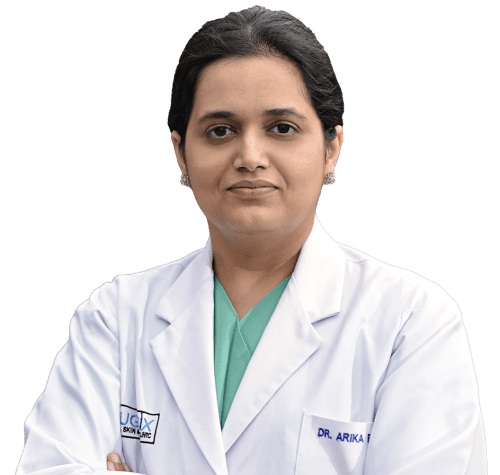
Dr. Arika Bansal
One of only a few female surgeons specializing in hair transplant surgery in India, Dr. Arika Bansal has been voted one of the best doctors in the world. She maintains an active fellowship in the ISHRS and regularly submits research papers to medical journals. 15+ years down the line, 20,000+ surgeries are accomplished under Dr. Bansal’s supervision. She specializes in female hair transplant, density improvement, corrective hair transplantation and hairline design.