

At the density planned at Eugenix for the mid scalp and crown, 25 to 35 grafts per square centimetre, 3,000 grafts cover roughly 85 to 120 square centimetres. Where a denser hairline zone is included, the area is smaller. For many people that means the hairline and the zone behind it, or a smaller front with part of the crown. What it covers for you depends on your hair loss, your hair type and your donor area.
Three thousand grafts sounds large, and it is a real amount of your own hair. It is also not a full head. The useful question is where those grafts go and what is left in your donor area afterwards. This guide from Eugenix Hair Sciences explains 3,000 grafts coverage zone by zone.
How much will 3,000 grafts cover?
The area 3,000 grafts can cover depends on the density planned for each zone. Behind the hairline and at the crown, at 25 to 35 grafts per square centimetre, 3,000 grafts reach roughly 85 to 120 square centimetres. At the hairline, planned at 35 to 45 grafts per square centimetre, the same number would cover roughly 67 to 86 square centimetres. Most plans mix both.
The method is the same one used for any graft count: each zone is measured in square centimetres and multiplied by its planned density. Measuring the bald or thinning areas in this way is also how published scales for planning a hair transplant are built. Our guide on how to calculate grafts explains the method in full.
How many hairs are 3,000 grafts?
3,000 grafts carry a little over 6,000 hairs on average. A graft is a follicular unit, a natural group of 1 to 4 hairs, and scalp grafts carry a little over 2 hairs each on average. The exact figure depends on your donor hair. At the hairline, single-hair grafts are used in the first 4 to 6 rows, so a plan with more hairline work carries fewer hairs per graft. Grafts, not hairs, are what the lead surgeon plans. Our explainer on grafts and hairs covers this in more detail.
Where do 3,000 grafts usually go?
Where 3,000 grafts go depends on how far your hair loss has progressed and which zones need hair most. The frontal hairline and the zone behind it frame the face, so they usually come first. The crown is planned more conservatively, because hair there fans out from the whorl and the same grafts give less visible coverage than at the front.
When hair loss is mainly at the front
When hair loss is limited to a receding hairline and the area just behind it, the area is small, and 3,000 grafts may be more than you need. In that case the plan may use a smaller graft number and keep the rest of your donor hair in reserve. A larger number is not automatically a better plan.
When the front and mid scalp are thinning
With mid scalp thinning as well as a receding front, 3,000 grafts can often be spread across the hairline and the zone behind it, with the crown left for later.
When hair loss is advanced
In advanced hair loss, Grade 6 and 7 on the Norwood scale, full coverage needs about 7,000 to 9,000 grafts, so 3,000 grafts covers only part of the area. At Eugenix, most such patients are covered in 2 sittings: the front and mid scalp first, then the crown in a second sitting, which can be done after 6 to 8 weeks, with beard grafts added as a filler where needed. The hairline is set more conservatively, in a V shape, which needs fewer grafts than a rounded one.
What do 3,000 grafts ask of your donor area?
3,000 grafts sits within what most Indian and Asian patients can give in one sitting, 3,000 to 4,500 grafts, but it is a large share of the lifetime donor capacity of about 5,000 to 8,000 grafts. For Caucasian patients, one sitting can give 4,000 to 5,000 grafts, and the lifetime capacity is about 6,000 to 9,000. Your donor supply is finite, so the plan always keeps future hair loss in mind.
Grafts are taken from the back and sides of your scalp, where hair is usually less affected by pattern hair loss. Extraction is spread evenly across the donor zone, never taken heavily from one patch.
What changes how much 3,000 grafts cover?
Two people with the same graft count can end up with very different coverage. The main reasons are:
- Hair type and thickness: thick, coarse hair covers more ground than fine hair, and curly or wavy hair covers more than straight hair.
- Colour contrast: dark hair on light skin shows the scalp more than hair close to the skin tone.
- Hairline shape: a conservative hairline needs fewer grafts at the front than a low, rounded one.
- Future hair loss: pattern hair loss usually progresses in the 20s and 30s, and slows down from the mid-40s towards the 50s, so plans for younger patients keep more donor hair in reserve for future procedures.
- Medicines: Finasteride slows the progression of male pattern hair loss. It is not a cure and is taken only under medical supervision. It can help keep the native hair around the treated area.
What will 3,000 grafts look like?
Transplanted density is about 50% of natural density. Natural hairs sit roughly 0.5 mm apart and transplanted hairs roughly 1.5 mm apart, so a realistic result has a slight see-through quality under direct sunlight, with flash photography, or when the hair is wet. Placing grafts closer than the blood supply can support can harm the grafts and the surrounding hair, so Eugenix plans optimum density, not maximum density. Our aim is a natural-looking result.
How is a 3,000 graft plan made at Eugenix?
At Eugenix, clear photos of your scalp give a first, tentative graft range. On the day of the procedure, the lead surgeon carries out Planning & Designing: marking the complete recipient and donor areas, measuring each zone, designing the hairline and setting the target density.
Eugenix performs Direct Hair Transplant (DHT). Direct Hair Transplant (DHT) is a modified FUE technique described by Eugenix Hair Sciences’ Co-Founders in their 2013 research paper, “Direct hair transplantation: a modified follicular unit extraction technique“, published in the Journal of Cutaneous and Aesthetic Surgery. Grafts stay outside the body for under 30 minutes with Direct Hair Transplant, compared to 3 to 6 hours with conventional FUE. DHT is different from DHI: in DHT the slits are made first and grafts are placed into them, rather than an implanter pen making the opening and placing the graft in one step.
The lead surgeon performs the extraction and sets every technical parameter. The Eugenix medical team assists and carries out implantation under the lead surgeon’s parameters and supervision, using the SAVA Implanter, a no-root-touch instrument. The lead surgeon supervises your procedure throughout, taking rounds between active steps and remaining available at all times during your surgery. The procedure is performed under local anaesthesia.
The cost depends on the number of grafts planned for your case, which is decided after your scalp and donor area are assessed. Our team explains the costs in full at consultation; our 3,000 grafts cost page covers this side. For nearby numbers, see our guides to 2,000 grafts and 3,500 grafts.
Frequently asked questions
Is 3,000 grafts a lot?
For most people, 3,000 grafts is a substantial session. It sits within what most Indian and Asian patients can give in one sitting, 3,000 to 4,500 grafts, but it uses a large share of their lifetime donor capacity of about 5,000 to 8,000 grafts. Whether it is the right number depends on the area to be covered and how your hair loss may progress.
Can 3,000 grafts be done in one sitting?
For most Indian and Asian patients, yes, because one sitting can usually give 3,000 to 4,500 grafts. Whether your donor area can give 3,000 grafts safely in one sitting is checked by assessing your donor density and scalp. Extraction is spread evenly across the donor zone, and a second extraction from the same donor zone needs a gap of at least 2 months.
Can 3,000 grafts cover the hairline and the crown?
Sometimes, when both areas are small and the donor area is strong. More often, 3,000 grafts are used for the front and the zone behind it, because the hairline frames the face and the crown needs many grafts for less visible coverage. The crown may then be treated later, in a second sitting. Your plan is set after assessment.
Will 3,000 grafts give me my old density back?
No hair transplant recreates natural density. Transplanted density is about 50% of natural density, with transplanted hairs about 1.5 mm apart against 0.5 mm for natural hair. A slight see-through quality under bright light, in flash photos or with wet hair is part of a realistic result. Planning places the grafts where they make the most visible difference.
What happens to my donor area after 3,000 grafts?
The donor area is nearly healed by Day 5. Grafts are taken evenly across the donor zone, so the thinning is spread out rather than in one patch. If you keep your hair very short, some thinning may be visible, so keeping the back hair at least 1 to 1.5 cm long is advised. Scalp micropigmentation can be considered after 1 to 1.5 months.
How long before 3,000 grafts show results?
Shedding of the transplanted hairs happens between Day 30 and Day 90 in every patient. New growth starts from Month 4 and becomes visible from Months 6 to 8. Full results take 10 to 12 months at the front and mid scalp, and 12 to 15 months where grafts were placed at the crown. Results vary from person to person.
The number is the start, not the plan
3,000 grafts can cover a meaningful area when they are placed where your hair loss shows most, at the density each zone needs, and with donor hair kept in reserve for later. The right number for you comes from measuring your scalp, not from the number itself.
Eugenix Hair Sciences has worked only in hair restoration since 2009, with centres in Gurugram, Mumbai, Hyderabad, Bhubaneswar and Bengaluru. It was founded by Dermatologists, alumni of AIIMS, New Delhi, and Fellows of ISHRS. Our panel of experienced surgeons is personally handpicked and trained by our Co-Founders.
Know more.
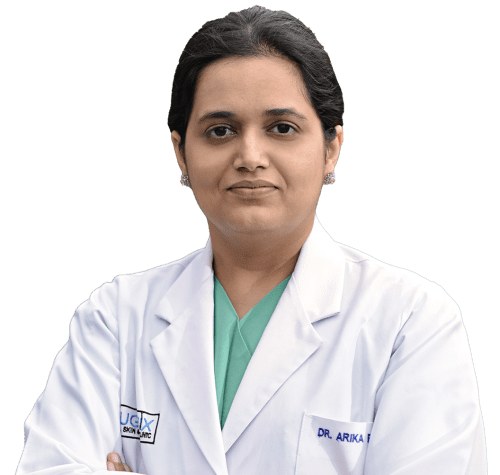
Medically reviewed by Dr. Arika Bansal, Co-Founder, Eugenix Hair Sciences; MBBS, MD Dermatology, Fellow of ISHRS; Reg. No. HN-34095 (Haryana Medical Council).
Dr. Arika Bansal
Dr. Arika Bansal, Co-Founder, Eugenix Hair Sciences. MBBS (Gold Medallist, Lady Hardinge Medical College), MD Dermatology, alumni of AIIMS, New Delhi. Fellow of ISHRS. Reg. No. HN-34095 (Haryana Medical Council).
