

Scabs after hair transplant surgery are small crusts of dried blood and healing fluid that form over each graft site in the first days. They are at their peak around Day 6. At Eugenix, the first head wash on Day 7 softens them, and they come away gently over the next 2 to 3 washes, so most people are clear of scabs by Day 8 to Day 10. Never pick or scratch them off.
This guide from Eugenix Hair Sciences explains why scabs form, what is normal day by day, how gentle washing removes them safely, and when to send a photo to the team. Eugenix Hair Sciences has worked only in hair restoration since 2009, with centres in Gurugram, Mumbai, Hyderabad, Bhubaneswar and Bengaluru.
Why do scabs form after a hair transplant?
Scabs are part of the normal healing process and of every hair transplant recovery. During the procedure, tiny slits are made in the recipient area and a graft is placed in each one. Each slit is a very small wound, and like any small wound on the skin, it seals itself with a little dried blood and fluid. On the scalp this shows as small scabs, often reddish-brown dots around each transplanted hair.
At Eugenix, hair transplants are done with Direct Hair Transplant (DHT). Direct Hair Transplant (DHT) is a modified FUE technique described by Eugenix Hair Sciences’ Co-Founders in their 2013 research paper. The slits are made first and the grafts are then placed into them, so the scabs you see sit over these graft sites.
Scabs after hair transplant surgery: day by day
Here is what most people see in the first two weeks of hair transplant aftercare:
- Days 1 to 2: some yellowish or pinkish serum may ooze onto the pillow. This is healing fluid, not a sign of a problem.
- Days 2 to 5: the recipient area starts to dry, and small scabs form around the grafts. Itching often begins around Day 3.
- Day 6: scab formation is at its peak, and the scabs are most visible.
- Day 7: the first head wash softens the scabs and starts to lift them.
- Days 8 to 10: with daily gentle washing, the remaining scabs come away. Most people are clear by Day 8 to Day 10.
How long do scabs last after a hair transplant?
For most people, scabs last about 8 to 10 days in all. They build up through the first week, peak around Day 6, and clear with 2 to 3 washes on consecutive days from Day 7. Scab removal is gentle and gradual; the aim of the first wash is a clean scalp with the grafts protected, not removing every scab in one go.
How to soften scabs in the first week
Before Day 7 the transplanted area is not washed. Instead, you spray saline on it every 30 minutes to 1 hour during the day for the first 7 days: Normal Saline after a trim procedure, and Ringer Lactate after a non-trim procedure. No spraying is needed at night.
The spray keeps the recipient area from drying out and stops the scabs from sticking too firmly, so they soften and come away more easily when washing begins. It also helps with itching after a hair transplant. Small cracks on the scalp from dryness are common in the first week; keep up the spray. Good post-transplant care in this week means not touching, rubbing or scratching the grafts, and following the surgeon’s aftercare instructions given to you.
How to remove scabs safely from Day 7
The first head wash is on Day 7. The method shown by the Eugenix team is:
- Wet the hair gently with saline water.
- Apply a mild shampoo and foam it up slowly.
- Keep sprinkling saline water every few minutes and leave the lather on for about 20 minutes.
- Very gently use your fingertips on the transplanted area to loosen the scabs. Do not rub in circles or press.
- Rinse with saline water or normal drinking water.
Use lukewarm water only; hot water is never used on the scalp after a hair transplant. If all the scabs do not come off, repeat the wash the next day. Two to three washes in a row may be needed. Daily gentle washing for the next several days clears the last of the scabs and is the main step in scalp care at this stage. Our guide to washing your hair after a hair transplant has the full routine.
Why you should never pick scabs
With scabs after hair transplant surgery, picking or forcefully removing them with your nails is the one thing to avoid. In the first days, a stuck scab can take a graft with it, and pulling at the skin can cause bleeding. Let the scabs soften naturally and come away with the washes. Rubbing also causes friction that can irritate the healing skin. A review of hair transplant complications in the Indian Journal of Plastic Surgery notes that drying and crusting cause the itch many patients feel, which is why keeping the area moist and not scratching both matter.
Are scabs coming off the same as losing grafts?
No. Scabs coming off at the first head wash are expected and are not lost grafts. You may see a few tiny hairs in the scabs as they lift; this is usually the hair shaft, while the root stays in place. As graft healing continues, the transplanted follicles become more secure each day, and from Day 8 the first-week precautions, such as the surgical cap, are no longer needed. Read more in our guide Can grafts fall out after 7 days?
When should scabs be checked by the team?
The operating doctor holds a video consultation with you on Day 8, after your first head wash. Send clear photos to the Eugenix E-Care team sooner if you notice:
- Scabs that are still firmly stuck after several washes.
- Bleeding that does not stop.
- Pus, spreading redness, severe swelling or fever, which can be signs of infection.
- Severe pain that does not settle with your medicines.
- Any dark or black crust that looks different from the small scabs around it.
Key points
- Small scabs form over each graft site and peak around Day 6.
- Saline spray in the first week stops them sticking too firmly.
- The first head wash is on Day 7; 2 to 3 washes on consecutive days usually clear them.
- Most people are clear by Day 8 to Day 10. Never pick or scratch them off.
Know more about recovery by speaking to our team.
Frequently asked questions
When do scabs fall off after a hair transplant?
At Eugenix, scabs start to come away at the first head wash on Day 7. Two to three gentle washes on consecutive days are usually needed to clear them all, so most people are clear by Day 8 to Day 10. Scab removal is gentle and gradual. Do not pick them off; let lukewarm water, a mild shampoo and your fingertips loosen them during washing.
Is it normal to have scabs after a hair transplant?
Yes. Small scabs form over each graft site as the tiny slits in the recipient area heal. They are a normal part of the healing process and are at their peak around Day 6. The saline spray during the day in the first week keeps them from sticking too firmly, and the head washes from Day 7 lift them away gently.
Can I remove scabs before Day 7?
No. In the first week the grafts are still settling, and pulling at a scab can take a graft with it. Do not touch, rub or scratch the transplanted area before Day 7. Keep up the saline spray every 30 minutes to 1 hour during the day, and wait for the first head wash on Day 7, when the scabs soften and lift with gentle washing.
What if scabs are still there after 10 days?
A few scabs can take a little longer, especially if washing was very light. Keep washing daily with lukewarm water and a mild shampoo, using gentle fingertip movements, and never pick at them. If scabs are still firmly stuck after several washes, or you notice bleeding, pus or spreading redness, send clear photos to the Eugenix E-Care team for advice.
Do grafts come out with the scabs?
Scabs coming off at the head washes are expected and are not lost grafts. You may see a tiny hair in a scab; this is usually the hair shaft, while the root stays beneath the skin. Grafts become more secure with each day of healing. Picking scabs off early is what can take a graft with it, so let them come away with washing.
Do scabs form in the donor area too?
The donor area has tiny extraction points that heal quickly. It is cleaned once a day with the antiseptic solution given by the Eugenix team, followed by the donor-area ointment, and kept open without a bandage. By Day 5 the donor area is nearly healed for most people. Severe pain, pus or spreading redness in the donor area should be reported to the team.
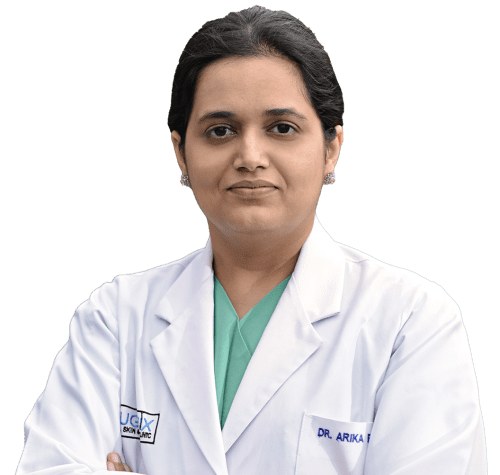
Medically reviewed by Dr. Arika Bansal, Co-Founder, Eugenix Hair Sciences; MBBS, MD Dermatology, Fellow of ISHRS; Reg. No. HN-34095 (Haryana Medical Council).
Dr. Arika Bansal
Dr. Arika Bansal, Co-Founder, Eugenix Hair Sciences. MBBS (Gold Medallist, Lady Hardinge Medical College), MD Dermatology, alumni of AIIMS, New Delhi. Fellow of ISHRS. Reg. No. HN-34095 (Haryana Medical Council).
