If you have been living with flaking, itching or red patches on your head, you have probably wondered whether any of it stands between you and hair restoration. The answer is more reassuring than most expect. Most scalp conditions are treatable, and very few rule out surgery permanently. What a scalp condition usually affects is timing, not eligibility.
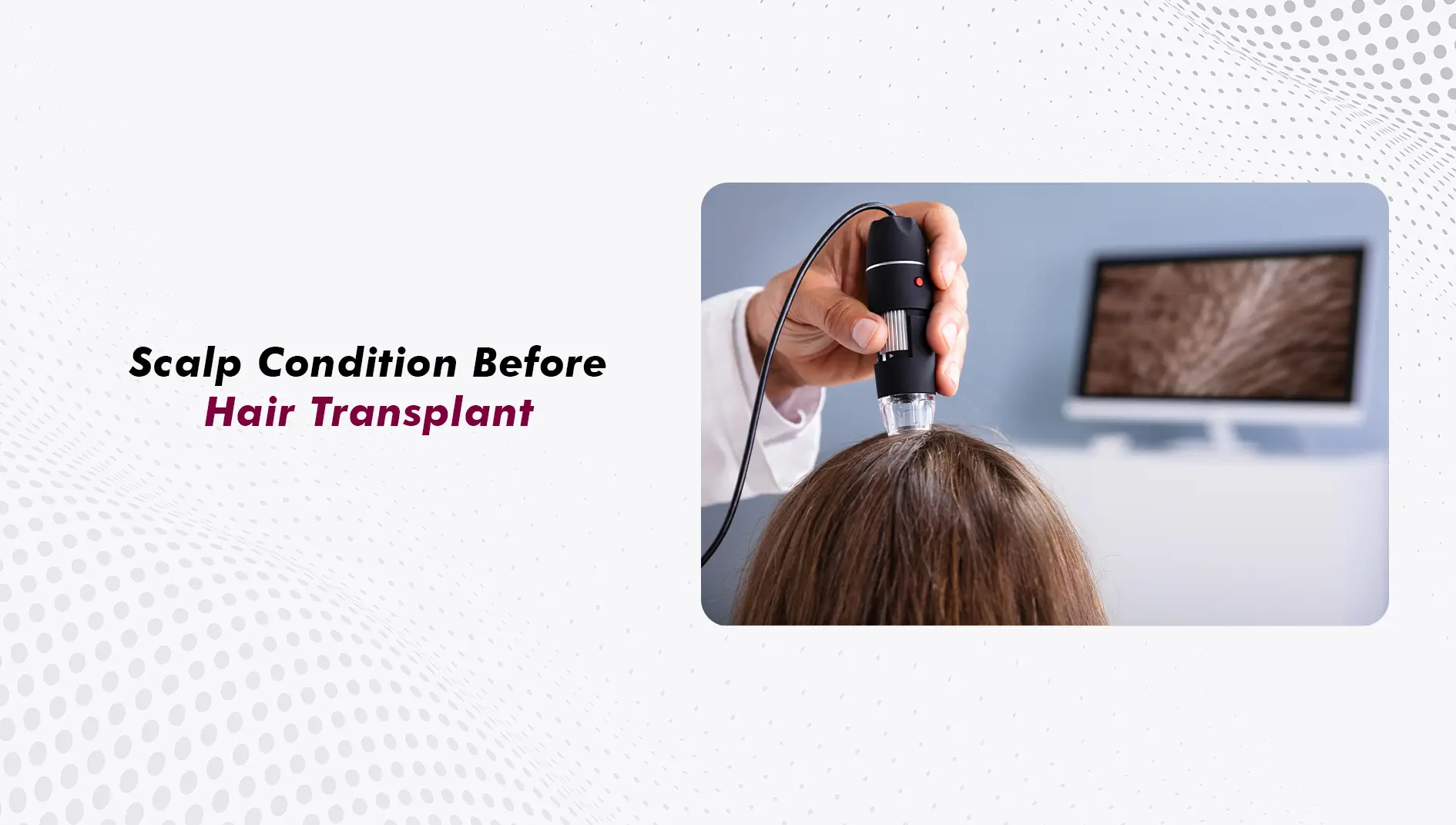
A healthy scalp heals faster, supports better graft survival and gives your surgeon a clear view of the donor site during planning & designing. That is why scalp health is a proper step in your preoperative workup at Eugenix. This article covers what seborrhoeic dermatitis and scalp psoriasis actually do to your hair, which conditions must settle before hair transplant surgery, and how your scalp is assessed before any plan is made.
Why Scalp Health Matters Before Hair Transplantation
Hair transplantation creates thousands of controlled wounds across the donor and recipient areas, so surgeons settle active disease first.
– Wound healing. Chronic inflammation means slow healing, and scalp inflammation disrupts the microcirculation that newly placed hair grafts depend on.
– Infection risk. Operating during an active flare raises the risk of infection after hair restoration surgery.
– Assessment accuracy. A flaky surface obscures the scalp in photographs and in person, making hair density and follicle health harder to judge.
– The hair loss itself. Some scalp conditions cause hair loss directly, and medical therapy alone can restore hair growth.
You do not need a perfect scalp, only a condition recognised and settled before a plan is finalised.
Seborrhoeic Dermatitis and Dandruff
What is actually happening?
Dandruff is scalp skin shedding faster than normal, usually linked to an oily scalp and to Malassezia, a yeast that lives on everyone’s skin but which some people react to more strongly. Seborrhoeic dermatitis sits at the inflammatory end of the same spectrum: redness with a greasy, yellowish scale that can also appear on the eyebrows and behind the ears.
Does seborrhoeic dermatitis cause hair loss?
Not permanent hair loss, and not male pattern hair loss. Androgenetic alopecia is driven by an inherited sensitivity of the hair follicles to dihydrotestosterone, and no shampoo changes that.
What seborrhoeic dermatitis can do is cause temporary hair fall. Chronic inflammation and repeated scratching irritate the follicle and push more hair shafts into shedding than usual. Hair growth resumes once the scalp settles, so treating the condition is worth doing on its own merit.
Getting it under control before surgery
Seborrhoeic dermatitis is not a disqualifier. The aim is a calm, non-inflamed scalp on the day.
– Ketoconazole 2% shampoo is the single most effective agent for dandruff and is the mainstay of the treatment protocol used at Eugenix. Where more is needed, your doctor prescribes the rest of the protocol based on how your scalp responds.
– Medicated shampoos containing piroctone olamine can be used, though they are generally less effective than ketoconazole 2%.
– Avoid harsh shampoos and wash regularly on the days before your procedure.
– Hard water does not damage hair grafts, though a high dissolved solids content may contribute to scalp irritation and flaking.
Scalp Psoriasis and Hair Transplant Eligibility
How scalp psoriasis differs from seborrhoeic dermatitis
Scalp psoriasis is an immune-mediated chronic disease, not a hygiene problem and not an infection. It produces well-defined, raised plaques with thick, scaly build-up, often along the frontal hairline, behind the ears and at the nape. Seborrhoeic dermatitis scale is finer, greasier and vaguely edged, while psoriatic plaques have sharp borders you can trace with a fingertip. Treatment controls psoriasis well, but it returns in flares rather than resolving once and for all.
Does scalp psoriasis cause permanent hair loss?
In most cases, no. Hair loss within a plaque is usually temporary, caused by the inflammation underneath and by thick scale being scratched or picked away. As the plaque settles under medical therapy, hair growth returns. Scarring is uncommon and follows years of repeated trauma to the same area. Patients often assume the hair is gone for good and delay treatment as a result.
Why an active flare must settle before surgery
Psoriasis can be provoked by injury to the skin. New plaques sometimes appear at the site of a cut, a scratch or a surgical wound, a well-recognised pattern known as the Koebner phenomenon. Because hair transplantation creates a very large number of small wounds across the donor and recipient areas, operating during an active flare risks aggravating the condition and compromising graft survival.
Planning is therefore done when the disease is quiet and under a dermatologist’s care. Your doctor makes this decision case by case at consultation, not as an automatic exclusion, and many patients with well-controlled scalp psoriasis go on to have a procedure without incident. Tell your doctor you have psoriasis even if your scalp looks clear on the day, and disclose everything you take for it, since some treatments suppress the immune system and affect wound healing.
Scarring Alopecias: The Scalp Conditions That Change the Plan
Cicatricial or scarring alopecias destroy the hair follicle and replace it with fibrous tissue, so the hair loss they cause is permanent. Primary scarring alopecia includes lichen planopilaris, frontal fibrosing alopecia, which typically affects the frontal hairline and eyebrows in women, and discoid lupus erythematosus.
These conditions change the approach rather than ending the conversation.
– Surgery is considered only where the disease is stable. Active disease is a contraindication, since the trauma of a surgical procedure can aggravate it.
– Diagnosis comes first. A dermatologist may recommend a scalp biopsy to confirm which condition is present before anything surgical is discussed.
– The approach begins with a test graft of roughly 100 to 500 grafts, with hair growth reviewed 6 to 8 months later.
– Graft survival in scarred tissue runs at approximately 30 to 80 per cent against close to 100 per cent on a normal scalp, because blood supply there is reduced, and density is deliberately kept low for the same reason.
– Recurrence cannot be ruled out, so full written consent is part of the process.
Other Scalp Conditions and Causes of Hair Loss
– Fungal infection of the hair follicles. Must be fully resolved before surgery.
– Folliculitis. Recurrent pustules are brought under control first, since the donor and recipient areas need healthy skin to heal cleanly.
– Alopecia areata. A hair transplant cannot be performed for alopecia areata at Eugenix. The follicles are still alive, and there is a strong likelihood of natural regrowth with medical therapy, so a surgical procedure would add trauma without benefit.
– Telogen effluvium. Diffuse shedding triggered by illness, surgery, nutritional deficiency or severe stress. It is self-limiting, and hair growth recovers, so it is identified rather than operated on.
– Diffuse unpatterned alopecia. Miniaturisation extends into the occipital scalp, so the donor hair is itself unstable and hair restoration is generally not advisable.
– Traction alopecia. Caused by prolonged tension from tight braids, extensions or heavy hairstyles, and often reversible early once the tension is removed.
– Underlying medical causes, particularly in women. Thyroid disorders, low iron stores and polycystic ovary syndrome accelerate hair loss and need stabilising before eligibility is confirmed.
How Eugenix Evaluates Your Scalp Before Planning
Consultations at Eugenix are conducted by a panel of experienced surgeons, each personally handpicked and trained by co-founders Dr Pradeep Sethi and Dr Arika Bansal, whose clinical standards sit behind every consultation. The co-founders are available by prior appointment.
Photo evaluation. Clear, well-lit images from the front, top, sides and back allow an initial read on donor density, the degree of baldness and follicle health. A hair science advisor consultation and photo evaluation are free.
Medical history. Your doctor will ask about bleeding disorders and bleeding risk, diabetes, hypertension, cardiac history, drug allergies, supplements including blood thinners such as vitamin E, and every medication you take. Any scalp condition belongs in the patient’s medical history.
Blood investigations. A standard panel is required for every patient, covering a haemogram, prothrombin time INR, aPTT, random blood sugar, HbA1c, HIV 1 and 2 antibody test (Anti-HIV), HBsAg and anti-HCV. Patients aged 40 and above also require an ECG with physician or cardiologist reporting, and a blood pressure check is mandatory. Tests must be done at least 15 days before the procedure, and reports are valid for 3 months.
Additional testing for female patients. Women require a hormonal panel in addition to the standard tests, never instead of them, covering thyroid function, serum ferritin, prolactin, androgen levels and ovarian reserve, timed between Day 3 and Day 5 of the menstrual cycle for pre-menopausal patients. These are mandatory and reviewed before eligibility is confirmed.
Medicine department clearance. Mandatory for every patient without exception, whether or not you have a comorbidity and whether or not you feel perfectly well.
Why This Matters at Eugenix
Eugenix performs DHT, or Direct Hair Transplant, exclusively. DHT is a modified follicular unit extraction technique developed by Dr Pradeep Sethi and Dr Arika Bansal and published in 2013. Extraction and implantation happen simultaneously, keeping hair grafts outside the body for under 30 minutes, against 3 or 4 hours in traditional follicular unit extraction.
Your lead surgeon carries out planning & designing, creates the recipient slits hands-on and sets every technical parameter, including punch size, angle, depth and density. Scoring, punching, extraction and implantation are performed by senior surgical assistants working to those parameters, using the SAVA Implanter, a no-root-touch device where the graft stays visible throughout and is placed smoothly into a pre-made slit without a plunger-based blind push. The lead surgeon supervises your procedure throughout, taking rounds between active steps and remaining available at all times during your surgery.
The Gurgaon centre is NABH accredited under Certificate No. DE-2026-0004, valid from March 2026 to March 2030. Major complications are exceptionally rare, supported by over 20,000 procedures performed across more than 15 years of clinical practice.
Frequently Asked Questions
Can I do a hair transplant if I have seborrhoeic dermatitis?
In most cases yes. Seborrhoeic dermatitis is treatable and is not a barrier to a successful hair transplant. Your doctor will want it controlled beforehand, and treatment usually starts with ketoconazole 2% shampoo.
Can someone with scalp psoriasis get a hair transplant?
Yes, provided the disease is quiet and managed. Surgery during an active flare risks triggering new plaques through the Koebner phenomenon, so planning waits until the condition is stable. Both a dermatologist and a hair restoration surgeon should be involved in that decision.
Is hair transplant risky for life?
No. It is a day procedure performed under local anaesthesia with no long-term systemic risk. Major complications are exceptionally rare, supported by over 20,000 procedures performed across more than 15 years of clinical practice. Excessive bleeding is uncommon, which is why bleeding risk and medical history are assessed beforehand, and medicine department clearance is mandatory.
Can I touch my hair 7 days after a hair transplant?
Your first head wash is on Day 7, done as guided by the team, and that is the first point at which the transplanted hair is handled at all. Even then, no rubbing or picking at scabs. A mild shampoo is used from that point, and daily washing does not damage the scalp. If you use medicated shampoos, ask your doctor when to restart.
The Bottom Line
Scalp conditions are far more often a question of sequence than of eligibility. Seborrhoeic dermatitis is treated and settled. Scalp psoriasis is stabilised under dermatological care before a date is planned. Alopecia areata is treated medically rather than surgically. Scarring alopecia is approached cautiously, with a test graft and an honest conversation about what is realistic.
What matters is that the scalp condition is identified before anyone discusses graft counts. If you are unsure where your scalp stands, start with a free photo evaluation from an Eugenix Hair Science Advisor, or book a consultation for a full in-person assessment of your hair restoration journey.
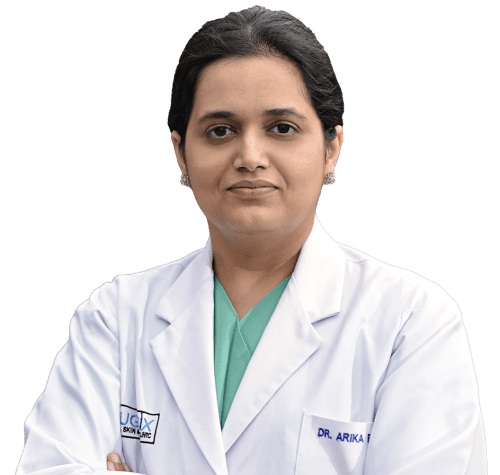
Dr. Arika Bansal
One of only a few female surgeons specializing in hair transplant surgery in India, Dr. Arika Bansal has been voted one of the best doctors in the world. She maintains an active fellowship in the ISHRS and regularly submits research papers to medical journals. 15+ years down the line, 22,000+ surgeries are accomplished under Dr. Bansal’s supervision. She specializes in female hair transplant, density improvement, corrective hair transplantation and hairline design.