

For many patients, covering the head is part of their faith and identity. People in the Sikh community wear a turban as part of their religious belief, and many others cover their head for reasons of faith or family tradition. So one of the first questions we hear at consultation at Eugenix Hair Sciences, a hair transplant clinic in India, is a very reasonable one: when can I wear my turban after hair transplant surgery, and how do I do it without disturbing the grafts?
The short answer is that a head covering and a hair transplant sit comfortably together. The restrictions are short, clearly defined and centred on the first seven days, when newly implanted grafts are still settling into the scalp. From Day 8, most patients return to their turban, patka or headwrap with a few simple precautions.
This article is written for anyone who covers their head, whatever their faith or religious practice. It explains the timeline for returning to a turban after hair transplant, how to manage tying pressure, and how a procedure can be planned around long or uncut hair. For caps and helmets, see our guide on wearing a hat or helmet after a hair transplant.
Why the First Seven Days Matter if You Cover Your Head
During a hair transplant, each graft is placed into a tiny slit already made in the recipient area, and the surrounding skin heals around it over the following days. For the first seven days, the transplanted area must not be rubbed, touched or bumped, and no sideways pressure should be placed on the grafts.
A turban is wound turn by turn, and each turn is pulled and tucked. That winding movement is exactly the kind of sliding, sideways pressure the grafts need protection from in the first week. The concern is the friction and pull of tying, not the fabric itself.
Your Turban After Hair Transplant: A Stage-by-Stage Timeline
Days 1 to 7: The Eugenix Surgical Cap Only
For the first seven days, wear only the surgical cap provided by Eugenix whenever you step out of home, and avoid other caps, a scarf or other head coverings during this period. A tied turban or a fastened patka waits until the first week is complete. If covering your head during this week matters to you for reasons of faith, tell your Hair Science Advisor before the procedure date, so the first week can be planned with you in advance.
During this week you will also spray the recipient area through the day, as explained by the Eugenix team, and wear front-open shirts rather than anything pulled over the head. Do not rub or bump the transplanted area, and do not sleep face-down. If your crown was treated, sleep at the edge of the bed with a large pillow under the nape of your neck, so the crown is not pressed against the pillow.
Day 7: The First Head Wash
Your first head wash takes place on Day 7, never earlier. Some patients need two or three washes on consecutive days for all the scabs to come away. Our guide to washing your hair after a hair transplant walks you through each step.
From Day 8: Returning to Your Turban, Patka or Headwrap
Once the first week is complete, the cap precautions end and you can return to tying your turban, patka or headwrap. If any scabs are still present, let the remaining washes clear them before you tie firmly over the transplanted area.
Tying Pressure: How to Protect Your Grafts When You Tie Again
The first few times you tie your turban after the first week, a little extra care helps:
- Use a soft, clean cotton cloth and lift it into place rather than dragging it across the hairline or crown
- Tie comfortably, not tighter than usual. Mild redness in the recipient area can remain for 4 to 8 weeks, and the scalp may feel more sensitive during this time
- Avoid repeated re-adjusting once it is tied
- Remove it gently, unwinding rather than pulling it off in one motion
Sweating under a turban does not harm your grafts; just avoid wiping or rubbing the transplanted area with force. A turban can also help with sun care: direct sun on the transplanted area should be avoided for the first week, and prolonged sun exposure minimised after that, as it can cause skin irritation and pigmentation.
Long Hair, Kesh and Unshaven Planning: Hair Transplant for Sikh Patients
Many patients who ask about turbans, particularly from the Sikh community, keep their hair uncut (kesh) as part of their religious belief. Every patient’s practice is personal, and we make no assumptions about it. This is the part of planning a hair transplant for Sikh patients, and for anyone with long hair, that deserves the most careful conversation.
What an Unshaven (Non-Trim) Procedure Involves
In an unshaven, or non-trim, procedure, your existing hair is not cut short in the recipient area. The grafts are implanted through and between your existing long hair. It suits many patients, but it has clear limits:
- It suits limited areas of baldness, where existing hair can cover the procedure
- A single non-trim procedure allows approximately 1,500 to 2,000 grafts, so it does not suit plans that need more
- It needs additional time and skill from the surgical team, which adds to the cost; your Hair Science Advisor explains this at consultation
- It is the preferred approach for women. For female patients, additional hormonal blood tests are mandatory before any procedure
- Healing, shedding and growth follow the same timeline as standard hair transplant procedures
For more detail, read our guides to unshaven hair transplant and keeping your length during an unshaven hair transplant.
The Donor Area: What Needs to Be Trimmed
Even in an unshaven procedure, the donor site at the back of the scalp still needs to be trimmed so that grafts can be extracted precisely. In a healthy, dense donor this is usually a small window; a horseshoe-pattern trim may be used if you have had a transplant before. Hair of at least 5 to 7 cm around the donor area helps conceal the trimmed section, and for patients with long hair this is generally covered.
For more advanced hair loss, beard hair can be used alongside scalp hair. If you keep your beard uncut, tell your surgeon, as this affects how much coverage can be planned from the scalp alone.
Whether any trimming fits with your practice is entirely your decision. Our team will explain exactly what is involved before you decide anything.
Caring for Long Hair in the First Week
- Do not comb through, rub or touch the transplanted area during the first week
- Keep long hair gathered loosely so it does not drag across the recipient area
- If your crown was treated, do not rest the weight of a knot on the transplanted area during the first week
- Oiling the scalp is not recommended after a hair transplant
Traction Alopecia or Pattern Hair Loss: Why Hair Can Thin Under a Turban
Not all hair loss under a turban is pattern hair loss. The majority of hair loss in men is androgenetic alopecia (sometimes written androgenic alopecia), or pattern hair loss, driven by genetics and the hormone dihydrotestosterone. Hair loss treatments such as finasteride slow its progression; finasteride is not a cure and is taken under medical supervision. Prolonged tension on the hair follicles can cause a different condition called traction alopecia. Hair tied tightly in the same way for many years, hair gathered into a tight knot, a turban wrapped tightly over it day after day, and very long, heavy hair are among the recognised causes. Loss follows the areas where the pull is highest, often the frontal region and the temples. In medical literature, this pattern in Sikh men is sometimes called Sikh pattern traction alopecia. Doctors sometimes see a rim of slightly longer hairs along the edge of the thinning area, called the fringe sign. A review of traction alopecia describes how these patterns vary with the way hair is tied.
The distinction matters because the treatment plan is different. In early traction alopecia, regrowth is often possible once the tension is reduced, while advanced cases may leave lasting damage to the follicles. Where the scalp shows scarring, a transplant is considered only once the area is stable, usually starting with a small test session of 100 to 300 grafts and a 12-month wait to see the growth. At consultation, your surgeon identifies the cause and explains which option suits you.
What to Expect in the Months After Your Procedure
Between 30 and 90 days after the procedure, much of the transplanted hair sheds. This is normal: the roots remain beneath the skin, preparing to grow new hair. If you notice shed hairs inside your turban during this period, it is part of the normal cycle, not a sign that your head covering has caused harm. Our guide to shedding after hair transplant explains this phase in depth.
- Around Month 4: new growth begins
- Months 6 to 8: visible results
- Months 10 to 12: full results (the crown can take 12 to 15 months)
The transplanted hair is your own natural hair. It grows naturally from your own roots, so patients who keep their hair uncut can let it grow long like the rest of their hair. Results vary from person to person. If you trim any of your hair, a visit to the barber can wait until 15 days after the procedure.
How Eugenix Plans a Procedure Around Your Headwear
All hair transplant procedures at Eugenix use Direct Hair Transplant (DHT), a modified follicular unit extraction (FUE) technique described by Eugenix Hair Sciences’ Co-Founders in their 2013 research paper, “Direct hair transplantation: a modified follicular unit extraction technique“, published in the Journal of Cutaneous and Aesthetic Surgery. Grafts stay outside the body for under 30 minutes with Direct Hair Transplant, compared to 3 to 6 hours with conventional FUE. DHT is different from DHI: in DHT the slits are made first and grafts are placed into them, rather than an implanter pen making the opening and placing the graft in one step.
The lead surgeon carries out Planning & Designing and makes all the slits. The lead surgeon performs the extraction and sets every technical parameter. The Eugenix medical team assists and carries out implantation under the lead surgeon’s parameters and supervision, using the SAVA Implanter, a no-root-touch instrument. The graft stays visible throughout and is placed into the slit that is already made. The lead surgeon supervises your procedure throughout, taking rounds between active steps and remaining available at all times during your surgery. The procedure is performed under local anaesthesia.
For patients who cover their head, Planning & Designing takes account of your long hair, your donor area and how your hair loss may progress. Your hairline is planned to suit your face and age. Single-hair grafts are placed at the front of the hairline, as in a natural hairline, and each graft is placed at the angle and direction in which your own hair grows. Consultations are conducted by our panel of experienced surgeons, personally handpicked and trained by our Co-Founders.
Eugenix Hair Sciences was founded by Dermatologists, alumni of AIIMS, New Delhi, and Fellows of ISHRS. Eugenix Hair Sciences has worked only in hair restoration since 2009, with centres in Gurugram, Mumbai, Hyderabad, Bhubaneswar and Bengaluru, and has carried out 22,000+ procedures.
Frequently Asked Questions
When can I wear my turban after a hair transplant?
You can return to tying your turban, patka or headwrap from Day 8, after your first head wash on Day 7. For the first seven days, wear only the surgical cap provided by Eugenix when you go out. If some scabs remain after the first wash, let the next one or two washes clear them before you tie firmly over the transplanted area.
What should I wear to cover my head in the first week after a hair transplant?
For the first seven days, wear only the surgical cap provided by Eugenix when you step out, and avoid other caps and head coverings. If covering your head during this week matters to you for reasons of faith, speak to your Hair Science Advisor before the procedure date, so the first week can be planned with you in advance.
Will tying my turban change the direction my transplanted hair grows?
No. The angle and direction of each graft are set at the time of the procedure, when the lead surgeon makes the slits following the angle, depth, density and direction of your own hair. Tying your turban after the first week, without dragging the cloth across the transplanted area, does not change how the transplanted hair grows.
Can I have a hair transplant without cutting my long hair?
Often, yes. In a non-trim procedure, grafts are implanted between your existing long hair, so the recipient area is not shaved. It suits limited areas of hair loss and allows approximately 1,500 to 2,000 grafts in one procedure. A small section of the donor area at the back still needs trimming, which longer surrounding hair usually covers.
Can tying my hair tightly under a turban cause hair loss?
It can. When hair is tied tightly in the same way for many years, the steady pull can cause traction alopecia, often at the front and temples. In its early stages it can often recover once the tension is reduced; advanced cases may leave lasting damage. At consultation, your surgeon checks whether your hair loss is traction alopecia or pattern hair loss, because the plan is different.
Can I touch my grafts after 7 days?
Yes, gently. At the first head wash on Day 7, you use your fingertips very gently to loosen the scabs. Once the scabs have cleared and the first week is complete, normal handling can resume, including tying your turban or patka. Avoid picking or scratching the area while it continues to heal, and remove your turban by unwinding it rather than pulling.
Plan Your Procedure Around Your Faith and Daily Life
Returning to your turban after hair transplant surgery is a matter of days, not months. For the first seven days, the Eugenix surgical cap protects your grafts. After the first wash on Day 7, your turban, patka or headwrap can return, tied with a little extra care in the early weeks. To understand how hair restoration would fit with your headwear and your hair practice, speak to a Eugenix Hair Science Advisor at consultation.
Know more.
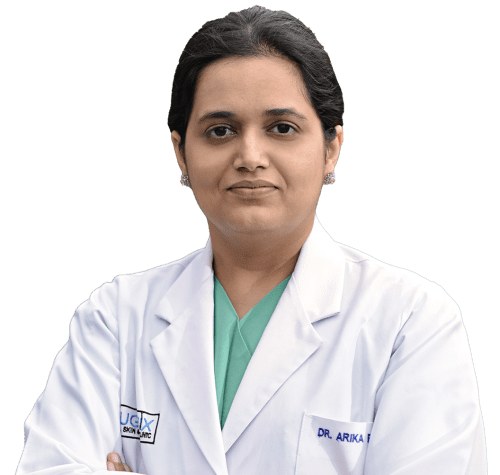
Medically reviewed by Dr. Arika Bansal, Co-Founder, Eugenix Hair Sciences; MBBS, MD Dermatology, Fellow of ISHRS; Reg. No. HN-34095 (Haryana Medical Council).
Dr. Arika Bansal
Dr. Arika Bansal, Co-Founder, Eugenix Hair Sciences. MBBS (Gold Medallist, Lady Hardinge Medical College), MD Dermatology, alumni of AIIMS, New Delhi. Fellow of ISHRS. Reg. No. HN-34095 (Haryana Medical Council).
